

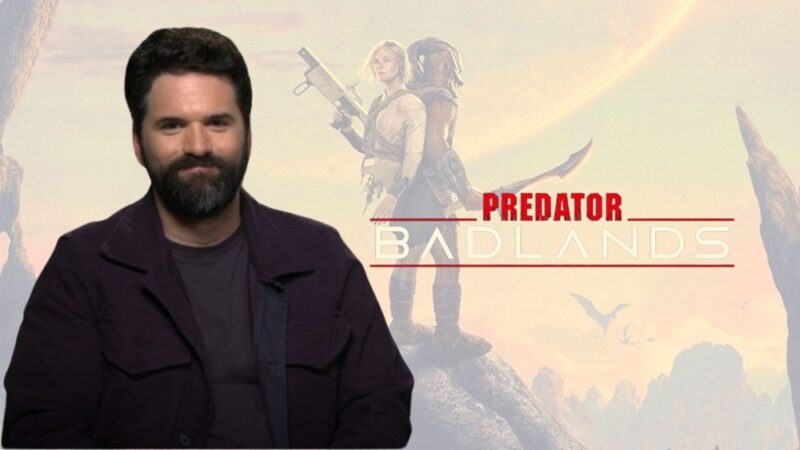
Set in the future on a deadly remote planet, Predator: Badlands follows Dek (Dimitrius Schuster-Koloamatangi), a young Predator outcast from his clan, who finds an unlikely ally in Thia (Elle Fanning) and embarks on a treacherous journey in search of the ultimate adversary.
The first film in the long-running Predator franchise that focuses on a particular kind of Predator species, the Yautja, director Dan Trachtenberg (Prey, Predator: Killer of Killers) continues to push the envelope as he evolves the series in manners we haven’t seen before, and in speaking with our Peter Gray ahead of the film’s release this week, he touched on unmasking the Predator’s universal humanness and the specifics in creating Dek’s language.
You said before that the most interesting monsters are the ones that reveal something human. What did you want Dek, this younger, more expressive Predator, to reveal about us with him?
I think there’s a lot in the movie where you assume something about a character based on how they look, and then learn something quite different through the actions that they take. I also think one of the pleasures of the movie is watching Dek get his ass kicked and still trying as hard as possible to overcome the insane odds he’s up against. I think we love watching people try. From part of why we love sports, to why we love watching Tom Cruise in the Mission: Impossible movies, or Indiana Jones, or John McClane, it’s seeing people really try as hard as they can.
And Dek is someone that, within the first 15 minutes of the movie, you will find yourself really rooting for. For both the emotional and physical stakes that he finds himself in. And all of us, like Dek and Thia, and some of the other characters, are trying to be more than where they’ve come from. And that I find to be something that is universally relatable.
I think a lot of people are going to walk into this and expect just a Predator movie, and they’ll probably walk out thinking, “I think I want the Predators to win,” it was just the humanness of them all. And I loved how the Yautja language is not newly constructed. It’s physiologically accurate. It’s designed around how a Predator’s jaw actually works. What did you and BriTon Watkins talk about when defining what this language should feel like emotionally? Did you want it to sound terrifying, ritualistic, beautiful? What was the design for you?
It’s possible that the only direction I gave BriTon was that it feel really harsh and feel linked to the sounds that we’ve already heard the Predator make. But from there, he used all of his talent to hone in on the actual grammar rules and the vocalizations to, as you put it, match up with the actual physiology of the Predator so that it feels super authentic, as if this was a real language that we have archeologically discovered. It wasn’t just the spoken language (too), we’re also making sure that every written, every rune combination that you see in the movie, is actually saying something.
And obviously we can’t talk about Dek without Dimitrius (Schuster-Koloamatangi). It’s such a physical, yet nuanced performance. We see him acting with his eyes and his breath. Is there a direction that you give an actor to play an alien, but it needs to evoke deep sympathy? What was that collaboration process like?
Yeah, I mean, Dimitrius is a tremendous actor. I was not prepared for him to deliver such a powerful performance. Our conversations would have been about what was happening in the scene. It was never more hierarchical than that. It was never, “Think of yourself as an alien,” or what have you. He brought a great physicality and presence to Dek, but also the emotion. Emotionality is really hard to make something feel as fierce as it is, but also have an inner life that resembles something that we’ve felt ourselves.
Predator: Badlands is screening in Australian theatres from November 6th, 2025, before opening in the United States on November 7th.
