

The Predator series has had a slew of existences since being introduced in the titular 1987 actioner, which, at the time, furthered Arnold Schwarzenegger’s stronghold as the genre go-to and served as something of a more popcorn alternative to the Alien franchise. The original film was a success of its time, and only grew in reputation over the years; though the cavalcade of sequels, all varied in their quality, threatened to tarnish such.
After two critically mauled spinoffs involving a crossover with the aforementioned Alien series, and a non-starter 2018 feature, it wasn’t out of the realms of possibility that Hollywood would wipe their hands of the franchise – or, at the very least, wait a good while before attempting a revisit. In 2022, in a complete identity rebrand in a bid to distance itself from any of the failed sequels, director Dan Trachtenberg (10 Cloverfield Lane) took the series back to its origins, chronologically placing it in the 1700s across the Great Plains, delivering Prey, which transcended its streaming fate (despite critical acclaim, it would premiere on Hulu) and proved the series still had plenty of fresh blood pumping through its veins.
Following Prey and the animated anthology film Predator: Killer of Killers (another Hulu title released earlier this year), Trachtenberg has maintained a chokehold on the Predator name, and with Predator: Badlands he, once again, pushes the series into an exciting new direction. It’s perhaps less of a traditional Predator film and more a science-fiction actioner with the character design weaved in, but the Patrick Aison–Brian Duffield-penned script succeeds in creating a fully rounded Predator character that, ironically, feels like the most human embodiment the entire series has been gifted thus far.
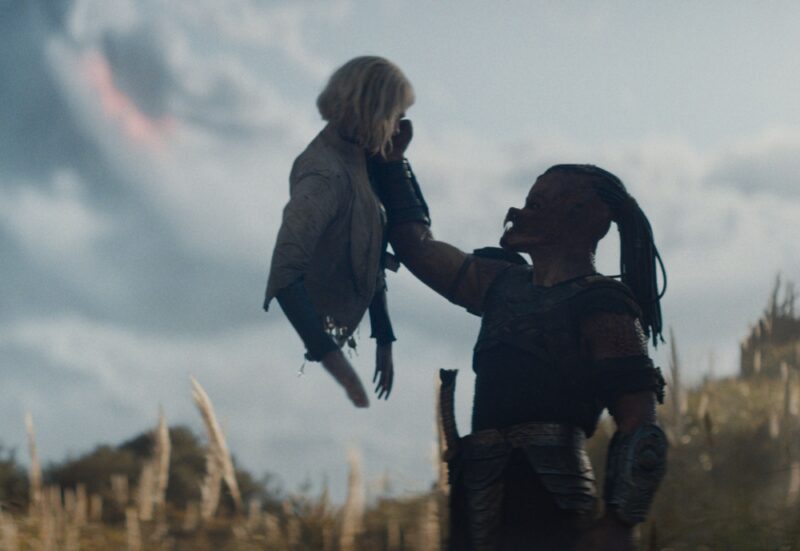
As portrayed by Polynesian actor Dimitrius Schuster-Koloamatangi, the main Predator focus, Dek, a young buck who is outcast for being the runt of his bloodline (Schuster-Koloamatangi also portrays Dek’s Apex leader of a father, Njohrr, who seeks to have the young one killed), is injected with a sense of humanity that makes the creation immediately sympathetic. He’s a killer, yes, but through the mistreatment at the hands of his father, we understand Dek’s need to prove himself as something of an Apex figure himself; Dek’s brother, Kwei (Mike Homik, a New Zealand former basketball player), seeing the potential in his younger sibling, and, defying his father’s wishes, personally interferes with the intended execution at the front-end of the film.
Dek is part of a Predator species known as Yautja, and we learn that they’re of the belief that the weak link in their familial tree is worthy of termination. Dek, in wanting to prove his worth, boasts of how he will kill “the unkillable” – a creature known as Kalisk – and, in doing so, is sent to the deadliest planet in the galaxy to execute his mission. He’s cocksure, but unprepared, and, somewhat begrudgingly, he teams up with Thia (Elle Fanning), a particularly chatty synthetic, he finds discarded in a pile of ruins; the Alien universe still tethered here as we learn she’s been designed by the in-universe corporation, Weyland-Yutani. Had Thia been a human, Predator: Badlands could have run the risk of audiences being more drawn to her presence, leaving Dek almost entirely in the space of “villain”, but in making Thia literally robotic in nature, it adds a sense of sci-fi whimsy to proceedings, with the film adopting an unlikely buddy adventure mentality; The Adventures of Dek, the alien of few words, and Thia, the effervescent, motor-mouthed robot, if you will.
With this dynamic, Predator purists might be disappointed that Badlands caters to a younger mindset in some ways. Whilst it’s still a violent film in nature, the fact that any of the bloodshed is alienatic means it’s technically not overtly graphic. And any of the imposing temperament brought on by the at-times terrifying Schuster-Koloamatangi is then counter-balanced by Fanning’s dialed-to-eleven personality, which could easily grate on audience’s nerves. Fanning is committed to Thia’s optimism and helpful nature though – even as she is without the bottom half of her body for much of the film – but once her secondary character is introduced, Tessa, another Weyland-Yutani synth, Thia’s personality makes much more sense. For a series that, for so long, was driven off masculine energy, it’s a welcome step that Badlands continues the strong femininity first introduced through Amber Midthunder’s Comanche warrior in Prey.
Predator: Badlands may never entirely surprise with it narrative as it moves along at a tight pace (it clocks in around the 107 minute mark), but Trachtenberg at least is aware that certain ingredients need to stay in the Predator recipe when all is said and done, and though this may ultimately prove more sweet in nature than many will expect, it builds a larger world of intrigue that the director wisely teases for future updates we can only hope he’s in charge of. Prey and Killer of Killers proved how original and exciting the Predator name can still be, and Badlands only continues that trajectory, albeit with a surprisingly softer tone.


THREE AND A HALF STARS (OUT OF FIVE)
Predator: Badlands is screening in Australian theatres from November 6th, 2025, before opening in the United States on November 7th.
