
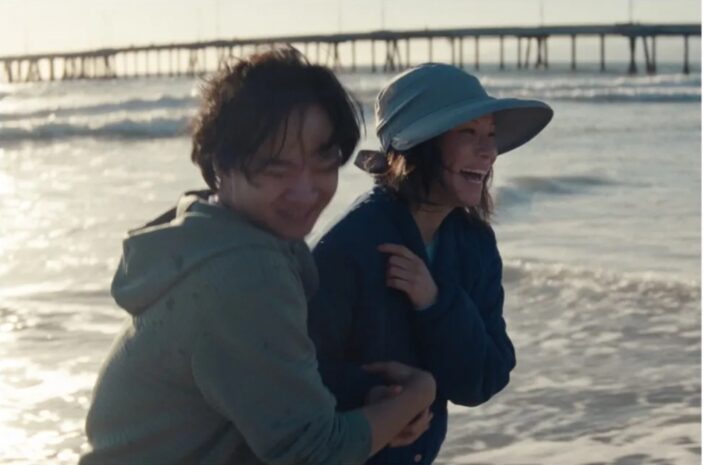
Set in the heart of the San Gabriel Valley and based on a harrowing true story, Rosemead is a gripping, emotionally charged portrait of a mother’s love pushed to its limits. Lucy Liu delivers a transformative performance as a terminally ill Chinese immigrant who uncovers her teenage son’s disturbing fixation with mass shootings. As her health deteriorates, she takes increasingly desperate — and morally complex — measures to protect him and confront the darkness he’s drawn to.
Urgent and unflinching, Rosemead wrestles with themes of identity, mental health and the immigrant experience in America, capturing the dissonance between cultural expectation and personal crisis. At a time when questions around gun violence, parenting and belonging feel more pressing than ever, this powerful film resonates deeply, offering a rare and necessary lens into the quiet tragedies unfolding in communities too often overlooked.
And elevating the emotion we feel on screen is composer Will Bates, who spoke to our Peter Gray about the sonic interpretation of the film’s emotional undercurrent, if he created any new sounds for Rosemead itself, and what he hopes audiences take away from the score.
This might be a question that is relevant to all your films, but with Rosemead, was there any sonic interpretation for you with the film’s emotional undercurrent? To reflect its setting and the themes, is there something you latch on to to make sure that the music is reflective?
Gosh, that’s a good question. I feel like every project is different in that regard, and sometimes a lot of that is to do with the kind of collaboration I have with the filmmaker. Sometimes it’s just the director. Sometimes it’s the director and the editor, which was actually the case with Rosemead. I know the editor, Joseph Krings, very well. We did a movie called 28 Hotel Rooms a long time ago. We’re good friends. I used to live in New York for 15 years, and we hung out a lot. His wife and my wife were good mates. So the collaboration was very much between the the three of us, and there were many initial conversations about how important sound is to the story, and how the character of Joe (played by Lawrence Shou) and his mother, Irene (Lucy Liu), go through this story together. Particularly what Joe is going through. Eric (Lin, director) really wanted that to be reflected in the sonic soundscape, in the score and the sound design. I made up about 10 or 15 sketches and kind if just threw them at (Eric and Joseph). Joe loves working that way. And I like it because it tends to avoid what US composes call “Temp love”, which is when a director falls in love with a temporary score. It has to be the bane of our lives (laughs). A lot of what we do is match or improve upon what they’ve been used to listening to in the edit room for so long. This process entirely bypasses that, which is really great and it allows me to really work with them, in terms of coming up with sketches and what they’ve responded well to. It sets up on a really good path to finding this kind of unique palette that’s really important for the story.
Quickly on that, I’ve heard about where the temp score is so good that the directors fall in love with it and don’t want to change it. Is there ever the temptation to make a really bad temp score so that they have to change?
I feel like some editors actually do that (laughs). To me, the best kind of temp score for us as composers, and I think also to some extent, filmmakers, is a bad temp score, because it gives us the ability to have a conversation as to why he or she chose that piece of music to be in there. There’s always a reason why it’s in there. And then it’s always great to have a myriad of things that they don’t like about it. It’s always a great place to be. Sometimes it’s as simple as liking a track because of the tempo and it has a helpful pace, but everything else about it we hate.
With scoring, did you create any custom instruments or processing chains specifically for Rosemead?
I did, actually. In my home studio I have a room called ‘The Orphanage’, which is where all the instruments and toys and weird bits go to die, because I’ll only use them once, because I’ll get so emotionally connected to an instrument for a specific project, and then it goes in the back room. It’s like that room at the end of Raiders of the Lost Ark (laughs). Funnily enough, an instrument I just got, not specifically for this project, but I got it on the day I started working on (Rosemead), and I’ve tried to use it on other projects since then. It tends to be this love-hate thing that filmmakers have about it. It’s called the string harmonica, and it looks like a guitar that’s horizontal. It’s got 12 strings and it has ebows underneath every string. Do you know what an ebow is? Guitarists use it as a way to sustain the notes. Like an electromagnetic piece that makes a kind of Peter Frampton sounding noise.
I have all sorts of weird outboard hear, and there was a very specific effects chain for Rosemead, and it became kind of the sound. It’s very beautiful. It sounds a bit like a glass harmonica. It’s very pretty. I put sewing needles on the strings that, when it resonated, it made this disconcerting sound, so as Joe is getting worse with his mental illness, the sound on the harmonica is kind of collapsing. It’s really reflective. And Eric loved it straight away. So I did that in the first round of sketches, using a bunch of instruments, and it all became a huge part of the toolkit.
Music can affect how an audience feels emotionally. Sometimes it can be really subliminal. Were there any scenes in Rosemead that radically changed after you scored them? Did you find that music redefined how the audience is supposed to feel?
That’s an interesting though. It’s funny, I was at the premiere after party and I talked to a couple of the actors, and they told me how they saw an early cut of the film without my score, and that it was very emotional. But then they saw it that night, and everyone was sobbing. It was just the luckiest thing, especially coming from the performers themselves. There are a few sequences where they reordered the organisation of some of the information. Some filmmakers are wary of melody, and Eric made sure to say that he wasn’t like that. He wanted there to be melody. He knew we could use melody to bring the audience along and change the context of the story. That became very useful.
There’s a couple of very identifiable melodies and a strong grounded context at the beginning, and then I was able to kind of use that as a way to alter the context and make the audience feel more disturbed. You get to used to hearing the melody in a certain way, and here it is now, twisted and messed up. I think that kind of stuff is often very subliminal, but I think it’s helpful sometimes for an audience.
Music can really be an invisible, psychological layering to everything. When you are taking on a score, do you have to almost approach it like a character in the film itself?
I think that has to do with a point of view. Like the POV of “What am I trying to say? Are with the character in this moment? Are we observing? Is it action based?” I feel like most of the score in Rosemead is quite psychological. It’s thematic and internal. It’s character based. But then there’s a pretty dark shift in the story in the third act, and it becomes much more procedural. You have to move the story along, and I think that that kind of scoring is completely valid, but you need it to be balanced with the more internal POV side of things, which this movie really sets up at the beginning in a beautiful way.
How do you feel Rosemead fits within your body of work? Do you feel it stretched a different musical muscle for you at all?
I feel like there was a period where I worked on a lot of projects that were based around trauma, and there was some of that in (Rosemead). There’s a show I did called Unbelievable for Netflix a few years ago where I found myself thinking about the process that I went through with that, but this was much more about a very intimate portrait and relationship. It’s very much about grief. It’s about trauma, but it’s really about isolation. And I think that really getting under the hood for that was something quite special for me. I’ve also been doing a lot of horror, so this sometimes aired on the side of that, so I knew I had to rein it in a little bit. My witch’s hat was still on (laughs). It’s really helpful to do these projects that are so diverse, and I think it’s important for me to be able to feel that there’s contrasting things happening all the time.
If someone had only heard the score for Rosemead without seeing the film, is there a hope for you as to what they should feel or what they should imagine?
Blimey, that’s interesting. I think that a lot of the score is counterpoint. There’s definitely moments where it’s quite disturbed. A lot of the earlier cues are kind of a counterpoint, and I think that it’s not exactly a misdirect, but more in order for us to connect with these characters, the music has these moments of feeling where it’s interesting and weird, but it also makes you feel joy. We talked about memory a lot. There’s obviously a ton of grief in the film, and I think than rather it being this thick, dark feeling of remorse, there’s more a feeling of memory. I think that’s something that I hope people would gather.
Rosemead is screening as part of this year’s Tribeca Film Festival, running between June 4th and 15th, 2025. For more information, head to the official site here.
