
After almost two decades of cinematic silence, Jason Voorhees is finally back. Well, sort of. The hockey mask-wearing, machete-wielding horror icon has remained conspicuously absent from our screens since 2009’s Friday the 13th reboot, with legal complications and creative uncertainty keeping one of the genre’s most recognisable villains frustratingly dormant. Now, with A24’s eight-part prequel series Crystal Lake (streaming on Peacock in the US and on Stan in Australia), the franchise has been given a new lease on life, and whilst the results are occasionally messy, frequently ridiculous and bound to upset a few purists, it’s difficult to begrudge a show that’s having this much fun with its own mythology.
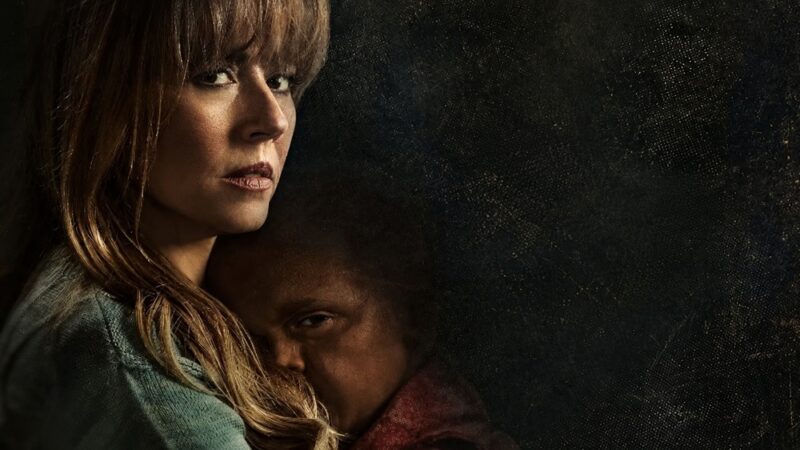
Developed under the guidance of showrunner Brad Caleb Kane, Crystal Lake takes us back to the events preceding the original 1980 film, shifting the focus away from the seemingly unstoppable killing machine Jason would eventually become and towards the woman whose grief would set the entire bloody legacy in motion. Pamela Voorhees, played with extraordinary conviction by Linda Cardellini, is the emotional and narrative centre of this reimagining, and it’s through her experiences that the series attempts to find something more substantial beneath the franchise’s familiar collection of sex, violence and unfortunate teenagers.
Set in the early 1970s, the story introduces Pamela as a single mother working at Camp Crystal Lake, where her young son Jason (Callum Vinson) struggles with the cruelty of those around him. Born with physical differences that make him an easy target for ridicule, Jason is presented not as the monster audiences have come to know, but as a vulnerable child whose greatest source of comfort is his mother. Their relationship is genuinely touching, and the decision to spend time establishing their affection gives the inevitable tragedy a weight that the original films, entertaining as they were, never particularly concerned themselves with exploring.
When Jason’s life is lost through the negligence of those entrusted with his safety, Pamela’s world understandably collapses. Her grief becomes an all-consuming force, gradually transforming a loving, protective mother into someone whose anger threatens to destroy everything around her. It’s familiar territory for anyone acquainted with the franchise’s origins, but Crystal Lake approaches the material with an emotional sincerity that makes its exploration of Pamela’s psychological deterioration surprisingly effective.
Of course, one could argue that the Voorhees family never particularly needed such an elaborate backstory. The simplicity of the original Friday the 13th was part of its appeal, and the franchise has hardly suffered from a lack of increasingly outrageous explanations for Jason’s apparent immortality. But rather than simply stretching a familiar premise across eight episodes, Crystal Lake uses the opportunity to reconsider how its most infamous characters came to be, and what emerges is often more compelling than expected.
Much of that success belongs to Cardellini, who is nothing short of magnificent.
Taking over a role immortalised by Betsy Palmer, Cardellini wisely avoids imitation, instead delivering a performance that is terrifying, warm, heartbreaking and gloriously unhinged in equal measure. Her Pamela is a woman who has spent much of her life being dismissed, underestimated and pushed around, with the loss of her son effectively destroying whatever restraint she had left.
Cardellini commits wholeheartedly to every emotional extreme the material demands. She can be wonderfully maternal in one moment, utterly devastated in the next, and then frighteningly unpredictable when her anguish gives way to violence. It’s a performance that could easily have descended into parody, particularly given some of the increasingly outrageous narrative developments, but she grounds even the most heightened sequences in a recognisable sense of pain.
And when the series finally allows her to go completely gonzo, it’s an absolute pleasure to watch.
What makes Pamela such an interesting character within the wider Friday the 13th mythology is that her motivation has always been relatively understandable, even when her actions are anything but. For all the enjoyment audiences have taken in watching Jason dispatch generations of unfortunate camp counsellors, the original tragedy was born from the negligence of those who should have been protecting him.
That doesn’t make Pamela’s murderous revenge morally defensible, of course, but it does mean the series doesn’t have to work particularly hard to establish why she feels wronged. Her anger has always been a fundamental part of the franchise’s identity, and Crystal Lake simply allows us to experience that anger from a perspective we’ve rarely been afforded.
There’s also something unexpectedly moving about seeing Jason before the legend. Vinson brings an innocence to the character that makes his eventual fate all the more upsetting, and the series finds genuine poignancy in the relationship between mother and son. By allowing audiences to understand the humanity behind the horror, the show adds another dimension to characters who have largely existed as instruments of cinematic carnage.
Thankfully, that additional emotional depth doesn’t mean Crystal Lake has forgotten what franchise it’s representing.
If anything, the series seems positively delighted to remind viewers of the wonderfully excessive violence that made the original films such enduring favourites. The practical effects are frequently spectacular, with the makeup and prosthetics teams delivering an assortment of increasingly gruesome deaths that should satisfy even the most demanding slasher enthusiast.
Episode three features a particularly horrific kitchen-set demise that ranks among the show’s most stomach-churning sequences, combining an almost playful sense of anticipation with effects work that’s genuinely difficult to watch. Episode six, meanwhile, embraces the more traditional slasher mentality, providing the kind of gleefully nasty entertainment that fans have been waiting to see return to Camp Crystal Lake.
The murders aren’t necessarily as frequent as one might expect from a franchise built around an impressive body count, but when the series commits to a kill, it rarely disappoints. There’s an appealingly old-fashioned quality to the bloodshed, with the emphasis on physical effects lending the violence a tactile nastiness that computer-generated carnage often struggles to replicate.
It’s also refreshing that the series makes no attempt to sanitise the material for television. Sex, drugs, questionable decisions and spectacularly unfortunate consequences remain very much part of the experience, and there’s a genuine affection for the excesses of 1980s horror running throughout.
Where Crystal Lake becomes less assured is in its determination to expand the mythology beyond Pamela and Jason.
The eight-episode format allows for a considerably broader collection of characters and subplots than the films ever required, and whilst some of these additions provide welcome texture to the town and its inhabitants, others feel as though they’ve wandered in from entirely different television shows.
Police Chief Levon Brooks (William Catlett) and his investigative journalist sister Briana (Devin Kessler) offer an interesting perspective on the increasingly strange events surrounding the camp, but their involvement isn’t always developed with the consistency it deserves. Similarly, the inclusion of younger versions of familiar franchise figures, including Crazy Ralph (Nick Cordileone), provides some enjoyable connections to the original films without necessarily justifying every narrative detour.
The series also attempts to incorporate ideas surrounding sexual freedom, social expectations, religious influence and the changing cultural landscape of 1970s America. Individually, these elements have potential, particularly when considered alongside Pamela’s increasingly fractured worldview, but they don’t always come together as convincingly as intended.
At times, it feels as though Crystal Lake is trying to be a psychological character study, a small-town mystery, a supernatural thriller and a traditional slasher all at once. The tonal shifts can be jarring, and certain characters are introduced with considerable promise only to find themselves occupying increasingly uncertain positions within the larger story.
Not every narrative thread receives a particularly satisfying resolution, either. Some characters and developments don’t sit comfortably within the established Friday the 13th universe, leaving questions that the season seems surprisingly uninterested in answering.
For those especially protective of the franchise’s continuity, such decisions may prove frustrating.
But then, this is a series about a character who has survived seemingly every conceivable form of physical destruction, returned from the dead on multiple occasions and even travelled into outer space. A certain willingness to embrace the absurd has always been part of the franchise’s charm, and it seems somewhat counterproductive to demand absolute narrative precision from a mythology that has never been especially concerned with maintaining it.
That willingness to take risks becomes particularly apparent during the season’s final stretch.
Episode seven, which delves further into Pamela’s past, is likely to be the most divisive instalment of the entire series. Its revelations substantially reconsider elements of the Voorhees mythology, introducing ideas that may challenge the expectations of even the most devoted fans.
It’s an ambitious swing, and not every development feels entirely earned. The series occasionally mistakes complication for depth, adding layers to a story that was arguably more effective in its simplicity. Yet there’s something admirable about its refusal to merely repeat familiar events with a fresh coat of blood.
The final two episodes also provide some of the season’s most confident storytelling, bringing together its emotional and supernatural elements in ways that suggest a potentially fascinating future for the franchise. Even when the execution is questionable, the ambition is difficult to dismiss.
And, perhaps most importantly, Crystal Lake never loses sight of the fact that horror can be both emotionally affecting and enormously entertaining.
Underneath its elaborate mythology and increasingly extravagant violence is a story about a mother who cannot accept the loss of her child, and the terrible consequences of allowing grief to consume every aspect of one’s identity. The series doesn’t always explore these ideas with the subtlety they deserve, occasionally spelling out its themes when the performances have already communicated them perfectly well, but its emotional intentions remain sincere.
Cardellini is ultimately the glue holding everything together. Even when the storytelling becomes convoluted, she ensures Pamela remains a compelling presence, finding moments of vulnerability within the madness and reminding us that the franchise’s most enduring nightmare began with an act of devastating human loss.
Whether Crystal Lake needed to reinvent so much of the established mythology is certainly debatable, and there will undoubtedly be longtime fans who take issue with the liberties it takes. Its supporting characters are unevenly served, some of its more ambitious ideas struggle to find their footing, and the season doesn’t always know when to exercise restraint.
But for all its imperfections, this is a thoroughly entertaining return to a world that has been absent from our screens for far too long.
The gore is gloriously excessive, the atmosphere is suitably sinister, and Cardellini delivers a fearless performance that deserves to be remembered as one of the franchise’s finest. More importantly, Crystal Lake demonstrates that there are still stories worth telling within the Friday the 13th universe, even if they don’t always unfold in the way audiences expect.
After seventeen years of waiting, Jason Voorhees and his unfortunate family have finally been given another opportunity to terrorise us. The journey may be a little uneven, and the mythology considerably more complicated than anyone anticipated, but when the blood is flowing and Cardellini is unleashing hell, it’s difficult to care too much about the semantics.


THREE AND A HALF STARS (OUT OF FIVE)
Crystal Lake will be available to stream on Peacock in the United States from October 15th, 2026 and on Stan in Australia from October 16th.
