
Set in the fading days of the Wild, Wild West, Long Shadows follows a lone young drifter driven by a single purpose: to avenge the brutal murder of his parents. Hardened by loss yet yearning for something beyond vengeance, his path unexpectedly shifts when he discovers love and the possibility of a new beginning.
But redemption never comes easy. As he journeys through a frontier riddled with greed, betrayal, and corruption, he becomes the target of an unforgiving lawman whose pursuit is as relentless as the ghosts that torment his own mind. Each step forward drags him deeper into a battle not only against the forces hunting him, but against the darkness within himself.
Torn between his thirst for revenge and his longing for peace, he must face the ultimate question: can a man scarred by violence and haunted by the past truly carve out a life of love and redemption – or is he destined to remain a prisoner of his own demons?
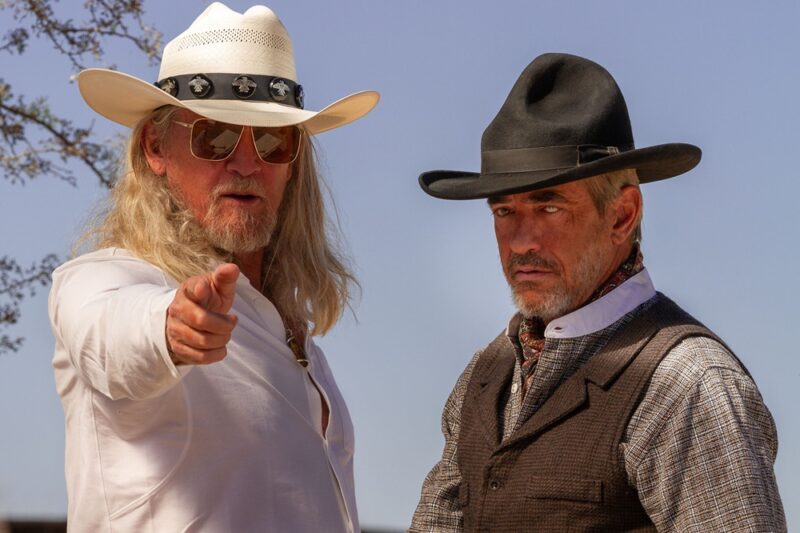
Featuring a stand-out ensemble cast, led by Dermot Mulroney, Jacqueline Bissett and Dominic Monaghan, Long Shadows marks the feature directorial debut from actor William Shockley, best known for his role as Hank Lawson in the long-running drama series Dr. Quinn, Medicine Woman, as well as such cult classics as Robocop and Showgirls.
As the film screens in select theatres across the United States, Peter Gray spoke with the creative about carving his own unique path in the western genre, what art inspired his visual aesthetic, and the fingerprint he hopes to leave on the world with the film itself.
Westerns have such a rich cinematic history, and it also feels like one of those genres that we’re unfortunately not seeing as much. How did you approach honouring the genre traditions, whilst carving out something that’s so uniquely your own?
Clearly, the genre speaks for itself. To make it my own, I watched a lot of European films. I’m a huge fan of British dramas. I’m just obsessed with them, like Jane Eyre. From Russia to Czechoslovakia, Italy, France, Germany…all these European films. They’re quite often better than a lot of American content. I wanted Long Shadows to not be a dirt Western, but rich and elegant, and true to the period with the costumes, with the production design and the score, the cinematography. I wanted it to be sumptuous. That was my desire. The story is so brutal, but tender.
As you said, there isn’t that dirty mentality to it. You can see the European influences when watching it. Were there any specific western films or directors, or even painters or musicians, that influenced the visual and emotional tone?
A.J. Raitano, my dear friend and the cinematographer, he and I studied a lot of Italian painters. You’re the first person that’s ever asked me about a painter. But yes, we were very fascinated with the Renaissance time. The Italians are just masters, right? How they created images on canvas…And honestly, I didn’t study any Westerns to make this film. It was just European films. I know this genre. I’ve lived in this genre for years and years on a TV show. Don’t get me wrong, I’ve watched a lot of westerns, but I didn’t go back to them. I didn’t want to be influenced in the current moment by a classic American western.
And when you’re directing, do you thinking more like an actor trying to feel the moment? Or like a composer trying to orchestrate it?
I think like a conductor of a symphony. That’s really what you are, you know? You’re up there leading this massive crew and this massive cast, and interfacing with every department head. You’re ultimately creating the entire look for the movie, so it is more that I’m the conductor of a symphony.
Being an actor, do you think that that helps in directing actors? You know what it’s like to be directed. You know how you wish you could be spoken to…
Yeah, I’ve worked with some great directors in my day. You know, Paul Verhoeven has hired me twice, and he’s just genius. I’ve seen some really brilliant minds at work. I took what I’ve learned. It’s a gift to speak the same language, because I’m not talking to the actors about lenses or shapes or angles. In old west terms, the horse that rung me was acting. I remember telling Blaine May and Sarah Cortez, the two young leads, “Guys, I’m an actor by trade. There’s nowhere to hide with me.” They were brilliant. So brilliant. To be honest with you, it was a gift (this film). I was blessed to be able to be given that much belief from my partners. They’re entrusting you with a lot of money, and you only get once chance to make this. It’s not theatre. We can’t do it better tomorrow night.
You have that history of interpreting other director’s visions, but when the canvas is finally yours, was there anything that surprised you the most about your own instincts as a director?
Honestly, I prepared so hard. I’m not a person that accepts excuses. So A.J., he would come down and spend days and days at my house. It was like camping out. He and I both shot at Old Tucson before. We knew the exteriors. I built out the interiors. I knew the landscape, the lay of the land. We had really envisioned everything. He and I would walk through the desert together for weeks, just with our little camera. If you’re prepared, it’s a lot easier. I was thrilled to have a great editor, and our casting director, and all these really talented minds around me to support the vision. Costumes, production design…it was a gift.
As you mentioned watching European films, and this is quite a romantic film. Obviously it blends revenge and redemption, all those classic themes, but there was an emotional tone that you were intent on capturing? One that surprised you? Or showed itself during the making of the movie?
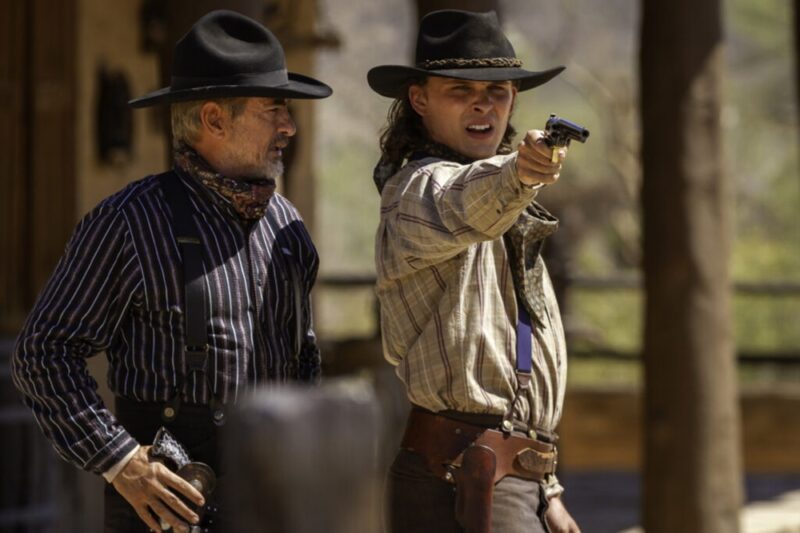
There was great chemistry between Blaine and Sarah. They’re just two beautiful humans, and they got along quite well. Their relationship evolved as the story did. The courtroom scene where Marcus is put on trial, I always knew that scene was almost the tentpole of the movie. If that scene failed, the movie wouldn’t be what it should be. On the day of filming for that courtroom scene, I just sequestered him in a room by himself. I told the whole crew, “Don’t open that door. Don’t talk to him.” He just sat in there for like an hour while they were lighting, and I would go get him and I told that when he was ready to just lift his hand. I’d walk him back to that room between takes. It’s such a huge moment in the film. I mean, I’m biased, but Blaine killed that scene! Crushed it. Again, great preparation leads to great things.
For a first film, you have this incredible cast; Dermot Mulroney, Jacqueline Bissett, Dominic Monaghan. How did you go about balancing them, guiding them, but also giving them space to bring their own interpretation to it?
Jacqueline Bissett is iconic. But she was hungry to talk. She’s a professional. She showed up sharp. We had dinner and we talked about the script a lot, and she had never played that kind of Mae West (character) before, so she was so into it. But I welcomed the deep, deep discussion we had. And then her and Sarah had deep discussions. And Dermot and I, we just clicked. We’re a couple of gunslingers, and we just had that symbiotic relationship from the start. He’s a brilliant actor. He’s a movie star for a reason, right? And then Dominic Monaghan is just a beautiful human being. So present. So willing. He’s an artist.
As you mentioned Jacqueline, and her character owns the Purgatory Saloon, which is such an evocative name. Was that symbolic of the moral limbo your characters inhabit at all? Was that the thought process behind the name?
That’s a great question. You’re the first person that’s brought that up. Yes, it was by design. If you see in Jacqueline’s cubby at the saloon, we flash to the seven circles of hell. So, yes it was by design. In our minds, we’re all in Purgatory, you know? We’re all living our own personal hell, if you will. Thank you for noticing that.
Was there a scene that tested you the most as a filmmaker?
I was enthralled emotionally when Dulce (Sara Cortez) knocks on Marcus’s (Blaine Maye) door and they meet for the first time. That was such a beautiful, tender, gut wrenching scene. I loved the courtroom scene. The hardest sequences to shoot were the shootout, when the lawmen are chasing Marcus, and the big shootout. That was a massive effort. Just all the gunplay and the horses and the coverage. That was really that one scene during the entire pre-production that was like, “Oh, that day is coming.” Everything else was a beautiful drama, but action is a different animal. It takes a lot of execution. And Grainger Hines, who plays the sheriff, he was down in this little ditch as they’re shooting, and, of course, safety first, we have these little dust balls that (are forming) as shooting in the dust was creating ricochets. One of these dust balls hit a little rock and it blew into Grainger’s face. I didn’t see it, and Grainger looks up and says, “William, I think I got hit by a rock.” We rush into the tent, we clean him up, and he asks if he’s okay, and then we got back at it. That was a surprise on a very complicated, hard day of filming.
That does seem to speak to the nature of the set that he was getting right back to it after an injury that could’ve been much worse.
Oh, a prima donna would have gone to their trailer and taken hours to find their character again.
And I feel like every director leaves a personal fingerprint on their first film. With Long Shadows, what do you think is the fingerprint you left here?
I think I just hope people go to the movie theatre to watch it, because that’s the best way to watch a movie, right? If you go to the theatre, or if you watch it at home on streaming, I just hope that people think for a minute when the film is done that goodness must lead the way. Right over wrong. Respect your family. Everybody carries something that hurts them. Respect that maybe the guy that’s having a bad moment, or the girl that’s having a bad moment, try to have more of an empathetic heart when you go through your day.
Long Shadows is now screening in select theatres in the United States.
