
If legacy sequels are supposed to coast on nostalgia, Nick Corirossi and Armen Weitzman clearly missed the memo.
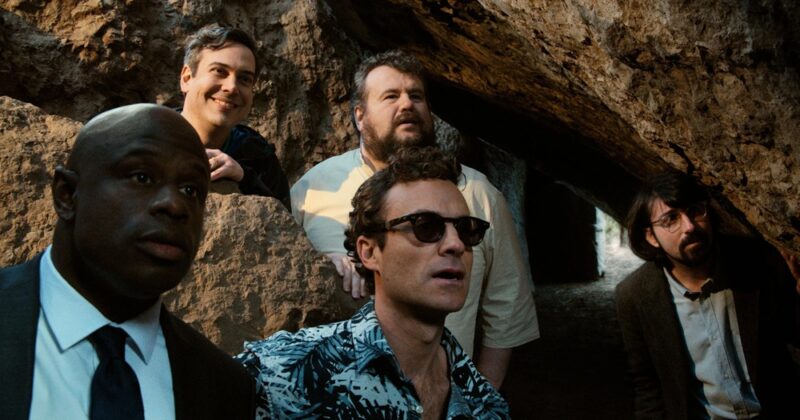
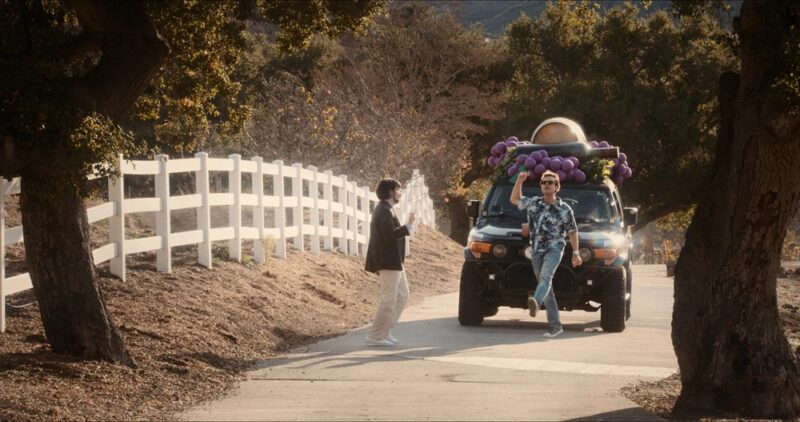
With The Napa Boys – the entirely fabricated “fourth chapter” of a wine-soaked comedy franchise that never actually existed – the longtime collaborators have pulled off something both mischievous and oddly sincere. Co-written by Weitzman and Corirossi, and directed by Corirossi, the film follows Jack Jr. (Corirossi), reluctant co-captain Miles Jr. (Weitzman), and their ragtag gang as they embark on another supposedly beloved adventure, this time guided by a shadowy Sommelier and accompanied by Puck, an over-enthusiastic podcaster who may know more about the franchise’s “legacy” than its creators do.
It’s a meta-joke that runs deep: invent the IP first, then treat it like sacred text.
But beneath the absurdity – the Wine Wagon™, the winking callbacks to films that don’t exist, and a stacked ensemble of alt-comedy heavyweights including Sarah Ramos, Mike Mitchell, Chloe Cherry, Vanessa Chester, Paul Rust, Jamar Neighbors, Nelson Franklin, David Wain, Ray Wise, Riki Lindhome, Natasha Leggero, Ivy Wolk and Beth Dover – there’s something more earnest at play. Corirossi and Weitzman aren’t just parodying franchise culture; they’re reclaiming it. Their “fourth installment” uses the very shorthand modern IP relies on – self-awareness, callbacks, legacy bait – and flips it into a delivery system for sincere character beats, classic setups and payoffs, and the kind of joke-driven comedy that feels increasingly rare.
What emerges is both satire and love letter: a film that pokes at Hollywood’s sequel machine while quietly arguing that maybe, just maybe, those tools can still be used for something heartfelt. In conversation with our Peter Gray ahead of the film’s release in North American theatres, the duo spoke candidly about cynicism, optimism, and why being “cynical about cynicism” might be the most hopeful creative stance of all – as well as what it means to invent a franchise legacy before earning it.
I knew going in that this was essentially taking the piss out of being the fourth entry in a franchise – I loved the ballsiness of that. Everything feels like an in-joke, but in a way that makes it funnier. You’ve described it as the first time franchise IP has been used for art over commerce. Is that a sincere provocation? A satire of how we talk about IP? Or both?
Armin Weitzman: It’s completely sincere. Truly. This came from our souls. Almost by accident, it also became a comment on what’s going on in the industry, but it really originated from us trying to remember why we love movies, why we watch them, why we’re even here doing this.
Nick Corirossi: That statement is entirely sincere. The shorthand and tropes that are used in a lot of current franchise filmmaking – that’s often there simply to get your money. “You don’t need to see the other one. Oh, that’s a callback. You get it.” So we thought: why can’t you use that same calculus, but instead of it being a cynical gotcha, you actually deliver a good movie with it? Why not use that structure to inject art, rather than extract money?
It feels like we’ve forgotten what movies used to feel like – what we grew up with over the last 20 years. We grew up rewatching films a thousand times. We wanted to tap back into that.
There’s a real tension in that idea – cynicism about the industry, but genuine love for cinema. Do you feel like you’re fighting Hollywood or trying to seduce it?
Nick Corirossi: It’s more like what George Lucas did, taking a disrespected genre like old serials and radio plays and elevating them with cinematic craft. We applied that same thinking. Yes, we use some of the tenets of this “disrespected” franchise genre, but we intercut them with tropes from films you don’t even realise aren’t in movies anymore.
You see something and think, “Why isn’t that in films now?” That dynamicism – that’s what we wanted to bring back. It’s not an indictment so much as a structural way to deliver something we genuinely love.
Armin Weitzman: And honestly, I don’t even know if we thought of it as a comedy while making it. It’s almost so earnest at times that it becomes funny, because that tone feels foreign now – like a throwback.
Also, being cynical about cynicism is actually optimism. If you’re critiquing something that’s already deeply cynical, that’s a hopeful act.
Watching it, from that opening with Nick casually stealing the entrance band, it reminded me of comedies we just don’t seem to get anymore. I was thinking Mel Brooks. There’s this feeling now that comedy can’t just have a joke and trust the audience to go with it. Calling it Napa Boys 4 before the other films even exist is kind of genius. What does inventing legacy before earning it say about how franchises function now?
Nick Corirossi: It goes back to that calculus. Franchise films often wrap clichés in self-awareness. They call out a bad plot point and think that makes it smart. So we used those same tropes, but instead of coasting, we delivered real setups and payoffs. Character moments. Things that feel forgotten. You use the tools for good. You bring back the parts of movies you actually love.
Armin Weitzman: And it’s character-based comedy. That feels rare now. Everything tends to filter through commentary or topical jokes. We focused on who these characters are and letting them follow their own rules.
It also feels like audiences sometimes over-correct. People talk about older comedies like American Pie as if they couldn’t exist now, but until something genuinely offends someone, we’re allowed to laugh. As a gay man, people often ask if I’m offended by certain jokes, and I’m like – we’re allowed to laugh at ourselves. That’s why this film feels refreshing. It’s not about being offensive; it’s about not being afraid.
You two clearly have a creative shorthand. What does one of you instinctively understand that the other doesn’t have to explain?
Nick Corirossi: It’s about expectation. Great comedy, and great films, are constantly shifting audience expectation. We’d challenge each other scene by scene: what would the audience expect here? If that’s the expectation, what’s the least expected move?
Sometimes that’s sincerity. Sometimes it’s resolving something quickly that you assume will drag out. Sometimes it’s paying off something you never thought would be paid off – or not paying it off at all. It was almost like a game of chess between us.
Armin Weitzman: Yeah, it’s a bit of a Lennon-McCartney dynamic. There’s always a nervous guy and a cool guy. But the key is love – you’re pushing each other to make a full album. That back-and-forth builds harmony.
I see so many films in this job, and it’s rare to walk into something not knowing what to expect and come out reminded why you love movies in the first place. It feels like you’re saying we don’t have to be so careful or so gentle with everything – it’s okay to just enjoy it.
Armin Weitzman: And imagine asking someone to watch a movie that’s currently in cinemas more than once – that feels like a burden now. But we grew up with DVDs on shelves, rewatching films until they got better every time. We wanted that feeling again.
Nick Corirossi: It’s secretly wholesome, too. It’s not anti-anything. It’s more like, “Can we all just make jokes and have fun together?” If everyone’s in on it and laughing, there’s harmony there.
The Napa Boys is screening in theatres in the United States from February 27th, 2026.
