

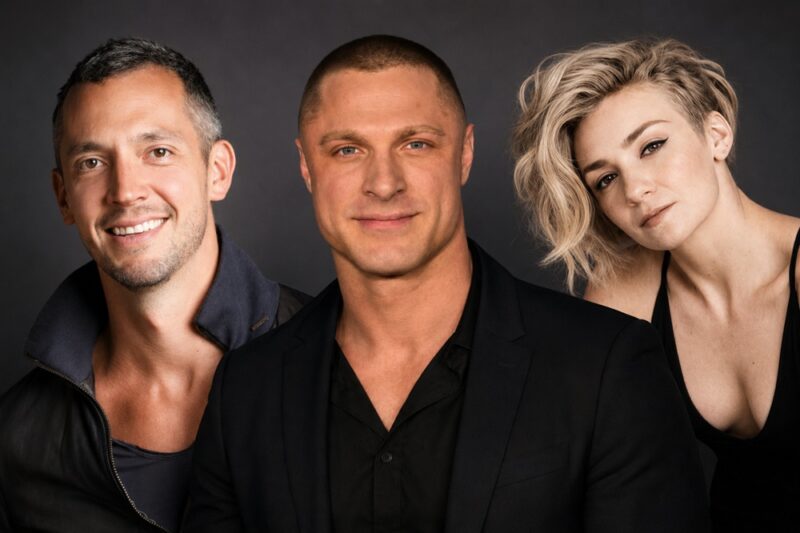
On its surface, Test is about bodybuilding: the relentless pursuit of physical perfection, the sacrifices demanded in chasing a professional career, and the dangerous temptations that can accompany that ambition. But beneath its sculpted physiques and competition stages lies something far more intimate. Director Sam McConnell and writer-star Brock Yurich use the sport as the backdrop for a deeply compassionate exploration of identity, faith, masculinity and self-acceptance, following Eddie, a small-town bodybuilder whose search for external perfection masks a much more personal journey toward understanding who he truly is.
Joined by co-star Paloma Garcia-Lee, whose quietly powerful performance provides the film’s emotional compass, McConnell and Yurich spoke with our Peter Gray ahead of the film’s OutfestNext screening about dismantling traditional ideas of masculinity, bringing authenticity to queer storytelling, and why the most important transformation in Test has nothing to do with muscles at all.
I want to get the emotional stuff out of the way first. I wanted to say thank you to all three of you, because, as someone who grew up struggling with body image and my own sexuality, this film very much affected me. I loved that it doesn’t present masculinity and femininity as opposing forces. Eddie finds the beauty in bodybuilding poses through the ballet, while also navigating his sexuality and searching for acceptance. It felt very honest. So thank you for making something that I feel a lot of people are going to see themselves in.
Brock Yurich: Oh, man!
Sam McConnell: That’s so nice.
Brock Yurich: (Wipes a tear) Thanks a lot (laughs).
Throughout the film, everybody is looking at Eddie’s body for different reasons. There’s the judges, the cam customers online, there’s his mother, and then the audience. But very few people stop to ask who Eddie actually is. Was that disconnect between being seen and being known the emotional engine of the film for all of you?
Sam McConnell: Very astute observation.
Brock Yurich: You nailed it.
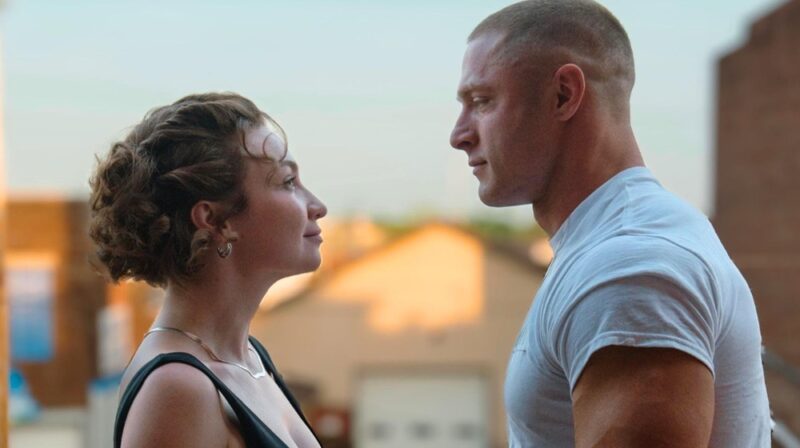
Sam McConnell: You really did. His body is really his currency in a way. It’s how the world sees him. It’s how he is able to move through lifea and negotiate different spaces. I think, interestingly, the character of Abby is really the one who isn’t so concerned about what he looks like, but really asks how he’s doing. She’s really the one who sees him. I think that’s why their relationship in the movie is so special, and in a way scary for Eddie, because there’s a moment where she holds up that mirror to him and is able to identify the scariest part of him that he’s keeping hidden. Even though she’s offering love and acceptance, it’s too much for him. He sees that as a threat. Very good observation.
Paloma Garcia-Lee: I love how you worded that. That really impacted me. I think there’s an interesting thing for Abby in this film. She’s one of the only people, if not the only person, that does not have an expectation of Eddie. She’s meeting him exactly where she’s at. She’s home dealing with her own life, and she’s able to intersect with him at a very important moment. I think everyone – down to Eddie’s mother, the coach, the pastor – has these expectations of him. Of who Eddie is supposed to be, what he’s supposed to look like, who he’s supposed to be for them. Everyone has a selfish approach of who Eddie is supposed to be.
It really was a joy in my life. Those parts of Abby are deep to me as a person to show acceptance and love, and meet people where they’re at and to be that purity. I don’t know if I see her as a light or dark, or anything, but to approach Eddie with immense purity and acceptance is something very special to explore.
Abby and Eddie have some really beautiful moments together. And one of my favourite ideas in the film is that Eddie doesn’t become more himself by being more masculine. He becomes more himself by allowing space for the softer, more feminine parts of who he is. Abby’s guidance becomes just as important as lifting weights. Was it always important that those traditionally masculine and feminine worlds weren’t in conflict, but actually completed one another?
Brock Yurich: Absolutely. The character of Abby has been in every version of this script from years ago. It was always there. I have memories of competitions that I went to, and I’ll never forget this one moment in this competition where one of the biggest guys at the show came (on stage) and everyone’s doing their routines beforehand, showing off…all just very masculine. This one gay came out, he put his music on, and it was the most beautiful music. I’m getting emotional just thinking about it. He did the most beautiful, fluid posing routine. The audience just stopped. It was one of the most beautiful things.
Bob Paris was a big influence on this. He was a queer bodybuilder. He was 23-years-old. He looked like a titan. He was one of the best bodybuilders, openly queer, and that hurt him. But his posing routines will make you cry. It’s almost like a ballet routine. Ballet is one of the most difficult sports you could do, but I like to think that bodybuilding posing is an art form and takes a lot of precision. It’s not something you just get up and do. When you really want to be good at it, it takes a lot of practice. I really wanted to infuse those two worlds. The feminine and the masculine are so deeply, beautifully connected. It was very important for Eddie to find his grace and his fluidity in this hypermasculine world.
Paloma Garcia-Lee: And to be faced with his grace and his fluidity in his life. I think that those mirrors are interesting too. He’s being held to that on two accounts.
Because one of the things that really struck me with this is that shame isn’t the villain. The film never judges Eddie for his cam work or for questioning his sexuality. The real conflict comes from secrecy and isolation rather than the desire itself. For all of you, was that an important distinction with the story?
Sam McConnell: I’m trying to think of how to answer that. Yes, very much. We thought it was really interesting and it felt authentic that this character starts to have feelings of desire. He starts to have feelings of love for Mike, and it’s not those feelings that directly go to a place of shame. He’s exploring and trying to discover. It’s the outside world that is incompatible. It’s incompatible with his church and the sport and the world he’s in. It’s not compatible with his mother. I don’t think he feels innate shame about it, which is intentional. It was an interesting place to begin with him.
I wanted to ask you, Brock, because you obviously transformed physically, but I noticed an opposite transformation, because as Eddie becomes emotionally freer, his body language almost changes. The way he walks, the way he stands, the way he makes eye contact…was that something you consciously built into the performance beyond the physical of it all?
Brock Yurich: I think that maybe the was subconscious. I was able to rely so heavily on Sam and feel safe on set, that it just kind of happened naturally. I don’t think I made a conscious effort to change. That just happened. I’ve been with the story for a while, and I was pretty well aware of Eddie’s journey. I knew how I wanted to approach this. I think in those beginning scenes, I just naturally felt a little hunched over, a little closed off. Then as we got into those later scenes in the script, yeah, I think Eddie’s body language does change. But it was organic.
I don’t really remember thinking, “Okay, in this scene I’m going to stand differently.” It was just what we created. We all created such a deep world. I can’t take credit for that. I’m so glad people are picking up on that.
Paloma Garcia-Lee: What Brock said is so true, though. Sam created such an environment where all of us were allowed to live in our characters where we were filming in Ohio. There’s just so much authenticity and honesty in how we were able to approach this project. It was amazing watching Brock go through (his process) day after day, week after week. I wasn’t there for the whole shoot, but I was there for a chunk of it, and being able to watch Brock transform through the process…it was so inspiring. Brock, you allowed yourself to flow in that character and we met Eddie every day exactly where he was in those scenes with so much honesty and so much care. Sam, you supported that so stunningly. I just want to affirm that was amazing.
Brock Yurich: I have to say, Paloma did the same thing. What you did with Abby, when we see her at the beginning she’s open and beautiful, and then at the end of her and Eddie’s journey, she really has to meet him where he is. That scene at the party? Oh, my god, you just morph and change into what Eddie needs. All I had to do was stay present with whoever I was acting with, and I took in what they were giving me. Really, when you work with amazing people, you don’t have to do much.
Paloma Garcia-Lee: Tammy (Blanchard) felt that way with (her character) as well. Watching that visceral performance that is so honest and so deep and nuanced. Watching her work through all of that was so inspiring.
Brock Yurich: Someone asked me if I was intimidated by her and if it was hard to keep up with her? Honestly, she made my job so easy. How powerful she was, and all I had to do was just look in her eyes and just take in what she was doing. There were moments where I wasn’t even acting. I was just living with “my mom.”
It’s a very lived-in movie. A very raw experience. You mentioned the Ohio setting before, Paloma, and I wanted to ask about if Eddie had lived in New York or Los Angeles, I feel like he might have found community much easier. Does the setting become another character that quietly shapes who he believes he’s allowed to be?
Sam McConnell: Yeah, absolutely. I think the experience of being queer in places around the world is just so wildly different. Certainly within the U.S, being in New York or Los Angeles, (Eddie) would have different access to cross paths and understand things about himself and connect with people. Being in these small towns in the middle of the county – we were in Ohio – it’s just not possible. I think it was really important and specific to Eddie’s journey.
(Ohio) happens to be where Brock grew up. He grew up in Dover, Ohio, and, as a coincidence, it’s also where my mother is from. My mother, my grandmother, they all grew up there. I’ve been hearing stories about this place my whole life, (so) it was really important to us that we shot it there and made it really specific a story that took place.
Brock Yurich: It would have been a very different movie had we set in New York. Me being from Ohio, I know firsthand what it’s like. There were questions of people asking, “Do you think it would be this big a problem?” And I’d say, “Yes.” Even today, I know there are still people who struggle, and that was something that I had to go back and forth with. I wanted to make people feel seen and heard in these small towns who can’t express themselves the way we can in bigger, more diverse, open places.
Paloma Garcia-Lee: I have such a hope for the movie to reach in that way too. I count myself lucky to have grown up in cities with artist parents who could accept these parts of myself and the people around me. I think this movie is going to be incredibly impactful for a wider audience, and that feeling of being in a place and grappling with who you are and trying to get out…at the end of the day, you just want to be loved and seen for who you are. That’s something I have to remind myself I’m so lucky to be able to exist as who I am, because there are so many people who aren’t able to with as much ease. I think this movie really captures that in a really special way.
And we talk so much about mental health and toxic masculinity now, and this movie feels like Eddie is someone who should embody that, but absolutely doesn’t. I hope men, specifically, watch this and can see that you don’t lose any sense of masculinity if you’re queer in any way. I really hope this movie generates the right conversations. Brock, writing from compassion, because Eddie could have easily become the audience’s pity, but there’s enormous dignity in him. Even in the moments where he’s making difficult choices. How conscious were you of protecting his dignity while still allowing him to be vulnerable?
Brock Yurich: I love that question. Thank you. Yeah, I have seen a lot of movies where it could have easily gone into territory where you don’t root for (them). I’ve seen a lot of stereotypes with bodybuilder characters, and that’s one thing with this script that I never wanted to go to. I wanted to avoid that trap. From my own personal experience, a lot of my bodybuilder friends don’t act like that. They don’t act crazy. In terms of queer stories, it’s very easy to fall into those tropes of what we’ve seen before. I wanted to write this story and write a character that you root for. That you can understand. It was a very careful thing that Sam and I worked really hard on in never losing Eddie.
But I really thought about every character. If my mother, Joanne, was the lead, what would her movie look like? If Abby was the lead, what would her story look like? That was something we all worked really hard on to make. I think we did everybody justice in terms of showing all these people as the humans they are.
I have a directing quesion for you, Sam, because I noticed the camera rarely objectifies Eddie. Despite this being a story that’s fundamentally about his body, it feels empathetic rather than voyeuristic. How much conversation was there making sure the audience looked with Eddie instead of just looking at him?
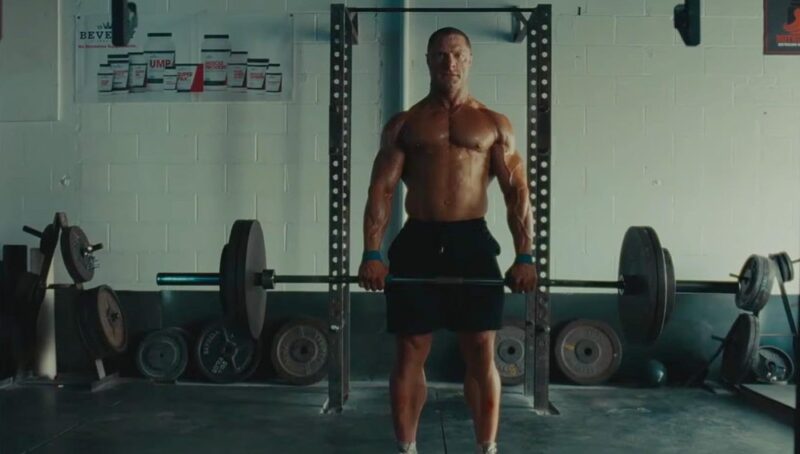
Sam McConnell: It’s a great question. It was really important to us. In fact, I worked deliberately with my cinematographer, Ava Benjamin Shorr, who’s just fantastic. We really wanted the film to have a tone of poetic realism. We wanted it to feel like a peek behind the curtain in some of those competition scenes. They’re the only moments where we see those bodies in those warm glows. Off stage, we wanted it to feel in the realm of some emotional honesty. Whether (Eddie’s) going through the gym with those harsh fluorescent lights, or parts of the small town are washed in greys and browns. It was important that we saw Eddie as a full complex human being, and not someone we’re objectifying.
It’s funny, we talked a lot about how much of Eddie we were going to show. We see a lot of his body. No spoilers, but there’s a moment early on that we decided we were just going to show Eddie’s (naked) body, and I wanted that to feel so nonchalant and that we’re there with him. This is a moment where he’s been through this difficult competition, where he’s had a range of emotion, and he’s washed all of it off. He’s coming out of the shower and he’s just himself. I wanted that moment to feel like we’re not voyeurs or objectifying him in this way. It’s just him. Honestly, simply him.
Paloma Garcia-Lee: I think it’s really interesting working with a director who comes from a documentary background. I think this film has a lot of intimacy because of that. I like what you said, Peter, about seeing what Eddie sees. You see his life as he sees it. I’m really in awe of what Sam was able to capture with that, because you really get to meet these characters from the inside out. Sam was really able to get in with Eddie, with Joanne, with Mike…the intimacy is so deeply reflected in the feelings that you’re able to feel when you watch (the film).
It is a very intimate movie. It’s really beautiful. I wanted to finish off and ask all three of you, because I imagine there’s a young person out there counting calories, trying to make their body “fit” this idea of masculinity, or wondering if they’re allowed to be strong and soft at the same time. When they eventually watch this film, what do you all hope that they’re finally able to give themselves permission to believe?
Sam McConnell: That’s a great question.
Brock Yurich: I just got teary-eyed hearing that question.
Paloma Garcia-Lee: I think coming from the feminine perspective on this, I really hope that women allow men to be soft. To allow men to not have this exterior they feel pressure to (uphold). To just love them for who they are. And their hearts. To remember those moments of softness can be life changing for someone, and to always approach with that. From my lens, this is something I really hope audiences – especially young female viewers – take away from this.
Sam McConnell: Yeah, I would say I hope viewers understand that there’s no one way to be a man. There’s no one way to be queer. There’s going to be all kinds of people and institutions that are putting their expectations of what it means to be either of those things onto you, and it’s really important to let those fall away and understand who you are outside of those expectations. Honestly, it sounds cliche, but you have to be able to learn to love who that person is. Nothing else matters.
Brock Yurich: I would say our bodies are the least interesting thing about us. They can be changed in a way you couldn’t even imagine in a split second. We put so much importance on it, and it’s the most boring part of (us). It’s a tough thing to wrap your head around because it’s how we move through the world, but beauty fades. Your heart and your brain are forever, right? It’s just so unimportant. I just want these young people to try and fight back against what the internet’s telling us what we think we all have to be. As you get older you realise how a person’s heart is the most important thing.
Test is screening as part of this year’s OutfestNext, running between July 23rd and 26th, 2026 in Los Angeles. For more information on the festival, head to the official site here. Test is then expected to continue its festival run across 2026 into 2027.
