
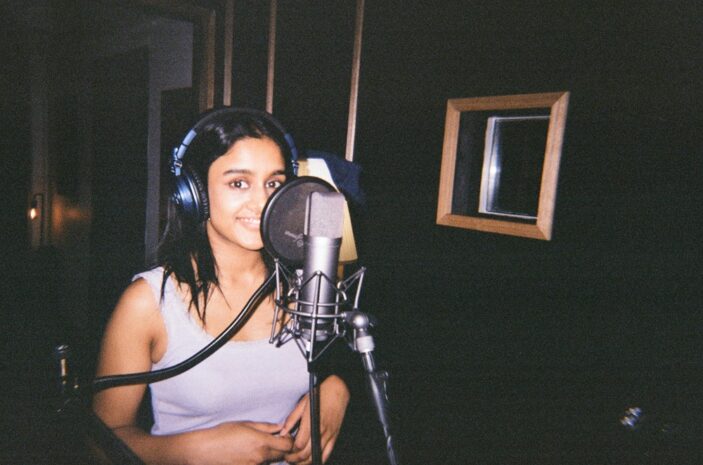
She’s a lesbian. She’s in space. She’s also a princess. And she’s voiced by Shabana Azeez.
After surviving the bachelor party weekend from beyond hell in Birdeater, and navigating the ins and outs of the medical world in HBO’s relentless new series The Pitt, Australian actress Shabana Azeez is, once again, throwing herself in a pit of uncertainty as the lead voice in Lesbian Space Princess, an animated comedy like other, one made by emerging creatives who are embracing LGBTQIA+ and culturally diverse voices, both on and off screen.
Following a triumphant run on the international film festival circuit, Lesbian Space Princess has won the hearts of audiences and critics alike at the Berlin, Karlovy Vary, Frameline and SXSW London Film Festivals. Most notably the film was honoured with the Teddy Award at the Berlin International Film Festival, one of the most prestigious accolades in queer cinema.
And now it’s Australia’s turn. Following screenings at both the Sydney and Melbourne International Film Festivals, Lesbian Space Princess is flying into local screens, and to coincide, Peter Gray spoke with Azeez about what resonated most about her character’s journey, the conversations she’s excited to see emerge from such a bold storytelling, and what she’s found most surprising regarding her placement in the industry.
The title alone for this is one of the best things ever! Obviously you’ve done live action work, but stepping into voice performance, did it expand your approach as an actor at all? Is it easier or harder to do because you have nothing else to hide behind, so to speak.
Oh, my God. It’s easier in some ways, and harder in others, right? It’s easier in that you’re not in a mini skirt and high heels in a forest and it’s raining, but you’ve got nothing to hide behind. Period. And you just have to have trust in your directors. It’s so intense to be fully alone in a room, doing a fight scene or a sex scene, your friends in the other room giggling (laughs). You have to be really vulnerable in a way that I’ve never experienced. I think also for this role, as a character who’s so anxious and in such a bad place, and then it’s the physical fighting, so it’s fighting and gloom, and I would be crying and screaming in the booth for days. Like, really vulnerable. But I think because the character is so vulnerable, I felt lucky I wasn’t playing a cool cat.
At the heart of this, it’s all about heartbreak and hope at the same time. Was there anything that resonated most regarding your character’s emotional journey?
I didn’t think of myself as particularly self-loathing, and then I did this (movie). This “head monster” is a real piece of work, and we all have them, and I think we all, to some extent, talk to ourselves in ways that we would never talk to other people. And seeing it manifest in this way, and I would play both Saira and the head monster, but it’s all her. It’s all one big thing. Insecurity makes me close off. I protect myself. But for Saira, she’s so vulnerable and so desperate. She’s incapable of loving herself. But she’s so open and she’s a raw nerve in a way that I think is really brave, and there’s no acknowledgement of that from anybody, because it doesn’t pay off. I think we award bravery when it pays off, and when it doesn’t pay off we call it stupidity. And that’s just not true. So, for me, I think that was a really big moment.
Emma Hough Hobbs and Leela Varghese have created something so unapologetically queer and anarchic. Was there anything about their vision that inspired you the most when you read the script and you saw what they were doing?
Oh, conceptually, I remember thinking, “I’m sorry, you’re pitching what?” (Laughs). We’ve been friends for years, so when they were pitching for Film Concept Lab, and the first film that won that was Monolith, I remember being in Adelaide, which it’s not conservative, but it’s not non-conservative, you know?, but they’re pitching Lesbian Space Princess and it was just insane. I think it’s gone on to do so well, like it’s coming out here in the United States on Halloween, which I’m so excited about, because it’s a movie for queer people, by queer people, by people of colour, and it’s trying to be something meaningful to one person, as opposed to cater to a million people. But a million people are seeing themselves in this story of self-love. It’s all resonating. And it doesn’t hurt that Aunty Donna are the most charming people in Australia. But it’s all really resonating so much wider than it needed to.
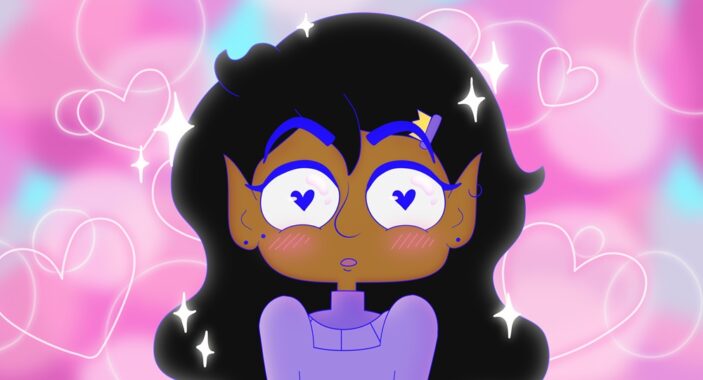
It’s really great that something so specific is finding a voice across all channels. I mean, the villains here are Straight White Maliens! How do you see comedy functioning as both a critique and a celebration in queer storytelling? Were there conversations had around that balance of taking the piss and commenting on the straight white male, but at the same time, this doesn’t punch down on them.
It was very important not to punch down. Very important not to become the enforcer of a new type of patriarchy, right? That’s my type of feminism, right? I don’t want to become the white man. I want to democratize what that looks like, so that everybody can have power in thei own ways. There’s no one right way of being. I’m glad to be a part of the conversation around queerness and people of colour, but I think it’s important that the straight white man got involved. The thing is in Lesbian Space Princess, the Straight White Maliens are literally the exact same as Saira in so many ways. They’re the same character in different circumstances. Two sides of the same coin. Loneliness is loneliness. Self loathing is self loathing. It’s just dressed up different. So the crux of it is we’re having the same issue, and if we let there be a million ways to solve it, as opposed to there just being “one way” to get over it, we will get a lot further as a society.
Looking back at making this, has it shifted or affirmed the kind of projects that you want to pursue as an artist?
I remember seeing a clip, I think it was of Rosamund Pike, where people were saying how she picks really great projects, and she was like, “I don’t pick jack shit, I want a job!” (Laughs). I’ve been thinking about this a lot, and people have told me that I pick really specific projects, and I’m really grateful that I think what is interesting about me in the world is my capacity for embarrassment. Which is something I think a lot of actors struggle with. There’s that “movie star” thing of wanting to look cool and look attractive to audiences in some way. Whereas, I’m Steve Carrelling my way through my career. It’s a very specific thing. I think Australia responded really well to it. I mean I’ve done one American gig where they just want me to humiliate myself day in and day out, but that’s okay. I think embarrassment, especially with Gen Z, is debilitating, generationally, in a way that I’m kind of immune to.
I’ve never had to play the “male gaze” human. I mean, Birdeater was the closest I got to it, but that was still so completely different. That was more a reflection on the male gaze. And Lesbian Space Princess is such a specific character. Nobody wants to put me in a box. People see me as this weird girl and we want to watch her be rejected. I’m so grateful that I get picked for projects that I would pick. I’m so lucky as an actor, because you can’t control how people see you, and the industry sees me in a way that’s complicated. I think young women in society are really maligned in a way that’s stupid. I see who it serves, but young women really have a lot of purchasing power.
Lesbian Space Princess is now screening in select Australian theatres.
