

More than two decades after he first introduced audiences to the gloriously misguided, culturally appropriating wannabe gangster from Staines, Sacha Baron Cohen is bringing Ali G back into a world that, in many ways, seems even more absurd than the one he originally inhabited. But while the character’s tracksuits, questionable vocabulary and unwavering confidence in his own intelligence remain reassuringly unchanged, the society surrounding him has become considerably more fractured, politically charged and, perhaps most troublingly, comfortable with intolerance.
That tension sits at the heart of Ali G: Who Iz I?, Baron Cohen’s latest comedy and his feature directorial debut, which reunites audiences with the self-proclaimed voice of the streets after twenty years spent, in his own words, “chillin’, tokin’ and bonin’.” When Ali discovers that his long-term girlfriend Julie is eight months pregnant, the prospect of fatherhood and another mouth to feed sends him across the Atlantic in pursuit of his former glory. Naturally, his American adventure proves considerably more dangerous than anticipated, as he encounters a series of increasingly hostile adversaries whose ideological convictions threaten not only his future, but the lives of those closest to him.
Blending the confrontational, hidden-camera comedy that defined Borat and Brüno with the heightened stakes of an action thriller, the film sees Baron Cohen inhabit three different characters while placing unsuspecting members of the public at the centre of an increasingly elaborate narrative. It’s an ambitious undertaking, both technically and thematically, and one that the comedian believes reflects a particularly dangerous moment in contemporary society.
Our Peter Gray was invited to attend a virtual press conference with Baron Cohen ahead of the film’s release, where the actor, writer and now director spoke candidly about revisiting one of his most beloved creations, the extraordinary logistical challenges of his filmmaking process, the influences that shaped his approach to satire, and why he believes making audiences laugh has never been more important.
For Baron Cohen, the decision to resurrect Ali G wasn’t necessarily driven by nostalgia, but by the opportunity to examine how dramatically the world has changed around a character who has stubbornly refused to evolve.
“The reason they’re funny is the world changes, and you see how the world has changed through this control experiment of the character,” he explained of his creations. “Ali G is still the white cultural appropriator. He is still one of the most stupid people in the world. He still is a fundamentally good person, despite all his sexist comments and inappropriateness. He believes in increasing the peace and stopping hatred.”
It’s that contradiction that has always made Ali such an intriguing figure. His ignorance is frequently staggering, his understanding of cultural identity almost entirely manufactured, and his attempts at appearing socially enlightened often expose precisely how little he understands about the communities he claims to represent. Yet beneath the bluster exists someone whose intentions, however misguided, are rarely malicious.
“The fact that he is a dinosaur, a relic from another time – I just love the idea of dropping him into today’s world,” Baron Cohen continued. “He’s the same, but the world has completely changed.”
That changing world provides the foundation for the film’s broader satire, particularly its examination of ideological extremism and the increasingly blurred distinction between moral conviction and moral superiority. To explore those tensions, Baron Cohen introduces two additional characters developed during his provocative television series Who Is America?, representing opposing ends of the political spectrum.
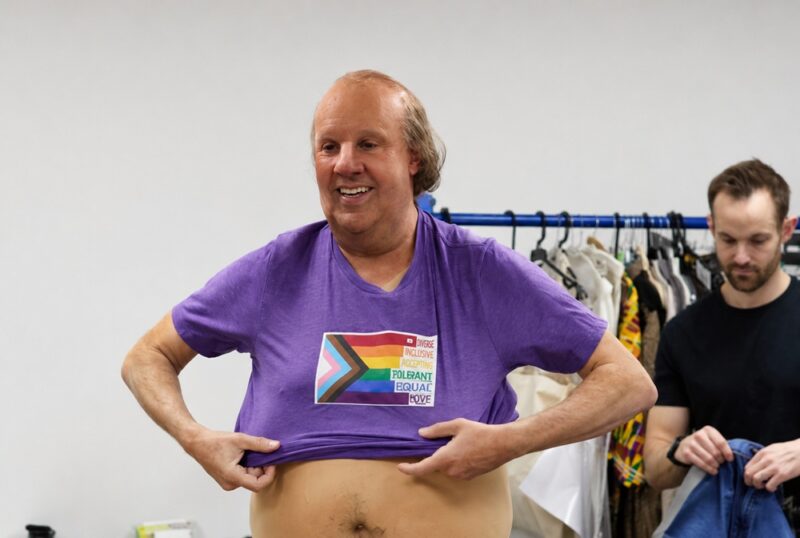
One of those characters, Dr. Nira Cain-N’Degeocello, embodies a particularly self-righteous form of progressive activism, positioning himself as an authority on cultural sensitivity while demonstrating little genuine understanding of the people he claims to defend. In one sequence, the character visits a Black community centre, where residents express concerns about issues including gentrification and violence against Black Americans. Rather than listening, Nira proceeds to instruct them on what they should actually find offensive.
“This white savior comes up to them and tells them what they should be worried about,” Baron Cohen explained. “And it’s completely condescending.”
The sequence speaks to the filmmaker’s interest in exposing the contradictions of performative morality, particularly when those claiming to champion tolerance become incapable of recognising their own prejudice.
“I wanted to show how society has become so divided,” he said, describing the film as an exploration of an “age of virtuous violence, where people carry out violence and are hateful because they feel they’re being ethical.”
For an artist whose career has frequently attracted accusations of crossing the very boundaries he claims to challenge, the question of whether audiences understand the intended target of a joke remains particularly relevant. Baron Cohen recalled a comment from one of the film’s writers, Colton Dunn, that he believes encapsulates the philosophy behind Ali G’s existence: “Ali G is not racist. He’s a tool to expose racists.”
He acknowledged that this distinction isn’t always immediately apparent, particularly when audiences encounter material deliberately designed to provoke discomfort. But he remains unwilling to dilute his comedy simply to ensure that every viewer interprets it in the same way.
“With art or with comedy, you always have a choice,” he reflected. “Do we make the movie for the lowest common denominator so that every single person in the world understands it? Or do we try and create something groundbreaking, something that we believe is ethical, something we believe creates a tolerant society and exposes prejudice?”
His answer, unsurprisingly, has always been the latter.
Reflecting on Brüno, his 2009 comedy centred on an outrageously flamboyant Austrian fashion journalist, Baron Cohen explained that the film emerged from his concern about the widespread social acceptance of homophobia at the time.
“We made this movie to show the danger of homophobia and the easy transition of homophobia into extreme violence,” he said, acknowledging the irony that a film intended to challenge anti-gay prejudice was itself accused by some of perpetuating it.
“When you start delving into a subject and try and fight against a certain form of prejudice, in my experience, you will be accused of that prejudice, and you hope that ultimately you’re doing some good while making the audience laugh hysterically.”
It’s a philosophy that extends beyond the characters themselves and into the increasingly elaborate filmmaking techniques Baron Cohen has developed over the years. With Ali G: Who Iz I?, however, he has pushed that methodology further than ever before, combining the unpredictability of real-world interactions with the tightly controlled demands of an action thriller.

“This is the first ever movie with real people that is a thriller and an action movie,” he explained, revealing that he enlisted Avengers screenwriters Christopher Markus and Stephen McFeely to help establish the necessary narrative stakes. The challenge of directing himself as three separate characters, often while interacting with people unaware that they were participating in a fictional production, required an extraordinary level of preparation.
“Every scene I storyboarded, because obviously I’m main character, and I wanted every camera to know exactly what shot I hoped they would get,” he said.
Nowhere was that preparation more demanding than during the film’s climactic sequence, an undertaking that sounds almost impossible even by Baron Cohen’s notoriously ambitious standards. According to the filmmaker, the sequence required eight hours of continuous filming across approximately 50 miles and twelve locations, utilising forty cameras while incorporating explosions, apparent gunfire, drone activity and even a woman giving birth.
“There are about 400 beats to that eight hours,” he revealed. “So, 400 moments that have to all work perfectly.”
The stakes were heightened by the presence of unsuspecting participants, whose belief in the reality of the unfolding events was essential to the sequence’s success.
“If one of them doesn’t work perfectly, the real people who are in the scene smell a rat, and it’s done.”
Even the production itself seemed determined to test the filmmaker’s resolve. Baron Cohen recounted how an early attempt was abandoned when a forest fire engulfed one of the locations, forcing the crew to evacuate and resulting, according to him, in millions of dollars in losses.
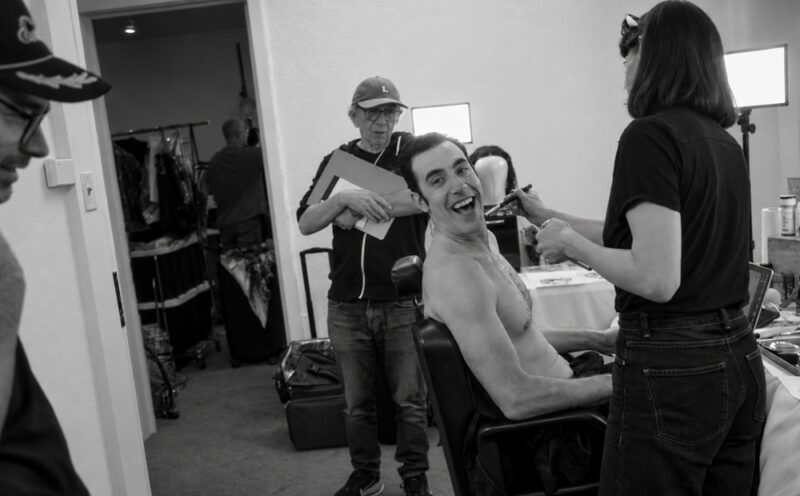
The physical demands were similarly punishing. Two of his characters required extensive prosthetics, with makeup application taking approximately five hours before filming could even begin. Combined with the intense desert heat, heavy body suits and the necessity of remaining in character for prolonged periods, the experience became an extraordinary endurance test.
“I wanted to push myself further than I’d ever gone, and I wanted to make a movie that no one had ever seen before,” he explained.
Yet the elaborate spectacle isn’t simply an exercise in technical excess. Baron Cohen revealed that the climactic sequence was constructed around the principles of the Stanley Milgram obedience experiments, examining how far ordinary individuals might be willing to go when encouraged by someone they perceive to possess authority. The results, he suggested, were considerably more disturbing than even the filmmakers had anticipated.
“When we wrote this scene, we couldn’t really comprehend that these people would do what they did.”
For Baron Cohen, those reactions speak to a broader concern about misinformation, manipulation and the erosion of shared reality, particularly as increasingly powerful technological platforms influence the information people consume.
“Societies, and democracies in particular, rely on shared facts,” he argued. “We’re moving to these autocracies that rely on shared lies.”
He also expressed concern about artificial intelligence and the possibility of misinformation becoming embedded within the systems people increasingly rely upon to understand the world. Ultimately, he described the film as an exploration of the danger of conspiratorial thinking and the potentially devastating consequences of political dishonesty, summarising his concerns with the stark observation that “when leaders lie, people will die.”
Despite those weighty themes, Baron Cohen is equally determined that audiences recognise the film as an entertainment experience first and foremost.
“My main thing is I enjoy nothing more than making people laugh and making my fans laugh,” he explained early in the conference, describing an almost obsessive commitment to measuring and refining the audience response to every joke.
He revealed that the film had undergone fifteen test screenings, with laughter recorded and individual sequences continually adjusted to maximise their comedic impact.
“I screen the movie relentlessly, engineering it to make sure that there are as many laughs per minute as possible, and that the laughs are as big as possible.”
It’s an approach that also explains his affection for the communal experience of cinema. Baron Cohen noted that his films are edited with theatrical audiences in mind, allowing pauses for laughter before introducing the next joke.
Even as Ali G: Who Iz I? prepares for its streaming life, he hopes viewers will resist the temptation to experience it alone.
“Get as many of your friends around. Get your political enemies around, and you may have something in common by the end of the movie.”
Another unexpected dimension of the film is its music, with Baron Cohen revealing that he approached the soundtrack with the structural principles of a traditional musical in mind.
Having previously appeared in Sweeney Todd and Les Misérables, he became interested in using songs not merely as comedic interludes, but as expressions of Ali’s internal thoughts and emotional decisions. Working with his brother Aaron, who contributed to the original Ali G television series, alongside Grammy-winning producer Andrew Watt and acclaimed hip-hop producer Hit-Boy, Baron Cohen developed an eleven-track soundtrack in approximately six weeks.
“I thought, what about if we used a musical structure here? Where essentially the songs [are] the internal dialog on the principal character,” he explained.
For a character whose entire identity is built around an exaggerated interpretation of hip-hop culture, the musical approach also provides an opportunity to explore the central question posed by the film’s title: who, exactly, does Ali G believe himself to be?
The discussion also offered an insight into Baron Cohen’s evolution as a filmmaker, particularly the lessons he has absorbed from working with some of cinema’s most celebrated directors. Although he has spent much of his career creating and developing his own projects, he explained that his occasional appearances in other filmmakers’ work have often been motivated by a desire to learn.
During the production of Martin Scorsese’s Hugo, Baron Cohen asked whether he could sit quietly inside the director’s monitoring tent and observe his process.
“For a few months, he let me sit in there,” he recalled. “And I really try and do that with every movie I’m on.”
He also cited Tom Hooper’s approach to filming performances on Les Misérables, particularly his decision to begin with close-ups before moving to wider coverage, as an important lesson in prioritising an actor’s emotional performance.
It’s a fascinating contrast to the apparent chaos of Baron Cohen’s own filmmaking, where improvisation and unpredictability are fundamental ingredients, yet every camera position and narrative development must be carefully anticipated.
Looking ahead, he also spoke enthusiastically about an upcoming theatrical collaboration with Quentin Tarantino, revealing that the filmmaker personally approached him with a leading role in a play that has required extensive sword-fighting training.
For Baron Cohen, the transition from improvising for hours as multiple characters to performing Tarantino’s meticulously constructed dialogue represents another opportunity to challenge himself creatively. And yet for all the discussion of technical ambition, political commentary and artistic evolution, the press conference repeatedly returned to one deceptively simple idea: the importance of laughter.
Baron Cohen recalled seeing Monty Python’s Life of Brian at seven years old and being profoundly affected by the sound of an audience erupting around him. Similar experiences watching Monty Python’s The Meaning of Life, South Park: Bigger, Longer & Uncut and There’s Something About Mary helped reinforce his fascination with comedy’s ability to bring people together.
“I want to make people laugh,” he said. “I think that’s a beautiful thing to do. I think it’s a fantastic communal experience. I think it makes life beautiful.”
He also acknowledged the influence of Stanley Kubrick’s Dr. Strangelove, particularly its ability to confront the possibility of global catastrophe through absurdity, suggesting that Ali G: Who Iz I? shares some of that film’s anxieties about the direction of modern society.
But where Kubrick’s satire finds humour in humanity’s apparent determination to destroy itself, Baron Cohen appears determined to retain at least a degree of optimism.
Reflecting on the film’s disturbing climactic experiment, he revealed that another participant had been confronted with a similar situation and ultimately refused to comply. For him, that refusal was as significant as the more troubling behaviour captured elsewhere in the film.
“We always have a choice,” he insisted.
It’s perhaps the most revealing sentiment to emerge from a conversation about a character whose entire existence has been built upon saying and doing the wrong thing. Ali G may be ignorant, offensive and hopelessly out of touch, but Baron Cohen sees something unexpectedly valuable in his continued insistence that people should respect one another.
In an era where political disagreements increasingly become personal hostilities, and where the loudest voices often drown out those advocating understanding, perhaps there’s something strangely appropriate about turning to a man from Staines in an oversized tracksuit for a reminder of what actually matters.
After all, as Ali himself would undoubtedly insist, sometimes the most revolutionary thing we can do is simply increase the peace.
Ali G: Who Iz I? is currently screening in select Australian theatres before streaming on Prime Video from October 28th, 2026.
