

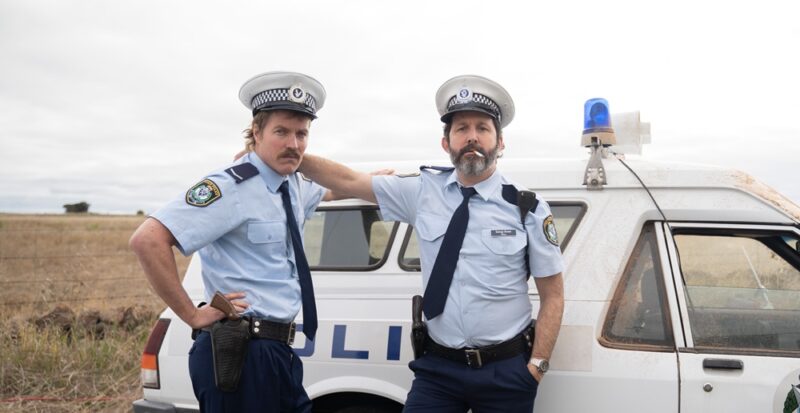
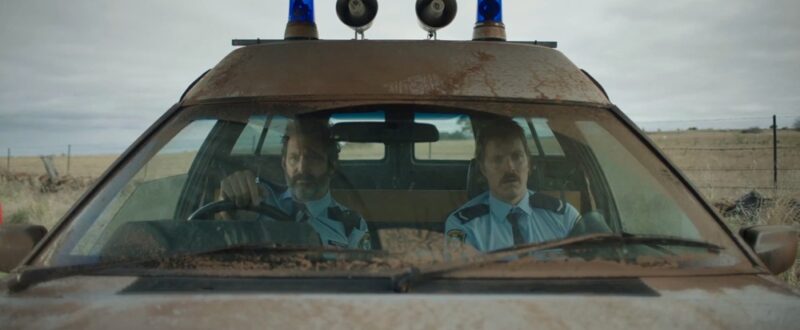
As one half of the delightfully deadpan police duo who cross paths with the stranded travellers in How to Talk Australians, Rick Davies brings a uniquely Australian flavour to the film’s affectionate send-up of life Down Under. Though his screen time may be limited, his outback police officer leaves a memorable impression, embodying the kind of laconic humour and easy-going absurdity that has long been a staple of Australian comedy.
Ahead of the film’s nationwide release, Peter Gray spoke with Davies about leaning into Australia’s reputation overseas, his love of classic Leslie Nielsen comedies, the enduring appeal of regional Australian settings, and why some of the country’s most cherished expressions are probably too rude to ever export. The conversation also touches on working alongside longtime collaborator Dave Lawson, finding comedy through trust and spontaneity, and the joy of celebrating Australian culture while gently taking the piss out of it.
Australians love joking that the rest of the world doesn’t understand us. After making this film, do you think we’re genuinely misunderstood, or do we secretly enjoy the myth?
I think it’s hard to put a blanket over Australia because there are so many different versions of Australians. Even when you travel somewhere like Bali, you see that. I think sometimes we become more Australian when we’re overseas and lean into it a little bit. Whether we’re misunderstood or not really depends on which Australians you’re talking about. That’s what makes it such a hard question to answer.
I definitely feel like Australians start saying “mate” a lot more when they leave the country.
(Laughs) Especially in America. Growing up through the ’80s and ’90s, there was that whole idea that everyone loved Australians, and I think Australians responded by going, “Alright then, we’ll give you more of it.” No worries. Not a problem in the world. I did love Bali, though. The Balinese were such beautiful people, and that’s probably the first place that comes to mind when I think about it.
Your character isn’t on screen constantly, but he plays a role in some key moments. Was there a particular gesture, phrase or detail that helped you find him?
Not really. For me, it was more about the shorthand I have with Dave (Lawson) and the trust Tony (Rogers, writer/director) creates on set. I’ve worked with Tony before, and with Jason (Byrne, producer) as well, so there was already that comfort level. Tony gives you the brief, trusts you to run with it, and then steps in with really insightful direction when needed.
Working with Dave is always a joy. We’ve done so many jobs together that there’s an instant familiarity. We both got excited about playing these cops, and the characters evolved as we went. It felt a bit like stepping into a time machine with those costumes and that world. It was just a lot of fun.
Beyond the stereotypes, what do you hope international audiences take away about Australia from this film?
Honestly, I just hope people laugh. I had such a great time making it and spent a lot of that time laughing my head off. If that joy translates to the screen and audiences have a genuine belly laugh, I’ll be thrilled.
I was laughing out loud through so much of it. It reminded me of the broad, fearless comedies I grew up with. Was there a comedy that first made you fall in love with the genre?
Absolutely. Leslie Nielsen. My mum showed me Airplane! when I was a kid and I completely lost it. Then I devoured The Naked Gun films and Spy Hard. I used to rent Spy Hard from Video Ezy almost every weekend. Nielsen’s approach to comedy had a huge influence on me. Even now, those films feel like an old comfortable T-shirt. I can put them on anytime.
Australia has a long tradition of stories that celebrate regional towns rather than major cities. What does a place like Dubbo offer a comedy that Sydney or Melbourne can’t?
Funnily enough, we actually shot those scenes in regional Victoria, but I’ve got a lot of mates from Dubbo and they’ve all got this fantastic energy. They’re just legends. It’s obviously a very different world from the hustle and bustle of Sydney and Melbourne, and I think that contrast lends itself perfectly to the kind of story this film is telling.
The characters get stranded in Dubbo instead of experiencing the postcard version of Australia. Do you think people learn more about a country when things go wrong?
I think so. And probably about themselves as well, which is really at the heart of this story. When things go wrong, you see the true character of a place and the people in it. That’s when the pulse of a country reveals itself. Those moments can become the furnace that shapes people into a slightly different version of themselves.
A lot of the humour comes from cultural misunderstandings. Were there moments in the script that felt surprisingly accurate rather than exaggerated?
To be honest, it’s hard for me to answer properly because I still haven’t seen the finished film yet. I’m really excited to see it. For Dave and me, we were mostly talking absolute nonsense and having a great time doing it, so our stuff sits in its own little corner. But from what I’ve seen, there are definitely moments that feel very recognisable.
What’s an Australian phrase you never realised was uniquely Australian until someone pointed it out overseas?
“Yeah, nah.” I was in Los Angeles with some Australian friends who live there now, and one of them stopped and said, “God, I haven’t heard ‘yeah, nah’ in years.” I’d never really thought about it before, but you never hear Americans say it. It’s one of those little Australian quirks that I love.
If you were appointed Australia’s spokesperson for a day, which Aussie expression would you ban forever, and which one would you protect at all costs?
That’s a great question. I think there’s a time and a place for “Aussie, Aussie, Aussie, oi, oi, oi.” When I was a kid, I absolutely loved it, but maybe we don’t need it quite as often anymore. As for one I’d protect forever, there are so many great Australian sayings that I couldn’t pick just one. I’d probably put the top five behind a pane of glass and write, “Do not break under any circumstances.” Some of the best ones are probably too rude to repeat here anyway, which honestly sums Australia up pretty well.
That’s usually the moment we tell international visitors that if an Australian calls you the C-word, it probably means they like you.
Exactly. Sometimes that’s when you know everyone’s getting along just fine.
How To Talk Australians is screening in Australian theatres from June 11th, 2026.
