

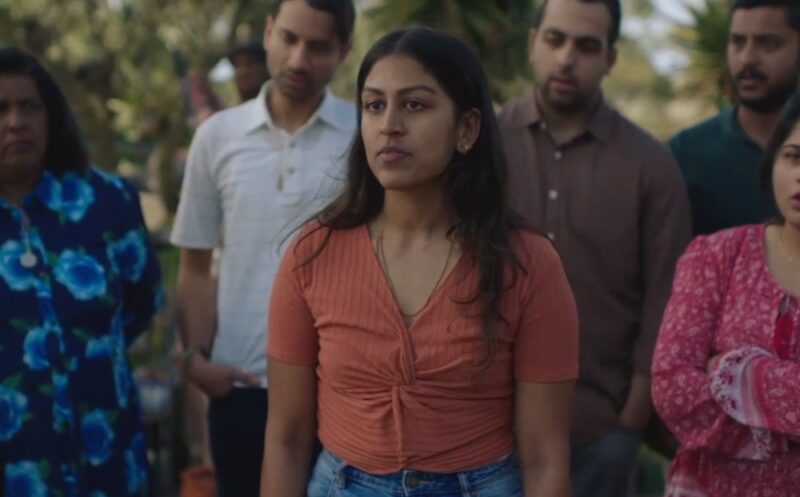
With more than 12 million views behind its viral web series, How to Talk Australians makes the leap to the big screen with a warm-hearted and sharply observed comedy about culture, identity and the misunderstandings that often bring people together. As Shani, an ambitious student from the Delhi College of Linguistics whose carefully planned Australian adventure quickly spirals into chaos, actress Ria Patel provides the film with its emotional anchor amid the absurdity.
Ahead of the film’s nationwide cinema release, Peter Gray spoke with Patel about playing the story’s “straight woman” amongst a cast of larger-than-life characters, the pressure and responsibility of representing Indian-Australian experiences on screen, finding comedy through honesty rather than performance, and why How to Talk Australians ultimately offers a hopeful reminder that our differences may be the very thing that unites us.
In comedy, it feels like the loudest characters often get the biggest laughs. But we need something to keep the word believable. Did you see Shani as the straight woman of the story? Or is she just as quietly absurd as everyone else?
No, I think she does become the straight woman of the story. As an actor, I was actually a little insecure about that in the beginning. I was like, “Oh, but where’s my funny scene? Where am I doing all this big stuff?” And slowly I realised, no, she’s grounded, and she’s the moral compass of the film.
Sometimes I think the reason people find the funny person funny is because of the reaction of the straight person. So that’s what I learned during the whole process of filming. If anything, I felt my job was really easy because all the actors we had were so funny. It was really just me having to listen and react to them.
But I think you’re totally right. I did see her as more of the straight woman, and just reacting to the world around her.
Was there any challenge for you in finding the comedy through the observation rather than chaos?
As an actor, I tend to gravitate more towards dramatic roles, and Tony (Rogers, writer/director) is just really good at getting comedy out of you. He’s someone who’s always saying, “Just do less. Just do less. Say the lines.” Sometimes he’d even say, “Just do it like a drama.” And I’d think, “Oh, I know drama. Great.”
I think actors can sometimes feel the need to do more because they want to be funny, but if you just sit back and honestly say the line, it often ends up being funnier. I don’t know if that answers the question, but yeah.
That’s true even in real life. I’m sure you’ve heard that comedy is telling the truth. I always try to notice it in everyday situations. If someone in my friend group or family makes people laugh, I’ll stop and think, “Why did my dad think that was funny?” Or I’ll realise it was just the way my mum said something. She wasn’t trying to be funny, but it came out in a certain way and everyone laughed.
So I think it was really about that. Tony is very good at telling you to do less. Just stop acting and do less.
This is one of the first big Australian feature films with a primarily Indian-Australian lead cast. Did that significance weigh on you while making it? Or is that something that hits you afterwards?
It did weigh on me while filming. There was a little bit of pressure because I didn’t want this girl to just be the ‘good Indian girl.’ My character starts off as the good, obedient, A-plus student who just wants to make her family proud. It’s that whole immigrant dream of coming to a new country with hopes and dreams.
But then she slowly starts getting angry, and that’s what I love about her. I think women are often told not to get angry. It’s an emotion a lot of us are taught to control or suppress. But I actually hope the film inspires audiences to get angry, because I think anger can be a really valuable emotion. It’s feedback. It’s telling you that one of your values is being challenged, that something is conflicting with who you are. You’ve reached your tolerance limit, so the question becomes: “What’s being challenged? What’s in conflict with you?”
I was also really mindful of representation. I didn’t want to play an Indian character who felt inauthentic. I’m sure you’ve heard people say, “The first Indian I saw on screen was Apu from The Simpsons.” Honestly, that was my experience too, and I remember thinking, “This doesn’t resonate with me. Why doesn’t that sound like us?”
So I wanted to be mindful of how we’re represented because, when I watch the film, I actually think it often makes Australians look a little confused or silly, and we’re the ones reacting to that. So that was something I was very conscious of throughout the process.
And with these characters arriving to expect one version of Australia only to discover something very different, have you had a similar experience where reality completely shattered your expectations of somewhere?
Growing up in Australia, I don’t know if it was really about expectations because I was born in India, but I moved here when I was one-and-a-half, so I feel like I grew up Australian as well. I didn’t come with the same expectations my parents might have had. I think what my parents lacked was a sense of community. They didn’t really have that growing up here, and I think they probably did feel lost and isolated at times. I wasn’t close to my family in India because we’re separated by countries, but as the years went on, it was really beautiful to see that Australia truly is a multicultural country. We do celebrate different cultures.
Of course, there were moments growing up where you get bullied because you’re different. You’re bringing dal and curries to school and other kids don’t understand it. They’re like, “What’s that smell? Is it nice?” Or you’re putting oil in your hair and people ask, “Why would you put coconut oil in your hair?” And now it’s suddenly trendy. The sleek look is everywhere, and I’m like, “I’ve been doing that since I was five years old.” (Laughs)
So I don’t know if it was necessarily expectations as much as those little moments of microaggression growing up. But I think kids can just be mean because they don’t understand. I don’t think it’s always intentional hate or aggression. I think a lot of immigrants feel this way, but I always felt like I didn’t fully belong to either place. I wasn’t Australian enough or Indian enough. As I’ve gotten older, though, and especially through filming this project, it’s been a beautiful reminder that I get to celebrate both. I get to celebrate Vegemite and my dal and coconut oil.
Maybe I’m being overly optimistic, but I’m excited about celebrating the human condition. Yes, it’s a reminder that we’re all the same, but at the same time it’s through our differences that we find that sameness. We’re celebrating unity through diversity. I’m not disregarding the idea that we’re all human, that our blood bleeds the same and we’re fundamentally the same. But I also think our differences and our uniqueness are what unite us. That’s something this movie gives me hope for, especially given everything that’s going on in the world right now.
One of the great things about comedy is that it can be so universal. It often comes from people taking themselves very seriously. Looking at Shani, what do you think she’s absolutely convinced she can control when everything else is spiraling out of her control?
Oh, great question. I think, because she’s trying so hard to be that ‘good Indian girl,’ she’s always trying to control the situation. She doesn’t want to disappoint the people around her, especially her family.
I remember growing up, the thing I felt I could control was my grades, because I didn’t want to let my parents down. I think it’s similar for her. In those early scenes, she’s with her aunt, and her aunt gives her the money to go on the tour. A lot of immigrant kids feel this pressure not to disappoint their parents because they’ve given up everything – their hopes and dreams – to give us a better life.
So I think she wants control, but it just never goes her way. Honestly, I don’t think she ever really gains control until the end. There’s that scene where the school board is questioning Miss Kamala and my character about what the dean did. What I love about that moment is that she could have easily ratted him out. She could have said, “Oh yeah, he did this and this and this.” But instead, that’s the moment where she finally takes control. She decides, “You know what? I’m going to forgive this guy. I’m going to throw him a bone here. He wasn’t that bad.” I think that’s a really beautiful part of her arc.
She starts as this obedient, high-achieving student, then becomes rebellious and angry, and finally reaches a place where she can make her own choice. It’s like she’s saying, “You know what? It was a bad situation, but I’m going to be the bigger person and forgive you.” That’s where she truly regains control.
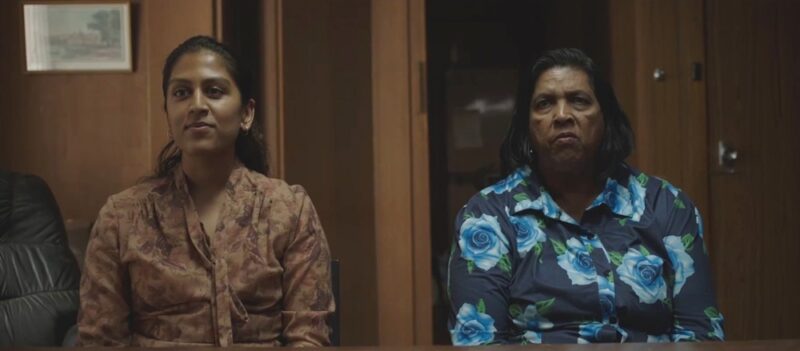
Looking at Shani returning home. If someone asked what Australians are actually like, what do you think she would say?
I don’t know… probably “dipstick wankers.” (Laughs). Yeah, I think that’s probably how she’d describe them. They’re just confused. They don’t really know what’s going on. But hopefully there’s still an intention to understand what’s happening around them. Growing up, I always appreciated it when people would say, “Tell me more about your culture,” or, “I don’t really understand that – can you help me understand?” Or they’d ask, “What does it mean when your mum does this?” or “Why do you do that?”
I think there’s a difference between being dismissive and being curious. So even if the Australians in the film come across as a bit confused at times, hopefully there’s still that genuine curiosity and willingness to learn and understand the people around them.
If an international audience watches this film and comes away believing they finally understand Australians, do you think they do? Or have they missed the point?
Look, I don’t think Australians are quite as clueless as they’re depicted in the movie (Laughs). What really surprised me was how well the film connected with audiences in India. We screened it there, it won Best Comedy at the Jaipur International Film Festival, and I honestly didn’t expect that. When I took my parents to see it, they laughed so much because they recognised that immigrant experience of being misunderstood, or not understanding the culture around you. They connected with those moments of miscommunication.
So for international audiences, I don’t necessarily want them to walk away thinking, “Now I understand Australians.” I hope they connect with that feeling of being misunderstood, or feeling out of place. The film definitely plays up Australian stereotypes for comedy. Hopefully people don’t leave thinking Australians spend all day eating Chicko Rolls and calling each other drongos.
There’s still that misconception overseas that we all have kangaroos in our backyards. The movie leans into those ideas, but it’s heightened comedy. Maybe we’re just taking the piss out of those stereotypes and giving people the version of Australia they think exists.
There were so many moments where I was laughing out loud. Was there a moment during filming where the cast just completely lost it and couldn’t keep a straight face?
There were so many. One that stands out was a scene where Miss Kamala is showing my character where the money is hidden. Someone forgot to put the money behind the picture frame, so she turned it around and it wasn’t there. She genuinely didn’t know what to do, and because she’s such a sweet person in real life, I was desperately trying not to laugh while she was going, “Oh no, where is it?”
The plane sequence was another one. Not the crash, but the pilot being drunk. That was really hard to get through with a straight face. And honestly, every time someone asked the Professor who he was and he’d reply, “I am a professor. I have five children,” I would lose it. It was just the way Robert (Santiago) delivered the line. You’d also hear Tony laughing behind the monitor because he was having such a great time.
I can’t point to just one moment. The entire shoot was a lesson in keeping a poker face. The cast and crew were constantly trying not to crack up.
I feel like that’s always a good sign. If the people making the comedy still find it funny, chances are the audience will too. I’m genuinely excited for people to see this in cinemas because it feels like exactly the kind of film we need right now – something that lets people sit together, laugh, and forget about everything else for a while.
You’re right. We never made this thinking it was going to change the world or send people home with some profound revelation. But if people walk out having had a good laugh, or even just a simple reminder to be a little kinder and more curious about the people around them, then we’ve done our job. It doesn’t have to be a film that completely changes the way you think. If someone leaves the cinema smiling, or feeling a little more connected to the people around them, that’s enough for me.
Well, you should be incredibly proud of it. It was such a funny and genuinely lovely surprise. I went in wondering whether the concept could sustain a feature film, and by the end I just wanted to see these characters travel the world.
(Laughs) We filmed it on and off over more than two years, and we shot so much material. It was an absolute joy to make, and everyone involved was so lovely. I’m just glad it’s finally out in the world. That’s a little scary, but mostly it’s exciting.
Congratulations again, and thank you so much for your time. It was a real pleasure speaking with you.
Thank you. And honestly, I really love what you do. It’s always nice talking to someone who asks thoughtful questions and is genuinely interested in the work, so I really appreciate you taking the time.
How To Talk Australians is screening in Australian theatres from June 11th, 2026.
