

Fame has a peculiar way of turning visibility into vulnerability, and few understood that contradiction quite as painfully as Carolyn Bessette-Kennedy. Long before her marriage to John F. Kennedy Jr. made her one of the most photographed women in the world, Carolyn had built a career at Calvin Klein, working in an industry where image, perception and presentation were carefully considered. Yet, as public fascination with her personal life intensified, the woman who once understood how to shape a narrative found herself increasingly powerless to control her own. Her every appearance was scrutinised, her silence interpreted, and her identity gradually reshaped by strangers who seemed more interested in possessing a version of her than understanding the person behind it.
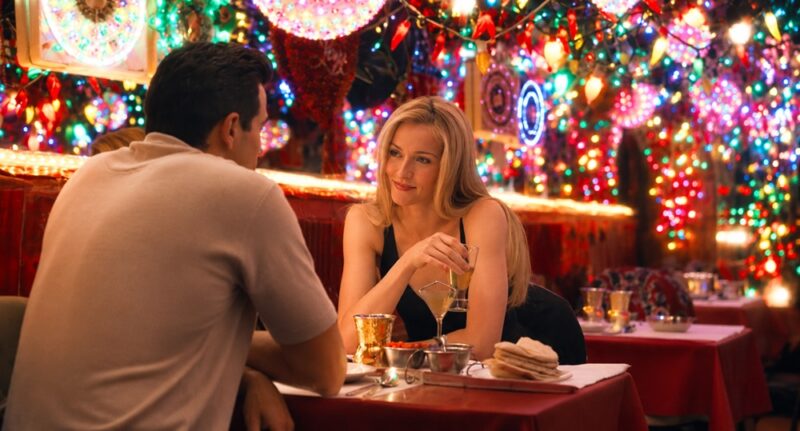
It’s this heartbreaking contradiction that sits at the emotional centre of Love Story: John F. Kennedy Jr. & Carolyn Bessette, the romantic drama from creator Connor Hines and executive producer Ryan Murphy, which stars Sarah Pidgeon as Carolyn and Paul Anthony Kelly as John. Chronicling the couple’s whirlwind romance and marriage, the series explores not only the extraordinary circumstances of their relationship, but the relentless public scrutiny that threatened to overwhelm the very intimacy that made their love story so compelling.
During a recent press conference attended by The AU Review, our Peter Gray asked Pidgeon whether portraying a woman who professionally understood how to shape an image, yet gradually lost control of her own, had changed the way she thought about the difference between being seen and actually being understood.
“That’s a really great point considering her work at Calvin Klein and understanding that part of this industry as a publicist,” Pidgeon acknowledged. “And I agree, it is heartbreaking to not be able to correct your own narrative.”
For the actress, however, one of the more illuminating aspects of inhabiting Carolyn wasn’t simply the cruelty of the media attention she endured, but the extraordinary restraint she demonstrated in the face of it.
“I think also something that was illuminating for me with Carolyn is that sense of restraint in not commenting when people spoke with so much abandon and wildly about her character in the press,” she explained, describing the relentless attention from paparazzi and tabloids as a form of “torment” that seemed to have no end.
It’s a particularly revealing observation because Carolyn’s silence was so often interpreted by the public as something else entirely. Her reluctance to engage with the press could be mistaken for aloofness, her desire for privacy reframed as arrogance, and her refusal to participate in the machinery of celebrity treated almost as an invitation for further speculation. In a culture that increasingly demanded access to every aspect of a public figure’s existence, choosing not to explain herself became its own form of defiance, even if it came at an enormous personal cost.
While Pidgeon was careful not to equate her own experiences with Carolyn’s, she admitted that portraying her had prompted a deeper consideration of the disconnect between personal identity and public perception.
“While my experience is so vastly different from Carolyn’s, understanding that the public perception of you may not – I don’t think it will ever fit who you know yourself to be,” she reflected.
For Pidgeon, that realisation extends to the realities of working in an industry where visibility is both a professional aspiration and an unavoidable vulnerability.
“I want to be in work that excites people, that people watch,” she continued. “And I think just reckoning with the fact that your sense of self may not align with people’s perception of you is not necessarily an easy pill to swallow, but I think just sort of the nature of the game.”
There’s something especially poignant about that admission in the context of a series attempting to reclaim the humanity of a woman whose identity was so frequently reduced to photographs, headlines and the expectations attached to the Kennedy name. Carolyn’s story serves as a reminder that being constantly photographed does not mean being genuinely known, and that the public’s familiarity with someone’s appearance should never be mistaken for an understanding of their character.
It’s also a distinction that Pidgeon hopes audiences will carry with them beyond the series, particularly when considering the boundaries between public interest and personal intrusion.
“I think something that I learned from Carolyn that I hope a lot of viewers have learned from Carolyn is that privacy is meant to be protected,” she stated, adding that “it is incredibly invasive to stalk someone outside of where they live.”
Although the media landscape has changed considerably since Carolyn and John’s relationship dominated the tabloids of the 1990s, Pidgeon remains unconvinced that society’s underlying fascination with celebrity has evolved in any meaningful way.
“I’m not sure our relationship to fame has changed that much,” she observed. “I think just the medium is quite different in that you can’t really outrun the paparazzi anymore.”
It’s a sobering thought, particularly in an era when social media has made public scrutiny more immediate, persistent and participatory than ever before. Where Carolyn was pursued by photographers and dissected in magazines, today’s public figures navigate a world in which speculation can spread instantaneously, and the expectation of constant accessibility has become almost inseparable from celebrity itself.
Ultimately, what makes Pidgeon’s reflections so affecting is her recognition that Carolyn’s tragedy wasn’t simply that she became famous, but that fame progressively deprived her of the freedom to exist beyond other people’s interpretations of her.
And perhaps that’s where Love Story finds its greatest emotional resonance. Beyond the glamour, the mythology and the fascination surrounding one of America’s most photographed couples, it offers an opportunity to consider the woman behind the carefully constructed public image. Not simply as a fashion icon, a Kennedy wife or a tragic figure immortalised in tabloid history, but as a person whose desire to be understood was arguably eclipsed by the world’s determination to keep looking.
Because, as Pidgeon’s portrayal and reflections suggest, there is an enormous difference between having the world’s attention and being afforded the dignity of being truly seen.
Love Story: John F. Kennedy Jr. & Carolyn Bessette is now streaming on FX and FX on Hulu in the United States and Hulu on Disney+ in Australia.
