

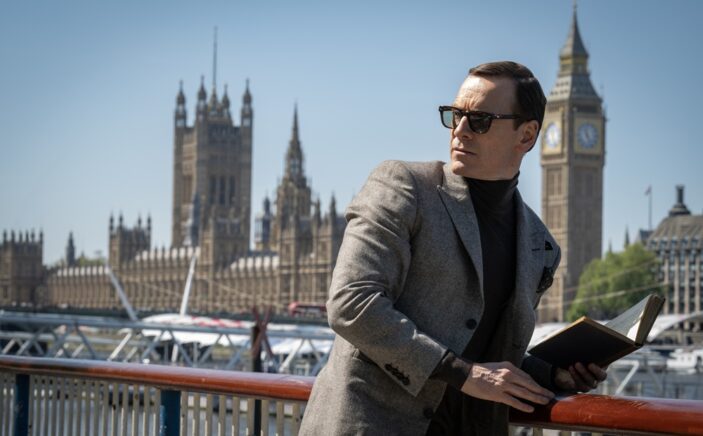
A top British intelligence officer faces the ultimate test of loyalty when he investigates a critical security breach in Black Bag, a riveting spy drama from Academy Award-winning director Steven Soderbergh. An insightful and stylish take on a classic genre (you can read our review here), Black Bag amps up suspense and tension in a twisted tale of deception and betrayal.
As the film arrives in theatres across the globe, our Peter Gray spoke with cast members Michael Fassbender, Marisa Abela, Regé-Jean Page and Naomie Harris, touching on the specificity of the script, if they questioned their characters’ motives, and why Fassbender was right to trust his on-screen wife, Cate Blanchett.
Michael and Marisa, I wanted to ask the both of you, looking back on the film, were there any moments where you realised your initial interpretations of a scene or your character differed from Steven Soderbergh’s vision? And, if so, how did you navigate those creative differences?
Marisa Abela: I mean, for me, not particularly. I think that the thing about Steven is that he’s really specific when it comes to casting, and he just lets you roll with it. You only do a couple of takes of each thing. There aren’t many notes that are coming your way. He really gives you free reign, which is a really freeing feeling. It’s also quite scary, because your initial response is really what you end up seeing on screen.
Michael Fassbender: Yeah, absolutely right. He’s either liking it or hating it, but he lets it happen for everyone. I didn’t really see that there was any conflict in terms of where the perception of the character was or their objectives. He hardly gives any notes at all.
I think just (me) picking the glasses that George was wearing (was it). We went through a bit of a process with that. Sending pictures back and forth of what glasses we thought would work for (my character). That was the most (input) I had.
Marisa Abela: Actually, yeah, my ponytail was a whole thing. I was like, “I can’t have my hair down?” And (Steven) was like, “No.” (Laughs).
Marisa, did you ever question the motives behind Clarissa?
Marisa Abela: Personally, I had a really fun job in that I think Clarissa’s motives are really as they seem. I think she’s new in this world. The audience are kind of experiencing it for the first time with her. She’s not taking everything for granted. She’s not jaded by the world, yet she’s asking a lot. I think her main objective is to kind of get to the bottom of how to function in this world in the best way, and whether or not she can continue on in wanting any semblance of normalcy in her personal life. David’s (Koepp, screenwriter) quite specific in that she’s quite brazen in the way that she goes after what she wants. I was really excited to get to the meat of her.
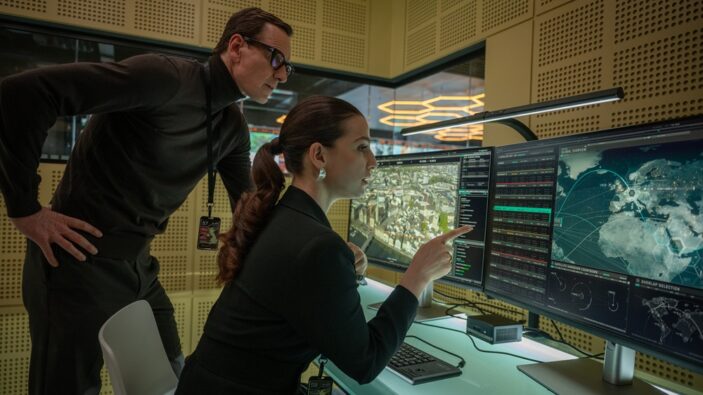
Michael, coming out of the series The Agency into this, is there anything specific about the world of espionage that you find intriguing? Or is this movie really more about marriage and what is needed to make that work?
Michael Fassbender: I just needed the work, and those two jobs came about (laughs). No, it was never planned to do two spy genre (projects) like that. It just happened. And both of them happened within days of each other. But I do find it a fascinating world. You know, what kind of individual decides to go down that path? Considering those sacrifices that it takes and how difficult it is to have, or maintain, a relationship of any sort. I think that was the interesting thing about this story, was that there was this marriage at the core of the story. That George and Kathryn have one another, and yet he isn’t sure how complicit his wife is, and he’s obviously investigating it, but his loyalty lies with her, for good or for worse.
I feel, regardless of what he found out in terms of his investigation, she is his soul mate, best friend, only friend, and perhaps the only person who understands him. It felt like a real deep need that he had for her, and maybe Cate (Blanchett) would say the same about Kathryn. But, for sure, I felt like George’s whole life was Kathryn.
Well, as an Australian, you should always trust Australians.
Michael Fassbender: Never trust somebody that says “Trust me” (laughs).
You mentioned how the script was so specific, but were you able to play within that building of the architecture of your character’s world? Were there any specific psychological techniques or exercises that you employed to know your character better? His contradictions or hidden motivations?
Michael Fassbender: There’s always clues in the script. George liking to cook, it was such a solitary activity. Even when there’s people around him, he found purpose in that. There’s a sort of meditative quality for him in that he goes fishing by himself. Everything is organised in his approach and his work and his life. He needs to have order.
Kathryn is the opposite. Her clothes are flung all over the floor. He can’t help himself but clean things up. There’s a character there. It’s hard to read a reaction from George. The way he interacts with people, the fact that he doesn’t have any real friends. There were all these clues to his character in the script.
I don’t like to intellectualise too much about the character beyond the clues that are there. And just through repetition, your mind starts to wander and things start to ferment. Then you just come on set, you put on your clothes, and everything comes together. Hopefully. But I didn’t have any psychological techniques. I just tried to put myself in a position where certain things, like paranoia, are just always there. It’s what keeps you alive in this world. It keeps the wolves from attacking, which, in this case, can happen within his own department.
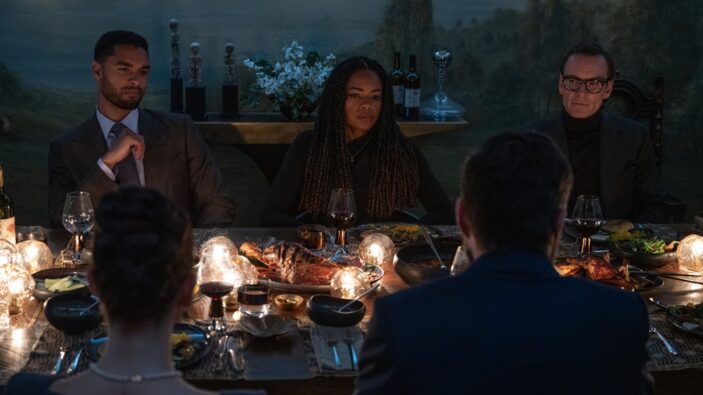
Naomie and Regé-Jean, the thriller genres often play with audience expectation. For the both of you, were there any deliberate choices that you made to either uphold or subvert those expectations with your characters?
Regé-Jean Page: I think, for myself, it was about allowing the character to care more than you often see in these films. People often think that the spy genre is all about repression and what people hold back. And I think that is true, but I think you then have to define what is being repressed and what is being held back. I think for this film, that’s all about intimacy. These characters are all searching for a place they can find intimacy and trust, and with varying degrees of success. I think that’s the main story between Michael and Cate’s characters, and I think that’s the same story with everyone in the ensemble. But with all different outcomes. They are all in need of that intimacy, and that way you see the cost of when they give it up for what they think is the most important thing in the film.
Naomie Harris: For me, the script really gave me that, because it gave me that Zoe is incredibly unorthodox in the way that she goes about therapizing her clients. I loved leaning into that, because I loved the idea that here is somebody who knows all the rules, but has chosen to throw the rule book away and rewrite it on her terms in order to get the kind of results that she wants from people. It’s corrupt, but it’s also admirable. I think.
Regé-Jean Page: All of these characters are dealing with a certain trauma, and they’re not necessarily being honest with themselves about how they’re dealing with it. I’d forgotten how much (Naomie’s character) is dealing with that. Certainly how much my character is. I think everyone has that vulnerability and a lack of awareness of how much it’s driving them.
Black Bag is screening in Australian theatres from March 13th, 2025.
