


For all the Hadoukens, roundhouses and larger-than-life personalities synonymous with Street Fighter, Noah Centineo sees something surprisingly vulnerable underneath Ken Masters’ famous bleached-blonde exterior.
Set in 1993, Street Fighter reunites the estranged Ryu (Andrew Koji) and Ken Masters (Centineo) when the mysterious Chun-Li (Callina Liang) recruits them for the World Warrior Tournament. What initially promises to be a brutal contest of fists, fate and fury soon reveals something far more dangerous, with a conspiracy threatening to turn the former brothers-in-arms against each other.
Directed by Kitao Sakurai, the new big-screen adaptation isn’t shying away from the heightened world of the games either. Centineo promises a film that is “90s to the bone,” embracing the characters, aesthetic and fighting legacy that have made the franchise an enduring pop-culture institution.
But before Ryu and Ken could convincingly fight each other, Centineo and Koji had to learn how to feel like brothers.
The pair effectively lived alongside one another throughout an intensive six-week preparation period, spending their days undertaking four hours of martial arts training, hitting the gym, recovering and then sharing dinner together. For Centineo, that time allowed an organic friendship to form that he hopes audiences will feel underneath every punch thrown between them.
As the new trailer launches ahead of Street Fighter bringing the World Warriors back to cinemas, Centineo spoke with Peter Gray about finding the humanity underneath an iconic video-game character, honouring rather than reinventing Ken, building his bond with Koji, and why this version of Ken is only beginning to discover the man – and fighter – he could become.
With Street Fighter and playing Ken, I feel like he’s always kind of lived in Ryu’s shadow. He started as almost a mirror image of him, but over the decades he’s evolved into this completely different character with his own personality. When you came into the film, were you more interested in honouring the Ken that people already know, or convincing audiences that this version deserves to stand on his own?
I think this version of Ken is all about him finding himself. So you’re kind of looking at the first iteration of Ken when you watch this movie, and the slow process of self-discovery that may or may not lead to him becoming the Ken that we’ve become familiar with in the later iterations of the game.
One of the things that I found fascinating about Ken is that unlike a lot of action heroes, he’s allowed to have a life outside fighting. In the game, he’s a husband, a father, someone who wants balance. Did you think that’s part of what has kept him interesting for 40 years?
Oh, yeah. I mean, he’s evolved, right? He’s evolved so much. Especially with Eliza (Ken’s wife in Street Fighter lore). I really want to bring her into this somehow. You know, him being a family man is really important. So I guess that is a part of it. He is pretty multidimensional, and I’m excited to see how he continues to evolve, especially in these film adaptations.
Street Fighter obviously lives or dies on the fights, but these characters have decades of history together. How much of making Ken beliebavle was actually about building that relationship with Andrew (Koji, Ryu) before you threw a punch on screen?
I mean, we were very fortunate. We got to pretty much live together for six weeks in prep before we ever said “action.” The film starts off with their brotherhood – they’re kind of estranged – so it was very important for us to spend that time together. Every day, we did four hours of martial arts training together, about an hour in the gym, then two hours of recovery, and another two hours at dinner. We did that every day for about six weeks, so we were together throughout the entire prep cycle.
We got to really develop this very organic friendship and professional relationship as well, and I hope that comes through. By the end of the film, without giving anything away, I think you can feel how close we got. Ryu and Ken have to be brothers. They trained together, they grew up together, you know? So that was important.
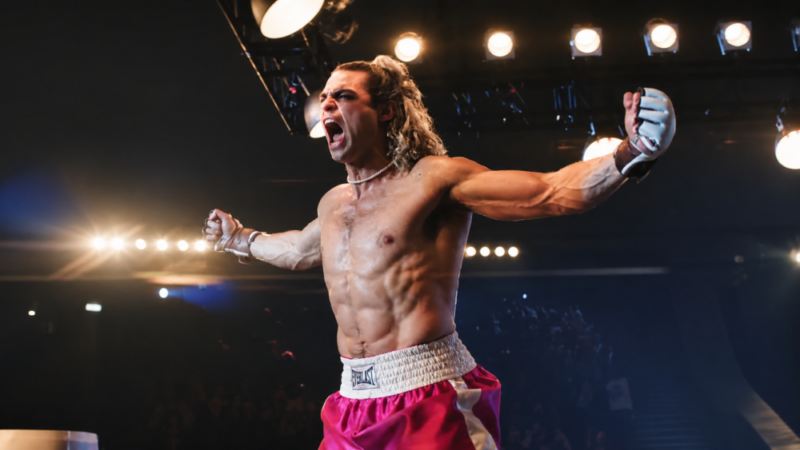
Did you find yourself creating little details for Ken beyond the choreography? How he stands, how he enters the room, how confident he is, so that people would recognise him before he does what he needs to do?
Oh, you definitely know it’s Ken the moment you look at him. That’s for sure. I didn’t really have to do much. Our hair and makeup team, mixed with our wardrobe team and the training I put in…you kind of walk into a room and you’re like, “That bleached blonde hair guy is Ken.” But there was a lot in the script. His stance. I wasn’t trying to reinvent anything new with this. That wasn’t my job. My job was to take this extremely iconic character and try to do justice to it. That’s what I tried to focus on as much as I could.
And if someone walks out of the cinema knowing nothing about Street Fighter beforehand, what’s the one thing you hope that they understand about Ken by the end of it?
He’s just a baby. He’s just a little dude. He’s a little kid. We all have a little kid inside of us that is looking for connection and self worth, and that’s who he was. And sometimes it drives us to be crazy motherfuckers!
That feels like the best way to wrap! I grew up playing these games, and I have a soft spot for the 90s movie, so I’m excited for this one. It looks incredible how it’s embraced that 90s feeling. Thank you so much for chatting today, and congratulations.
Thank you so much, man. It’s definitely 90s to the bone. To the teeth. I hope you enjoy it.
Street Fighter is screening in Australian theatres from October 15th, 2026.
