

To look at Ken Carter’s 90-foot ramp jutting into the Canadian skyline was to look at a monument to sheer impossibility. In The Stunt Driver, filmmaker Michael Dowse dives headfirst into the folklore of Canada’s most audacious stunt performer, who, battered by decades of broken bones, staked his survival on jumping a mile across the St. Lawrence River. Star Jay Baruchel inhabits Carter with a blistering mix of carnival showmanship and suffocating dread, turning a daredevil spectacle into an underdog tragedy reminiscent of Fitzcarraldo.
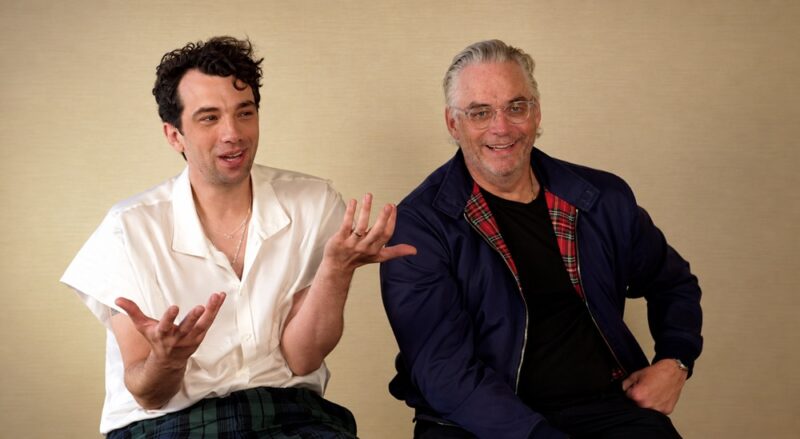
Ahead of the film’s theatrical release, our Peter Gray sat down with Dowse and Baruchel during TIFF to discuss the razor-thin margin between love and enablement, the cultural chip on the Commonwealth shoulder, and the quiet relief that comes with surrendering control on set.
With The Stunt Driver, obviously Ken is attempting something objectively insane, to say the least. I like that the film never treats it as a joke. I kept wondering at what point does believing in someone stop being an act of love and almost start being an act of enablement?
Michael Dowse: That’s a very good question. I think that’s Gloria’s issue, in terms of she gets to that point where you got to shit or get off the pot. It’s a really good question. What is that point when it becomes so dangerous, when you know it could potentially kill the person? Are you letting them follow their dreams? That’s the paradox of the film in a nutshell.
Jay Baruchel: And they might actually attain their dream one day. So, I think there is no right point. I think it seems to be a results-based thing, that if the person doesn’t do the thing, then they had enablers. If they do the thing, then they had people that believed in them.
Ken has built this identity around being the guy brave enough to do the thing that other people won’t. Did you ever think about what happens psychologically when courage stops being about something you process and becomes something you have to continually prove?
Jay Baruchel: Absolutely. It has to be exhausting. You constantly have to find reasons and ways to get through it. Anyone who has been through heavy shit in life knows it’s never a sprint – it’s an endurance test. You have to keep coming up with reasons to stick to it, finding ways to exorcise your demons or at least keep them at bay.
I’ve been on camera since 1995, and I still have to force myself to handle this part of the job. There are really only three places in the world where I’m truly comfortable: my house, my cottage, and on set. The rest of it is hard. Doing a red carpet last night, for instance – that stuff takes real effort. Every single time, I have to find a new way to beat that monster.
With this project, it’s a bit easier because I genuinely love the film. I keep telling my wife, “I really believe in this movie. It’s my favorite thing I’ve ever done.” I want the world to see it, and people won’t know it’s out there if I don’t show up and do the work. But even that justification can fall short when anxiety starts suffocating you. At the end of the day, you just have to keep finding ways to beat that fear.
From a filmmaking point of view, Ken knows he’s being filmed. There’s this version of him that comes alive when he’s being watched. When you’re making a film, Michael, about somebody who is already performing himself, how do you decide which Ken is actually the truth?
Michael Dowse: I think both are true. It’s all Ken. There’s an innate showmanship to him – the on-camera persona was what he did, and he even had his own name for it. Ken Carter was a showman.
What I tried to highlight in the film is that duality. There are overt moments where it’s clearly put on for the cameras, like that scene in the rain where he goes, “Oh, you missed that? Let’s set it up again.” But there are subtler moments, too, where you see a deeper, more vulnerable truth – moments where he’s honest with himself, even if he still puts on a bit of a show for his wife.
Right after the jump fails, he’s standing by the window and she asks, “Are you going to jump?” You see this quiet, heavy sigh – a genuine moment of honesty – before the mask slips back on and he goes, “Well, I think I’ll do it.” The goal was to cut through that performance to find the core of who he was. He almost had a split personality; it was his way of coping. So really, both of those truths coexist.
I feel like there’s something wonderfully Canadian about Ken’s ambition, because he’s attempting this enormous thing in the shadow of an American celebrity. Did you see Ken’s obsession as being something about wanting to prove he’s just as good? Or was it about turning himself into a superhero?
Michael Dowse: For me, it was really about him wanting to cement his legacy. He was in his late thirties, early forties, had broken almost every bone in his body, and knew his time was running out. Meanwhile, he was watching his peer from the South cash in and become a household name, making him feel that ticking clock even more acutely. That was his chief motivator: his legacy truly mattered to him, and he desperately wanted people to remember his name. Hopefully, in some small way, this film helps do that and keeps that legacy alive.
Jay Baruchel: You’re not wrong to read it that way. Zooming out and looking at it reasonably, doesn’t everybody secretly want to see the poor kid knock out the rich kid’s teeth? The bad guys in a summer camp movie are never the poor kids, so it starts right there.
Beyond that, we have this obsession with anonymity. It’s something all Commonwealth countries seem to share: this ingrained mentality of “How dare you try to rise above your station?” We value people who keep their heads down far more than those who talk about themselves. In my own family, the absolute worst thing you could do was make a fuss about yourself. But that humility comes at a cost – often burying parts of you that are just as ambitious, interesting, and beautiful as anyone else’s.
We definitely carry a bit of a chip on our shoulder, and we look for places to channel it. In a way, you could easily view that giant ramp as one massive middle finger aimed straight in Evel’s (Knievel) direction.
And you’re a filmmaker yourself, Jay.
Jay Baruchel: Thank you for saying that. I appreciate that. I’m going to tell everybody!
When you’re collaborating, are there times when Jay’s director brain is thinking “I would do this,” but you’ve got to trust Michael? And Michael, are you ever thinking, “What would director Jay think of this?”
Michael Dowse: He never thinks that (laughs).
Jay Baruchel: I promise you, he’s never once thought that (laughs). For me, there’s a very clear delineation. Now, that applies to him specifically because I like him, I respect him, and I think he’s great at what he does. That’s definitely not universal.
There are times on set where it’s agonizing because I know I could get us all home six hours earlier, but here we are. Still, I always respect the chain of command. There’s a certain freedom in knowing you only have one job to do. Even if I sincerely believe I could build the house better than the person running the job, if I’m hired as the painter, all I have to do is paint the wall they told me to paint. I can leave it at that. It’s not my fucking problem, and I don’t have to lose sleep over it. I did my piece, and my piece will always be solid – even if I know in my gut I could’ve built a sturdier house.
The Stunt Driver is screening in theatres across North America from September 25th, 2026.
