

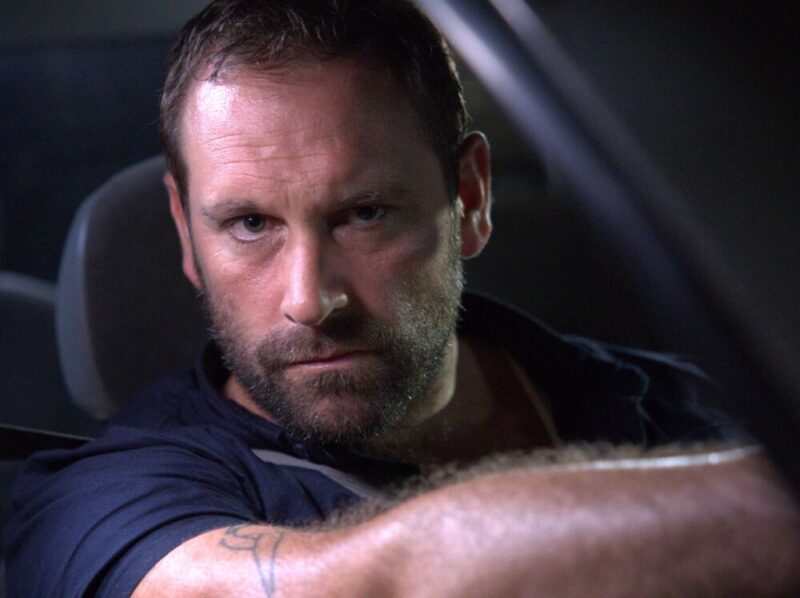
In Blair Moore’s Badland Rising, Jake Ryan isn’t playing the kind of action hero who charges headfirst into danger. His character is a man running from it. A former soldier turned construction worker, Ryan’s Dave dreams of nothing more than returning to his wife, son and the quiet life they’ve built together. But when a botched robbery leaves him in possession of a bag of stolen cash, that dream quickly gives way to a blood-soaked fight for survival across Queensland’s haunting cane fields.
Speaking with our Peter Gray, Ryan reflected on playing a reluctant man of violence, grounding larger-than-life action in emotional truth, the enduring appeal of old-school practical stunt work, and why stories about finding your way home continue to resonate with Australian audiences.
Looking at the psychology of the film, obviously former soldiers can be portrayed as people equipped for violence. What interested you about exploring someone who perhaps wishes those skills weren’t as useful anymore?
I had a pretty good sense of what I was getting into, knowing Blair’s (Moore, director) style and the kinds of films he likes to make. His work tends to be built around action, so I knew that would be a big part of it. I also seem to be falling into a bit of a pattern playing ex-soldiers – damaged or otherwise – who have violence in their toolkit. What I liked about (my character) Dave was that he’s really a reluctant violent man. He wants a simple, quiet life and doesn’t want to be involved in any of this. But, of course, you’d have a pretty boring movie if he managed to avoid all the trouble (laughs).
His greatest motivation is his family, but I feel like family can both be a source of strength and burden sometimes in these films. Did you see his devotion as something that saves him? Or something that traps him?
Initially, I think he’s motivated by survival. But at the same time, it’s his desire to do better for his family and protect the people he loves that ultimately leads him down this pretty brutal path. He leaves a trail of destruction in his wake, but everything he’s doing comes from a place of wanting to do the right thing. I’m a dad myself, and there’s really nothing you wouldn’t do for your kids or your family. That’s what I connected to most with Dave. His intentions are good, even if the choices he makes and the consequences that follow become increasingly messy.
Talking about that destruction, there’s this fascinating tension between action and restraint. How much of your performance is built on the moments where you chooses not to pull the trigger? Metaphorically or literally…
Yeah, I think for Dave, whenever violence enters the equation, it’s always a last resort. He’s not somebody who goes looking for trouble or seeks out confrontation. In a lot of ways, he’s begrudgingly forced into these situations and has to do whatever it takes to get through them.
What I find interesting about him is that he doesn’t dwell on it. He deals with what’s in front of him, puts it aside, and keeps moving forward. His focus is always on getting back to his family. He’s not driven by revenge or aggression; he’s driven by necessity. If something stands between him and the people he loves, he’ll do whatever he can to get through it.
Does that shift the emotional weight for you? Obviously many action heroes are driven by revenge, but Dave is driven by responsibility. Was that something in the story for you?
It’s a slightly different take on it. I kind of separated the two sides of the character in my mind. You’ve got Dave’s emotional journey, and then you’ve got all the action and chaos happening around him. For me, the approach is the same as it is with any role: you try to find the truth in every moment. Whether it’s a fight scene, a dramatic scene leading into the action, or the aftermath of it, you’re always looking for what’s emotionally honest.
As wild and unrealistic as some of the situations in the film can be, I think the best place to start is by grounding everything in truth. If you can find that authenticity in each moment, then the audience will go along with you, no matter how crazy the circumstances become.
I feel toughness can be celebrated in Australian storytelling, but here it feels there’s more vulnerability than invincibility. Were you interested in challenging the traditional ideas of what a “strong man” looks like?
I think those kinds of guys can be a bit boring, honestly. What I liked about Dave is that there’s a real humanity to him. He’s carrying that conflict of knowing he doesn’t want to be the tough guy anymore. He just wants a quiet life on the farm with his family, away from all the chaos, away from people like this, away from these kinds of situations.
The irony is that he just happens to be very good at violence when he’s forced to use it. That’s what makes him interesting to me. He’s not embracing that side of himself; he’s trying to leave it behind.
As you mentioned the setting, the cane field here create this environment that’s beautiful and threatening at the same time. Did the landscape affect how you approached the character physically or emotionally at all?
I suppose there’s a certain quality to country people. I live in a pretty rural area these days, and there’s a more laid-back, slower-paced way of life that comes with it. People tend to be a little more wound down, without some of the angst and anxiety that can come with city living.
The landscape was a huge part of the film as well. I had a lot of fun shooting in the cane fields. They’re visually striking and unlike anywhere else, but they also carry a sense of mystery and danger. They’re beautiful, but there’s something unsettling about them at the same time, which really suits the tone of the story.
Looking at action as a physicality, so many of these films have characters that communicate through movement rather than dialogue. Did you discover anything about Dave through the way he walks, the way he fights, the way he carries himself at all?
I think I discovered that he’s probably getting too old (laughs). I got a lot of injuries on this. He’s a very physical guy, but yeah, I don’t know, man, it was…
You’re just getting too old for this shit!
(Laughs) Yeah, but he’s still very capable. We’re thinking of ideas to do a follow-up. If people like this, there’s a chance that he’ll come out of blissful retirement again to go down that reluctant road of having to fight people.
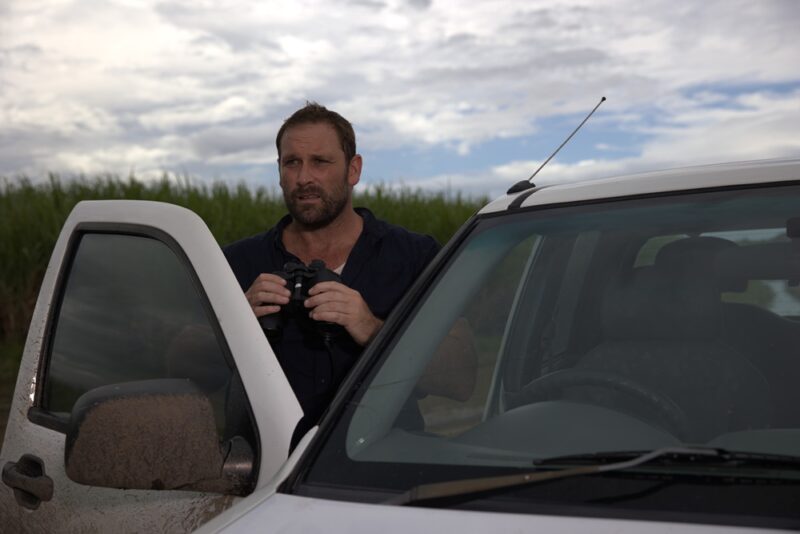
I did like that almost exhaustedness you had when you would fight someone.
I think it’s a lot more interesting than playing someone who’s just a meathead looking for a fight all the time. That’s pretty boring to me. What I liked about Dave is that whenever violence erupts, it’s the last place he wants to be. He doesn’t want to be doing any of this.
The turning point is when his family is threatened. Once the people he loves are put in danger, then it’s game on. Until then, he’s doing everything he can to avoid that side of himself. It was fun to play because, on a practical level, these Australian indie shoots are pretty gruelling. Everyone’s working incredibly hard, often for mates’ rates, and it’s a real team effort. As the film went on, it actually became easier to tap into Dave’s reluctance because I was probably feeling it physically myself. There were definitely days where I thought, “Not another fight scene.”
We had a fantastic stunt team, including the guys from Gorilla, and we’re already working with them again on another project. It feels like we’re building a really strong group of people who are passionate about making old-school Australian action films with Australian stories. We don’t have huge budgets for CGI, so we’re trying to do as much as possible for real – practical stunts, practical action – and I think audiences can feel that authenticity on screen.
In any regard, action films are just better with as much physicality as possible. Properly choreographing a fight scene, filming on location… it just makes it feel so much more visceral.
It’s a lot more fun because you’re actually doing it. I can’t think of anything more boring than standing in front of a green screen and having visual effects or AI create everything else around you.
More than anything, I love being on set. I love the process of making films and the actual doing of it. To be honest, I’m not even that motivated by watching the finished product. That’s never really been the thing that drives me. What I love is turning up every day and creating something with a group of people.
That’s why projects like this are so rewarding. It’s an old-school approach where you’ve got to get in there and do it yourself. There are no stunt doubles stepping in, no elaborate rigs, no shortcuts. You’re getting your hands dirty, throwing punches with a bunch of mates, and trying to make something entertaining for an audience. That’s the part of filmmaking I really love.
This is very much the type of film that reminds me of those action movies of the 80s and 90s that I grew up with. Was there a movie for you that served as your gateway into the genre?
Yeah, I was a huge (Jean-Claude) Van Damme fan growing up, so films like Bloodsport were massive for me. Then there were actors like Bruce Willis and films such as Die Hard and Lethal Weapon. There are so many from that era that I loved.
On the Australian side, you’ve got classics like Wake in Fright, which was definitely an influence on this film as well. But honestly, it was often the actors more than the films themselves that drew me in. When I was a kid, if Bruce Willis or Jean-Claude Van Damme was on the poster, I was sold. You could take my money straight away.
Did you build any type of private history for Dave? A military background? Something that doesn’t appear in the script, but informed the way you approached certain things?
I think having that military background was really important because it gives Dave a certain level of confidence and capability in these situations. He knows what he’s capable of, so when things start escalating, it doesn’t feel completely out of character for him to adapt, plan counterattacks, track people, or survive under pressure.
If he were just an ordinary farmer with no background like that, some of those moments might feel a bit far-fetched. By making him an ex-soldier, it gives you a whole toolkit to draw from as an actor and helps ground the action in something believable.
At the end of the day, it’s still a movie, and some of the situations are pretty extreme, but you always want to make them feel as authentic as possible. Giving Dave that military history means that nothing he does feels completely outside the realm of possibility. It helps the audience believe that, when he’s pushed into a corner, he has the skills to fight his way out.
At the heart of the film, this is very much a story about a man trying to get home. Why do you think stories about homecoming continue to resonate so deeply, particularly in Australia?
I think those kinds of moments resonate because they’re something people can relate to. There are so many people working away from home, especially in Australia. I’m away working at the moment myself, and by the time I get home it’ll have been close to three months, aside from the odd trip back.
You’ve got FIFO workers and plenty of others who spend long periods away from their families because that’s what they have to do to pay the mortgage, pay the rent, and look after the people they love. Maybe that’s part of why those reunion scenes connect so strongly with audiences. We’re all conditioned to those goodbyes and periods of separation.
When they’re done well, though, those moments can be incredibly powerful. People want to see hope. There’s something genuinely heartwarming about seeing people come back together after they’ve been apart. It’s a beautiful thing.
I also think experiences like COVID probably made those moments hit even harder. We all experienced isolation in some form, and we all know what it’s like to miss someone. Everybody has someone they want to see again, and I think that’s why those scenes continue to resonate.
Looking back on Dave now, is there a question about him that you still don’t have the answer for?
Yeah, I kept finding myself asking questions like, “What’s he going to do with all the bodies?” or “How is he going to get out of this one?” The cops are pretty good at their jobs, after all. You can spend a lot of time trying to answer every one of those questions, but at a certain point, with a film like this, you have to let a bit of logic go and embrace the ride. Otherwise, you won’t get past the first few pages of the script.
Early on, I remember thinking, “Well, he can’t do that because he’ll leave fingerprints,” or, “He can’t leave that there because someone will find it.” Blair would just laugh and remind me, “Mate, it’s okay. It’s just a movie.”
That said, I don’t think it’s a bad thing to have those thoughts in the back of your mind as an actor. Even if the audience never sees it, Dave is still carrying those concerns somewhere. You want to ground the character in reality, even when the situations themselves become increasingly outrageous. Action films, by their nature, can be pretty ridiculous at times. The trick is finding enough truth within them that the audience goes along for the ride.
Badland Rising is now available on Digital and On Demand in the United States. An Australian release date is yet to be announced.
