Beasthits with more than just brute force. Beneath the bone-crunching action is a story about restraint, identity, and the internal battles that don’t end when the fight does. Academy Award winner Russell Crowe steps into the role of a seasoned trainer, guiding Daniel MacPherson’s Patton James – a fighter pulled back into a world he tried to leave behind – in a performance shaped by years of physical preparation and emotional intensity.
Directed by Tyler Atkins and co-written with David Frigerio, the Australian-made sports drama leans into authenticity, from its real-world locations to fight sequences staged in front of a live crowd in Bangkok. But what lingers isn’t just the spectacle – it’s the tension between control and chaos, and the idea of violence as both a weapon and a form of expression.
In conversation with our Peter Gray as the film arrives in Australian theatres, Atkins spoke of that duality – from the evolution of the film’s title to the collaborative process behind the scenes, and the challenge of capturing something that feels as emotionally grounded as it is physically explosive.
I wanted to ask about the title – I know it was originally Beast in Me and then changed to Beast. Was that your decision? How did those conversations go?
Beast in Me was the original title when I first received the screenplay around 2022, so it had always been that. I really loved it – I thought it captured the idea of Patton wrestling with that “beast” inside him. But then, a few months ago, the Claire Danes Netflix series Beast in Me came out, and it just became confusing. People were asking if it was the show.
I think it was the American distributor’s decision to simplify it to Beast to avoid that confusion. Ironically, there are already a few other films called Beast, so there’s always going to be overlap. Something similar happened on my first film – it was changed to Ocean Boy instead of Bosch & Rockit, which I wasn’t thrilled about. I tried to fight for it, but ultimately those decisions are out of your hands.
That’s part of the industry – there are always people above you making those calls. My job is to deliver the best film I can, and then everyone else handles their side of things. That said, I’m still happy with Beast – it works, and it suits the film.
Yeah, I remember seeing the US materials for Bosch & Rockit listed as Ocean Boy and being completely thrown. I was like, “Wait, what?”
Yeah, exactly. It happens. It’s one of those industry realities – you don’t always have control over those decisions.
You mentioned the screenplay being sent to you – and with Russell Crowe involved in the story, how collaborative was that process? Did he maintain a strong sense of ownership on set, or did he step back and let you shape it?
The original script was written by David Frigerio. I received it in early 2022 and spent a long time workshopping it with Dan McPherson, shaping it into the film I wanted to make. Russell then did a pass on the script and really elevated it – he fleshed out the characters and brought a lot of heart to them, which really unlocked the film. I wasn’t there for that stage as I was deep in prep, but his contribution was significant.
Once we got to set, it was very collaborative. Filmmaking is always evolving – ideas shift, scenes change. Russell would work his scenes, but we also had a structure with three shooting blocks, and his material was largely contained within one of them. I’m a director who likes to experiment – try things, even if they don’t always make the final cut. And when you’re working with someone like Russell, he just transforms. He’s a master of the craft – everything he does feels right. It was an incredible experience.
Speaking of transformations – when George Burgess showed up, I was like, “Wait, that’s George Burgess?” He’s genuinely great here. And I love that these supporting characters don’t just feel like they’re passing through – there’s real depth to them.
Yeah, Russell actually wrote the role of Neil specifically for George. He suggested I check him out – he’d been doing acting classes – and when I saw his work, I thought he was fantastic. That character is really important. If you take him out, Patton loses a big part of his emotional core. He’s what brings out Patton’s softness – you see him caring for someone else, sharing with him. It humanises him.
There’s something special that happens when you cast right. George brought a real heartbeat to the film. And Dan was incredible in supporting him – creating a safe space, helping him through it. Their dynamic is really beautiful, and it adds so much to the story.
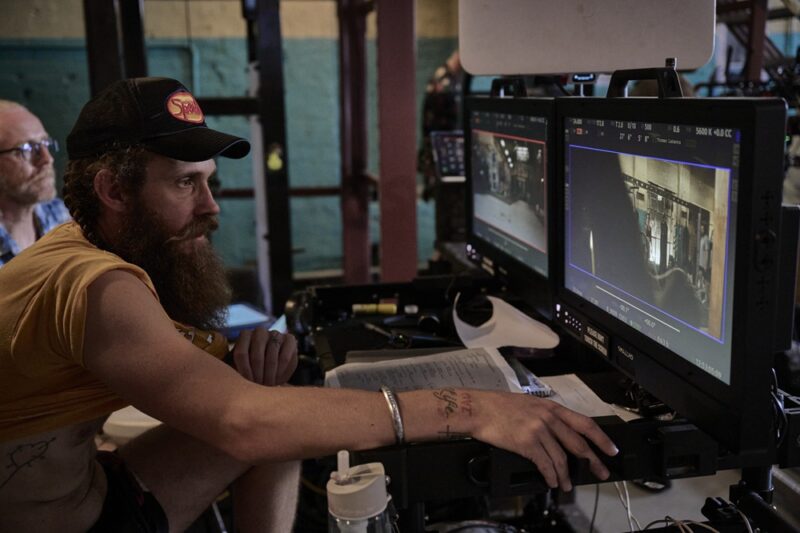
Tyler Atkins directing on the set of Beast (Rialto Distribution)
And then offsetting that, you have violence almost functioning as a form of communication. It feels like a language these characters understand – was that something you consciously built into the film?
Yeah, absolutely. I studied fighters a lot and realised that martial arts is really a form of meditation. It’s discipline, repetition, control – mastering something over time. I also found that many fighters come from traumatic backgrounds, and the sport becomes a kind of outlet – almost like church for them. Outside the ring, they’re often incredibly humble and gentle people, but inside it, they’re lethal.
I wanted to explore that duality – the killer instinct versus the calm, meditative side. That balance is in the film, and it’s also reflected in the score. We mixed primal, percussive elements with softer, more emotional tones. Life is about balance, and that’s what I wanted the film to embody.
That ties into the opening mantra – “If I can breathe, I can think…” Was that always part of the story?
That line actually came from Russell. He’d heard something similar from a coach years ago and adapted it into the film. It became the core mantra – not just for the character, but for us behind the camera too. The shoot was intense, and that idea of grounding yourself, controlling your breath, was something we all connected to. It really unlocked the film.
It’s such a strong way to open the film. And then when you get to that final showdown – were you thinking more about who wins, or what it means either way?
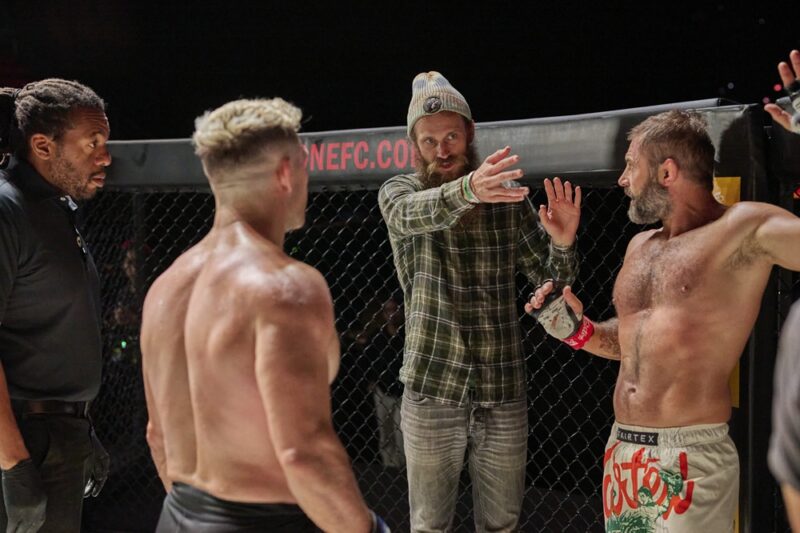
That sequence was incredibly complex. I worked closely with Brent Foster, who choreographed the fights, and we mapped out the emotional beats we needed for Dan’s character. But once you’re shooting, things change. You adapt constantly. We only had a couple of days to shoot the final fight – at a real 15,000-person event – and about ten minutes to capture certain moments. So I focused on getting wide shots to anchor it in reality, knowing we’d build around that.
It was physically intense. Dan and Brent were getting hit all day, exhausted, running on no sleep. Dan had trained for years to get to that level, but Brent has decades of experience – he’s incredibly conditioned. We had no backup plan. It was a huge risk. But I trusted the team – I positioned us as best as I could, and everyone delivered. It could have gone completely wrong, but thankfully it didn’t.
Well, it absolutely pays off. That final sequence is intense – it feels almost overwhelming in the best way.
Yeah, it’s meant to feel like that – like you’re in it.
The sound design really sells that too – every hit just lands.
Yeah, my sound designer worked on Bosch & Rockit as well, and he’s incredible. We really pushed it – we wanted the hits to feel real, almost uncomfortable. Because when you’ve trained or been hit, you know how much it hurts – and these fighters are taking dozens of hits. It’s unbelievable what they endure.
Seasoned film critic and editor, music reviewer, occasional lifestyle collaborator. Gives a great interview. Penchant for horror. Unashamed fan of Michelle Pfeiffer and Jason Momoa. Voter for the 84th Annual Golden Globes.
Contact: [email protected]