
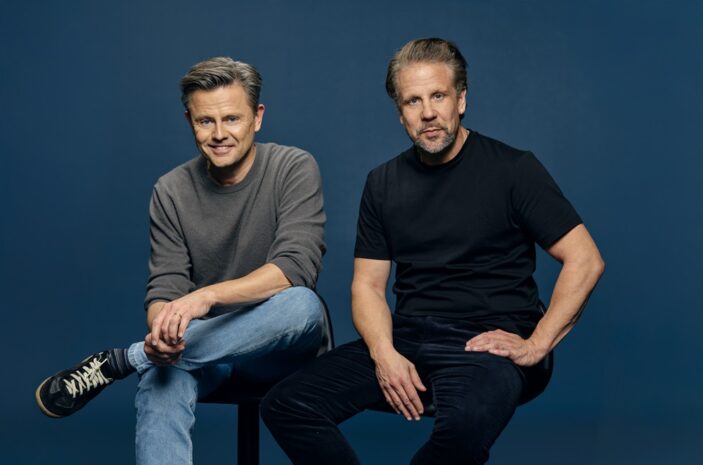
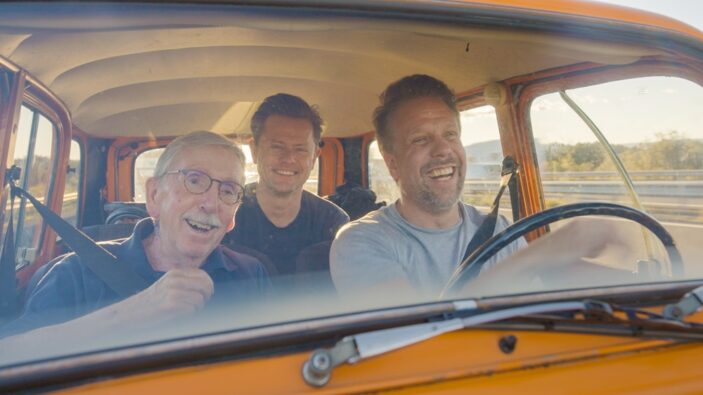
Known in their local Sweden as Filip och Fredrik, popular TV hosts and journalists Filip Hammar and Fredrik Wikingsson have moved into the documentary film space with The Last Journey, which sees the duo take Hammar’s father, Lars, on a road trip to France. Lars has recently retired after 40 years as a French teacher but instead of a “third age” of travel, wine and experiences with his wife, he’s become passive and tired. By making the same road trip that the family used to make when Filip was a child, and staging some of life’s most beautiful moments, they hope to rekindle Lars’ spark.
As the film journeys into Australian theatres later this month, and ahead of the duo’s visit here for a special live screening event, Peter Gray spoke with both Filip and Fredrick about personal realisations during filming, if their original vision ever shifted during the making of the film, and, perhaps most importantly, if they ever found out what the famously passive Lars said to a taxi driver that he deems as his most sinful act.
Lovely to talk to the both of you. I’m going to say, I’ve seen a lot of joyful movies in my time, but I walked out of this just feeling elated about everything that was put on screen. But my first question, I have to ask you, Filip, did you ever find out what your dad said to the taxi driver?
Filip Hammar: (Laughs) No. There’s a scene in the film where my entire family, you know, he forced us to convert to Catholicism. And he didn’t do it for religious purposes. It’s more that he wanted to be closer to France, or Italy and just the southern parts of Europe. We all had to make confessions regularly, and I didn’t know this until the film was being made, (but) that’s his biggest sin. That he was screaming at a cab driver in the 60s. Knowing him, I can’t see that he would’ve been rude to the cab driver. He probably wanted to, you know, ask if he could put another passenger in the cab, It’s insane.
Fredrik Wikingsson: I would have loved to find that cab driver for a sequel or something. What happened in this small town so many years ago? In all likelihood, he’s dead as a door nail. So it’s going to be hard (laughs).
Filip Hammar: I think that whole scene also, in a way, shows my dad’s likeability. Here’s a man, and obviously I’m biased because it’s my dad, but I have to say when I see that, I’m like, “Well, it’s hard to not like this little man.”
Obviously you’re telling Lars’ (Filip’s father’s) story, but did the tone or the style of the narrative evolve during production? Was there a focal pivot at any point? Or everything that we see from beginning to end is the vision that you had as storytellers and directors?
Fredrick Wikingsson: We had a naive vision at the beginning. Filip’s enthusiasm is very contagious, in a good way and sometimes a bad way, but I think we were all enthused by the possibility of a trip that could make this old man find his zest for life again. This was an experiment. And I think during the trip we gradually realised before (Filip) did that this trip is maybe going to be more about him realising that you can’t reverse time. That you have to come to an acceptance with age and with the coming of death. To make this documentary we had to be open. You have to plan for some kind of bigger truth of the experience.
Filip Hammar: I guess we wanted to make an original film about a good man. But it’s a good man that has an edge and a weirdness to him, because it’s hard to make a film about a good human being. Sometimes that’s just too lame and bland. But I really changed. The biggest journey in this film is my journey. I think the relatability is that when our parents get older, we don’t want them to get older. I think that’s very common.
I was thinking about it with my mum. I told her about this film and how much she would enjoy it. She’s getting older, but I don’t want her to, and I still think of her as young. It’s really one of those moments where certain things become real. But it really is such a beautiful story you’re telling her, and with that, was there a moment for both of you during production where you both thought, “This is why we’re making this film?”
Fredrik Wikingsson: I think there were small moments. Like, when Filip talks about his dad being depressed, and then during the trip he forgets that he’s depressed. We wanted to create this reverse bucket list. Instead of him experiencing things he’s never experienced before, we took him back to the places and the moments that he loved the most during his life, and that will remind him that life is worth living, so to speak. And to see that these sometimes elaborate schemes that we set up, and the viewers know that we’re staging things, but we would do it for his benefit. And when you see him really light up, that was incredibly moving and gratifying. Of course, there are darker moments as well that feel very true, like when he wants to make his world famous ratatouille, and he can’t cut through the vegetables anymore. And that wasn’t planned at all.
Filip Hammar: That’s a key scene. If you look at that part of the movie, that’s when I realise that he’s going to become that guy again. He can’t even cook like he used to. I hardly recognise myself in that scene, desperately trying to find a sharper knife. I think that we felt that when we were filming that it was going to be a key scene. But, as Fredrik said, there are those moments where we lure him into a situation where he suddenly becomes the storyteller he wants. Those are the memories that I’ll cherish for the rest of my life. And I think that’s why I chased something bigger. I wanted him to become my old dad, but I got something else, and I think that’s really, really valuable.
And we’ve seen that in Sweden. The film’s been a huge success, and we had no idea that it would relate this well with people’s own experiences. Now people are taking their parents on trips. It’s a little bit of a movement. I think it’s also a timely film. Maybe when you feel that your whole world is falling apart, there’s suddenly a film where it’s about what’s in the end, all that matters is our family. Let’s curate that a little bit.
Nostalgia is a powerful thing, and I felt this film really encapsulated that feeling of everything that’s old becomes new again. It’s so beautiful. And I’m so happy your dad continued on his trip, because as you’re watching it you really don’t want to see him just get back into that bed. It made me appreciate a lot more, so thank you for this film.
Filip Hammar: If we come to Australia, we’ll buy you dinner.
I’ll hold you to it!
The Last Journey is screening in Australian theatres from February 27th, 2025. Ahead of the film’s national release, Filip Hammar and Fredrik Wikingsson are conducting a special live Q&A screening in Sydney on Sunday the 16th February at the Hayden Orpheum Cremorne. Tickets for the event are on sale here.
