
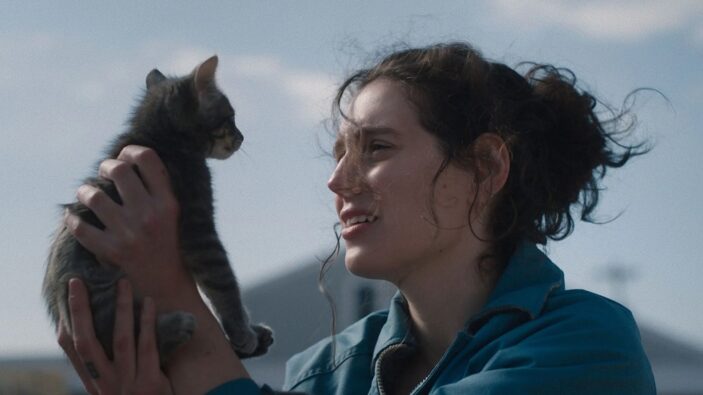
Eva Victor is a writer-director and actor whose fearless character-forward comedic sensibility has cemented them as an undeniable triple threat to watch. Victor has boldly established themself as a singular emerging cinematic voice with their feature directorial debut Sorry, Baby, which world premiered to massive acclaim at the Sundance Film Festival, before closing the Director’s Fortnight at Cannes and earning further acclaim out of both this year’s Sydney and Melbourne International Film Festivals.
Critics have lauded Victor as “an idiosyncratic and exciting new American artist,” (The Daily Beast), “a breakaway talent” (Esquire) and “one of (their) generation’s most insightful new voices” (The Wrap), among other praise, including our own Peter Gray, who wrote in his review, “There’s a mischievousness to their delivery throughout that speaks to their obvious dry, black comedic sensibility, and it’s within that jocular mentality that we, as an audience, find the permission in being able to laugh with the film in some of its most uncomfortable moments.” Prior to Sorry, Baby, Victor cut their teeth in the comedy sphere, achieving significant success with myriad viral videos, which led The New York Times to deem them “a magnetic performer whose motormouth characters evoke the comic anxiety of Roz Chast cartoons.”
As the film arrives in Australian theatres this week, Peter spoke with the talented multi-hyphenate actor/director/writer to discuss the infusion of humour within the tragic narrative and how the support cast brought the film to life.
What I loved about Sorry, Baby is that it sidesteps the trauma narrative by focusing on the textures of Agnes’s life; the kitten, the sandwich, jury duty. How early in the writing process did you know that you wanted to avoid showing the assault? And what did you hope audiences would take away by not centering it?
I think the reason I made the film was not to show it, and I had to figure out why I didn’t want to show it. And so if I’m not showing that, that means the film’s not about that. So what is the film about? And then the film, to me, became about friendship and the little joys of the world and the little pains of the world, and trying to move through years when other people look away and get back to their lives. And this one person is just moving at a glacial pace, trying to just make it through another day.
And so then it became about (how) we’re telling the story of a life in five years, and the violence very much informs the five years. And I think this deep friendship is life saving. The film was always built to never show the violence, so it was a question of, “What do we show?” I remember writing that she goes into the house, and it was just intuitive to me that we just wait, we wait, we wait…I think the script just says “We wait” a bunch of times. Then she emerges and she’s holding the boots and her thesis, and that was always how it was. It was both a relief and felt like the simplest way to show the experience of how time and this experience moves for her.
There’s been a couple times when someone’s read a draft and then read another, and they’ve mentioned how I took the part out where we see (the assault), and I was like, “No, you just built an image in your head based off of words,” which is really interesting. And I wonder about that. But I always wanted Agnes, in her own words, to tell Lydie (Naomi Ackie’s character) what happened, and that’s how we find out what happened. It’s not through this third person objective lens that’s anonymous. It was always through Lydie’s lens that we see this story.
Your background in comedy very much shines through in the tone of the film. It’s wry, but deeply moving. Did you find yourself consciously blending comedic beats into the heavier subject matter? Or did they naturally emerge as part of the process in the way you tell stories?
When people ask me why I did that, I’m like, “Well, it’s just what I did.” I do think so much of making a first film, or making anything, is instinctual. And then you try to learn about why that mattered to you upon reflection. I think in the edit is when you learn about why you did something, or even in prep for the film, there were ways I wanted to shoot the film that, for some reason, was “the shot”, and then it was a lot of work for me and my DP to figure out, well, “Why is it that?” And then you figure out there’s an emotional reason to back up why I want this to be the shot, or why this is the joke. But it felt very instinctual.
More often than not it was just how I moved through writing (the script), and I think because there’s this friendship at the centre of it, humour is allowed to exist in the film. I think if Agnes was completely alone, it would be a very different one of a film. But Lydie and Agnes together is what allows the film, in moments, to be a romantic film about two friends reuniting, and in other moments be this buddy comedy. This is a dark buddy comedy where they’re at the doctors and they’re like, “What the fuck is he talking about?” And in other moments it’s tragic. I think their relationship holds so much, as a best friendship does. I think being able to move through tone is possible because they have such a deep, warm thing.
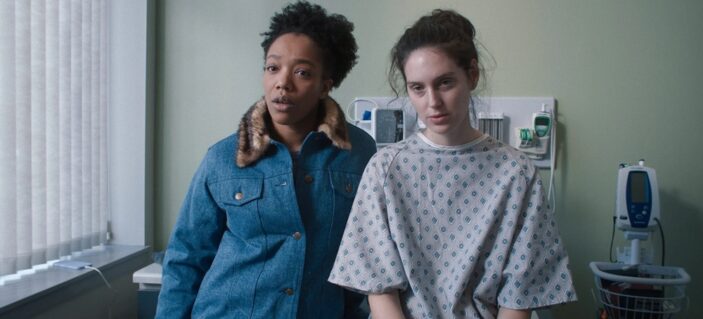
Going off the mention of Lydie, you have Naomi Ackie, Lucas Hedges, Kelly McCormack…
It’s really good!
What was the process of bringing them into this world? And did they influence the way that you saw Agnes’s relationships in any way?
Totally. I mean, finding Naomi was the important part. Arguably, the most important part of making this film. I kept saying that Agnes is the moon and Lydie is the sun, and we needed to find our sun, because without the sun, the film isn’t the film. I remember meeting Naomi, and she was so warm and so funny. I’d seen her in some pretty serious stuff up to that point, and she was so good, (but) I remember being so disarmed by her. She’s so charming. She could have chemistry with a wall. It was astounding. Then we read together, and it was like Agnes just clicked into place.
(Lydie) says this line in the film, and (Naomi) said it when we read together, which is where she’s talking about her baby, and Agnes asks, “Are you scared of the pain?” And she says she is, but that she also wants to make a really good person. And when she said that, it was as of mountains moved for me. I was so lucky that she wanted to do the film. And she made the film so good. Once (she) was locked into place, it was really fun building the rest of the world. Lucas, I wrote him a letter, and I like that (his character is) a little younger than Agnes and that he’s the antidote, but also part of the problem. But he’s also so harmless. It was perfect. And then Kelly taped for the film, and I’d never met her, and I was like, “Who is this?” Really, once the world started happening, it was such a joy. So much of the cast is also these local Boston actors, who really make the world (too).
They really are all incredible. They feel so lived in as characters, which is so important for us watching it. We believe every relationship and person on screen. And before I go, and I don’t know if this is too hard a question to end on, but I love that the film captures the strange poetry of jury duty. If you could be sequestered with any three filmmakers, dead or alive, who do you think they would be?
(Laughs) Fuck my life. Okay. It’s like dream blunt rotations (laughs). Fuck. Can I pull up my phone? This is worth it. I don’t want to fuck this up. I think it would be Wong Kar-wai. Jonathan Glazer. And Michaela Cole. What do you think? I think I want to add like six more people. Was it four or three? I mean, maybe also Elaine May and Brad Bird.
I do know that The Incredibles is in your Letterboxd Top 4, so I get the addition of Brad Bird.
What do you think I’m looking at right now? Actually, everyone who made Shutter Island. I just saw it for the first time, and it’s the best movie I’ve ever seen.
Sorry, Baby is screening in Australian theatres from September 4th, 2025.
