


For all the extraordinary technological advancements that have transformed modern blockbuster filmmaking, there’s something undeniably exhilarating about the knowledge that what we’re watching unfold on screen is actually happening. Not necessarily in the literal sense of the danger being depicted, but in the physical reality of actors responding to environments, movements and moments that haven’t been entirely manufactured through digital effects.
It’s a philosophy that has long informed the filmmaking of Steven Spielberg, a director whose ability to marry extraordinary spectacle with recognisably human emotion has helped define the cinematic blockbuster for more than half a century. Whether it’s the terrifying mechanical unpredictability of Jaws, the overwhelming physicality of Jurassic Park, or the relentless, almost documentary-like intensity of War of the Worlds, Spielberg has consistently understood that the most effective spectacle isn’t simply about what audiences see, but what they believe the characters are genuinely experiencing.
And with Disclosure Day, his latest science-fiction thriller, that commitment to making the extraordinary feel tangible has once again placed his performers in some remarkably demanding situations.
Led by Emily Blunt and Josh O’Connor, alongside Colin Firth, Colman Domingo and Eve Hewson, the film marks Spielberg’s return to the extraterrestrial territory that has fascinated him throughout his career. Conceived as something of a thematic companion to his 1977 masterpiece Close Encounters of the Third Kind, Disclosure Day examines what might happen if humanity were finally confronted with undeniable proof that we are not alone in the universe, and the lengths to which powerful institutions might go to prevent that truth from becoming public knowledge.
Working from a screenplay by longtime collaborator David Koepp, Spielberg places that enormous existential question within the framework of a propulsive conspiracy thriller, following two seemingly ordinary individuals whose mysterious connections to a closely guarded secret place them in the path of forces determined to silence them.
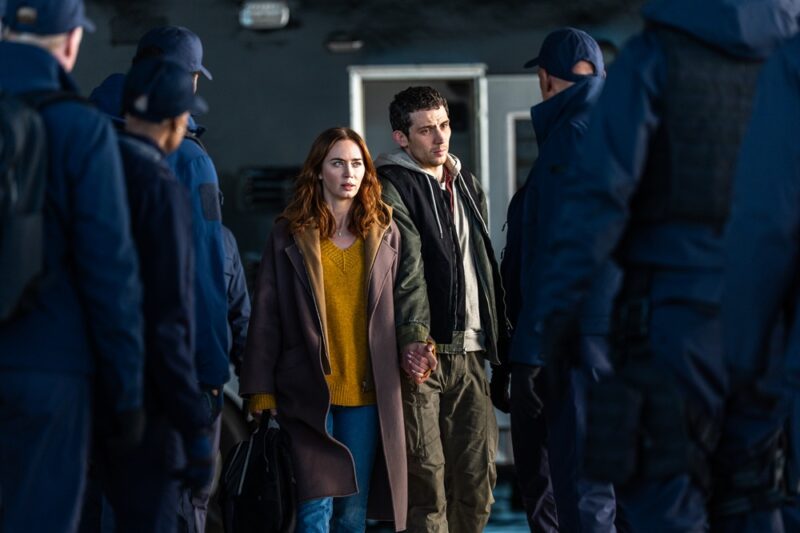
Blunt portrays Margaret Fairchild, a Kansas City television meteorologist whose ambitions extend beyond delivering the weather forecast, only to discover that her connection to an extraordinary truth could make her one of the most consequential people on the planet. O’Connor plays Dr. Daniel Kellner, a cybersecurity expert working within a shadowy organisation responsible for protecting evidence of extraterrestrial visitation.
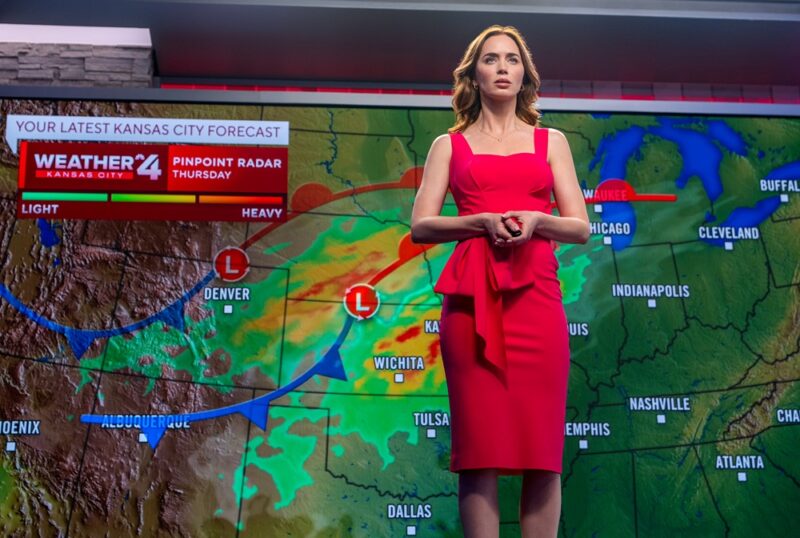
Neither character is particularly equipped for the dangerous circumstances in which they find themselves, and that vulnerability is central to the film’s approach to action. These aren’t invincible heroes confidently navigating impossible situations. They’re frightened, overwhelmed individuals attempting to survive events that continually threaten to spiral beyond their control.
And nowhere is that distinction more apparent than in one of the film’s most elaborate sequences, involving a moving freight train, a violent vehicle collision and an extraordinary commitment to practical filmmaking.
Working alongside longtime cinematographer Janusz Kamiński, Spielberg spent three weeks filming the sequence using an actual moving train, with actor Henry Lloyd-Hughes driving a vehicle involved in the collision. It’s the kind of technically ambitious set-piece that could easily have been constructed through digital environments and visual effects, but instead demanded that the performers engage with a very real sense of physical movement and impact.
During a recent press conference for the film, which our Peter Gray was invited to, we were particularly interested in what that experience meant for Blunt, not simply from the perspective of performing a demanding stunt, but in understanding how the unpredictability of genuine physical action might influence an actor’s emotional response.
After all, there’s a considerable difference between imagining the sensation of an approaching collision and sitting inside a vehicle knowing that an impact is actually coming.
Peter asked Blunt what goes through an actor’s mind in those moments before impact, and whether working within such tangible physical chaos fundamentally changes the way she approaches Margaret’s panic and instinct for survival.
For Blunt, the benefits of that immersion were immediate.
“I mean, physical chaos is always incredibly transporting,” she explained. “Anytime you can be fully immersed in that world, whether it’s a stunt or a beautiful set, I think when you can touch it and there’s something tactile about the world you’re in, it’s so helpful as an actor.”
It’s an observation that speaks to the relationship between performance and environment. While actors are routinely required to respond to circumstances that exist only in their imagination, the presence of something tangible can introduce an entirely different emotional dimension, allowing instinctive reactions to become part of the performance rather than something that must be consciously manufactured.
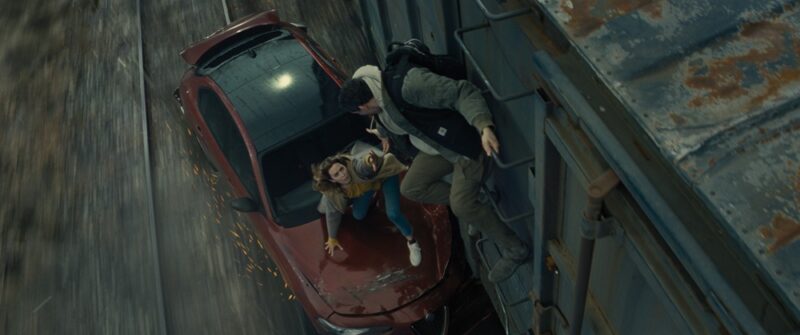
For Blunt, that distinction became particularly apparent when the production subjected her to an actual vehicle impact.
“So we really did get rear-ended by a car, and that was pretty jarring,” she recalled. “And nerve-wracking.”
The uncertainty surrounding the precise moment of collision only heightened the experience.
“I knew I was playing the scene with Josh O’Connor like this, and you know the car’s going to impact you at some point. You’re just not really sure when.”
It’s a wonderfully revealing detail, because it suggests that the tension audiences experience during the sequence isn’t entirely removed from what the actors themselves were feeling.
Although the collision was a planned component of the production, the inability to anticipate its exact moment introduced a genuine element of apprehension. Blunt knew what was going to happen, but not precisely when it would happen, creating an unusual overlap between the actor’s awareness of the filmmaking process and her character’s experience of an increasingly dangerous situation.
And that unpredictability feels particularly appropriate for Margaret, a woman whose ordinary existence has been upended by circumstances she could never reasonably have anticipated.
The film’s action is designed around the vulnerability of people who don’t possess the training, confidence or physical invincibility traditionally associated with blockbuster protagonists. Margaret and Daniel aren’t necessarily making the right decisions under pressure, nor are they expected to emerge from every encounter looking effortlessly composed.
Their fear is part of the spectacle.
It’s a quality Blunt also emphasises in the film’s production notes, describing the train sequence as an example of how Spielberg grounds extraordinary action in recognisable human behaviour.
“Daniel and Margaret are not idealized action heroes, so they are moving through this scene absolutely terrified out of their minds, which is an interesting emotional wrinkle to play.”
That distinction is essential to understanding why Spielberg’s practical approach remains so effective. The physical scale of a sequence might generate excitement, but it’s the emotional credibility of the people caught within it that ultimately gives the spectacle meaning.
When an actor is required to react to something genuinely moving, colliding or threatening to overwhelm their immediate surroundings, there’s an opportunity for the performance to capture an instinctive quality that can be difficult to replicate through imagination alone.
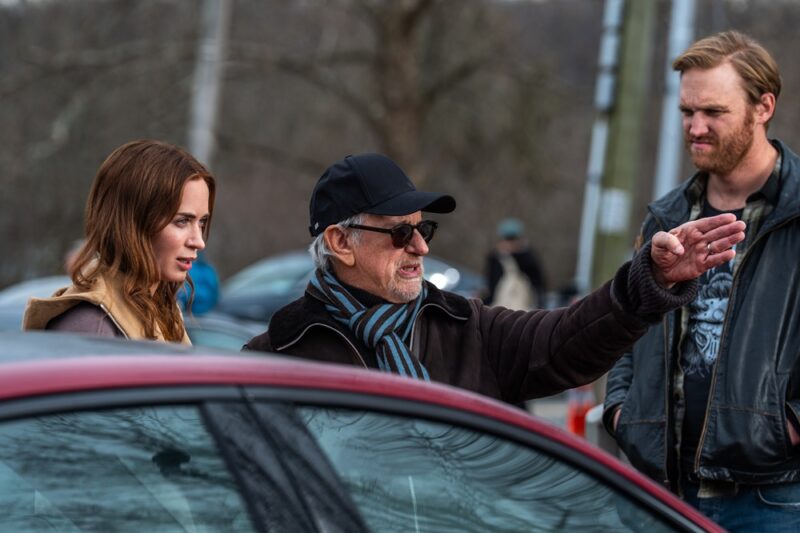
Of course, physical authenticity doesn’t automatically guarantee emotional authenticity. A convincing performance still depends upon an actor’s understanding of their character, their relationships and the circumstances driving their decisions. But the presence of a tangible environment can provide something valuable: an external reality against which those choices can be tested.
For Blunt, whose career has frequently placed her at the intersection of emotionally grounded storytelling and ambitious genre filmmaking, that relationship between physical immersion and psychological credibility is hardly unfamiliar.
From the relentless extraterrestrial warfare of Edge of Tomorrow to the suffocating tension of A Quiet Place, she has repeatedly demonstrated an ability to make extraordinary circumstances feel intimate through the vulnerability of the people experiencing them.
Yet there’s something particularly appealing about seeing that sensibility filtered through Spielberg’s cinematic imagination.
The filmmaker has long demonstrated an affection for ordinary individuals suddenly forced to confront situations that dwarf their understanding of the world. His protagonists are frequently defined less by their ability to control extraordinary events than by the emotional honesty of their responses to them.
It’s an approach that finds a natural home in Disclosure Day, where the discovery of potentially world-altering truths is accompanied by the immediate, very human concern of simply staying alive long enough to understand them.
The train sequence also carries a particularly personal significance for Spielberg himself.
According to the film’s production notes, the director had been considering a variation of the sequence since his early work on Duel, the 1971 thriller in which a motorist finds himself relentlessly pursued by a mysterious truck driver.
While developing additional material for that film’s international theatrical release, Spielberg imagined a sequence in which the pursuing truck would force the protagonist’s vehicle towards a moving freight train.
The train would pass without striking the car, but the idea remained with him.
Decades later, Disclosure Day offered the opportunity to revisit that concept on a considerably more ambitious scale, bringing a long-held piece of cinematic imagination into physical reality.
There’s something rather fitting about that creative full-circle moment, particularly for a filmmaker whose fascination with the mechanics of spectacle stretches back to childhood experiments with toy trains and a Super 8 camera.
What began as a young director’s fascination with orchestrating movement, danger and suspense has evolved into a production of extraordinary technical complexity, yet the underlying instinct remains remarkably consistent: to create an experience that feels immediate, unpredictable and emotionally involving.
For Blunt, however, the appeal of participating in such an elaborate sequence extended beyond its technical execution.
Even after the anxiety of anticipating a genuine collision, she admitted that the opportunity to find herself at the centre of one of Spielberg’s signature action set-pieces carried an excitement all its own.
“I don’t know, just the thought of being in a Steven Spielberg action sequence was so exciting.”
It’s a disarmingly enthusiastic admission from an actor who has already experienced more than her fair share of large-scale cinematic spectacle.
But perhaps that’s the enduring appeal of Spielberg’s filmmaking. Regardless of how sophisticated the technology becomes, or how accustomed audiences grow to increasingly elaborate visual effects, there’s still something uniquely thrilling about the prospect of being swept into one of his carefully orchestrated moments of cinematic chaos.
And while Disclosure Day may be concerned with some of the largest questions imaginable, from humanity’s place in the universe to the potentially devastating consequences of discovering truths we’ve been denied, Blunt’s experience serves as a reminder that its emotional impact ultimately depends upon something considerably more immediate.
A woman sitting inside a car. A collision she knows is coming. The uncertainty of not knowing precisely when.
And the instinctive human response to suddenly finding herself at the mercy of forces beyond her control.
For all the cosmic mysteries Spielberg is preparing to explore, sometimes the most effective way to make audiences believe in the extraordinary is to ensure that, at least for a moment, the fear feels entirely real.
Disclosure Day is now available to rent and/or buy on Digital, On Demand or physically on DVD, Blu-Ray and 4K.
