
In Disclosure Day, Steven Spielberg returns to the skies, but not simply to repeat the wonder of Close Encounters of the Third Kind or the terror of War of the Worlds. This is not an action-centric spectacle, and anyone expecting a relentless alien invasion thriller may be surprised, perhaps even disappointed. Instead, Spielberg has crafted something more searching, more emotional, and ultimately more moving: a sci-fi conspiracy thriller about what happens when the truth is no longer out there, but right in front of us.
Working from a story by Spielberg and a screenplay by David Koepp, Disclosure Day centres on Margaret Fairchild (a phenomenal Emily Blunt), a Kansas City meteorologist who longs for a more meaningful journalistic path. That opportunity arrives in the most terrifying way possible when she discovers she may be connected to secrets that could alter humanity’s understanding of itself. Her path collides with Dr. Daniel Kellner (Josh O’Connor), a cybersecurity expert working for WARDEX, a shadowy agency dedicated to concealing decades of evidence surrounding UAPs, extraterrestrial contact, and the possibility that we have never been alone.
Together, Margaret and Daniel are thrust into a race to expose the truth, pursued by Noah Scanlon (Colin Firth), the autocratic head of WARDEX, who believes disclosure would destabilise the world. But Spielberg and Koepp are not interested in easy villains. Scanlon’s secrecy is monstrous, yes, but it is also rooted in fear, grief, and a paternalistic belief that humanity cannot survive certain truths. That moral tension gives Disclosure Day its pulse. The film is less about whether aliens exist than whether people are emotionally equipped to accept what their existence means.
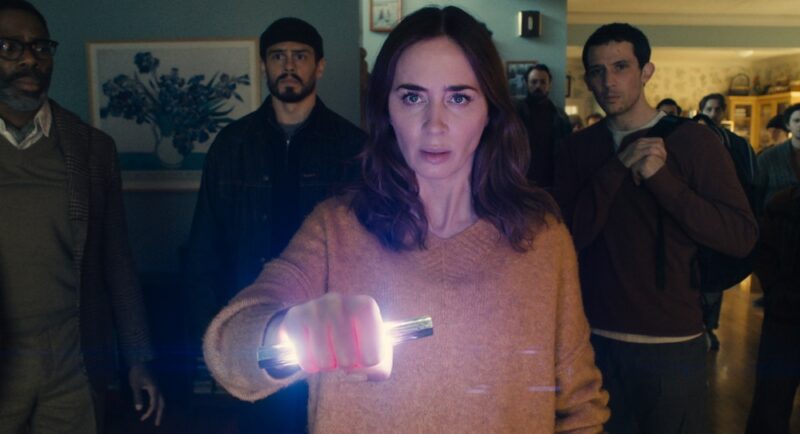
Blunt truly is extraordinary here. Margaret could have easily been written as a standard “ordinary person in extraordinary circumstances” lead, but Blunt gives her texture, humour, terror and resolve. She makes Margaret feel fully alive before the film’s mythology begins to overtake her, and that grounding is essential. Whether she is trying to understand her own fragmented memories, decoding the strangeness of “the device,” or simply surviving one impossible situation after another, Blunt never lets the character become a symbol. She remains human, scared, messy and deeply compelling.
O’Connor is a strong counterbalance, playing Daniel not as a polished action hero but as someone who looks deeply uncomfortable being forced into heroism. His anxious intelligence and wounded interiority make him a natural fit for Spielberg’s world of reluctant believers. His chemistry with Blunt is warm and believable, giving the film an emotional steadiness even when the story moves into increasingly strange terrain.
There is action in Disclosure Day, and some of it is spectacular. A late-film train sequence is pure Spielbergian craft: tense, cleanly staged and thrilling without losing sight of the characters’ panic. But the film is not built around spectacle in the way some audiences may expect. The set-pieces are impressive, yet they serve the emotional and philosophical stakes rather than overwhelming them. Spielberg is more interested in awe than destruction, and more invested in revelation than conquest.
That distinction matters because Disclosure Day leans heavily into the real-world implications of its central question: what would happen if we knew, beyond doubt, that we are not alone? The film treats that idea with seriousness. It considers how governments might suppress it, how institutions might weaponise it, how religious belief might be challenged by it, and how ordinary people might fracture or unite in response. It is a film about disclosure not just as an event, but as an emotional reckoning.
And then, towards the back end of the film, Spielberg delivers a sequence that is genuinely tear-jerking. It will not work for everyone; viewers need to be on board with the film’s open-hearted mentality and its belief in empathy as a world-changing force. But for those tuned into its frequency, the moment lands beautifully. It is sentimental in the Spielberg tradition, but not cheaply so. It feels earned because the film has spent so much time asking what truth costs, and what it might heal.
Disclosure Day is at its best when it allows wonder and fear to sit side by side. Its conspiracy-thriller framework gives the film momentum, but its soul lies in its yearning. Spielberg is asking whether humanity can meet the unknown without immediately turning it into a weapon, a secret, or a threat. In that sense, the film feels like a companion piece to Close Encounters, but one made by an older filmmaker looking at a more fractured world.
Nearly 50 years after he first asked audiences to look up with curiosity, Spielberg does so again. This time, the hope is more bruised, the questions more urgent, and the wonder more complicated. Disclosure Day may not be the alien action movie some expect, but as an emotional, thoughtful and deeply humane sci-fi thriller, it proves Spielberg’s fascination with the cosmos remains one of his most powerful creative instincts.


FOUR STARS (OUT OF FIVE)
Disclosure Day is screening in Australian theatres from June 11th, 2026, before opening in the United States on June 12th.
