

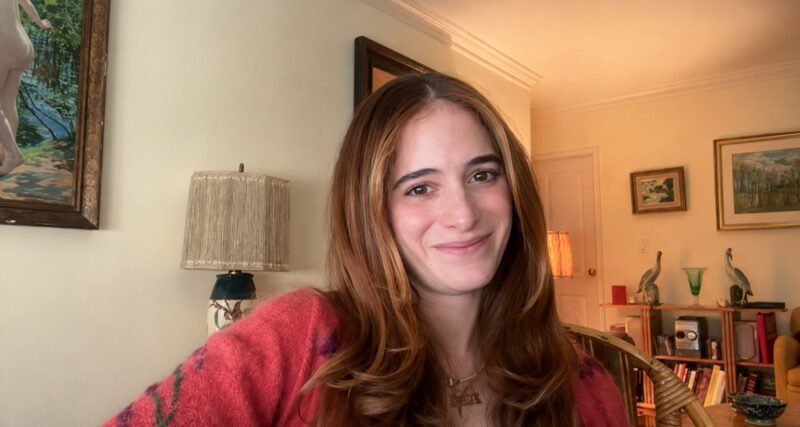
With her feature debut Lucy Schulman, writer, director and star Ellie Sachs has crafted a charming, painfully relatable comedy about the dangers of building your identity around other people. Following a devastating breakup, Lucy returns home to live with her eccentric father and begins the messy process of figuring out who she is when she’s not someone’s girlfriend, fixer, editor, or emotional support system. Equal parts funny, insightful, and deeply empathetic, the film explores self-worth, modern relationships, and the often-overlooked challenge of choosing yourself.
Our Peter Gray spoke with Sachs as the film premieres at this year’s Tribeca Film Festival to discuss the fine line between romance and self-erasure, why Lucy’s heartbreak is really an identity crisis, the surprising tragedy hidden inside comedy, and the uncomfortable truths about love that her younger self might not have been ready to hear.
I wanted to ask about identity and selfhood. You’ve described Lucy’s real problem not as heartbreak, but as losing herself inside someone else’s life. I’m curious, do you think most people recognise when they’re falling in live, but they don’t recognise when they’re slowly disappearing themselves?
Yeah, it’s such a great question, and it’s something that I find endlessly fascinating. I wouldn’t even really know how to answer it. Sometimes, I think that can be so part-and-parcel of falling in love. When people talk about getting married, it’s combining our lives, you know? It’s really baked into culture in a lot of ways. Obviously, as we can, for Lucy, there’s a real negative side to it when you get too enmeshed with somebody and you lose yourself in a big way. It’s something that I see happen a lot, and I find it…inspiring is the wrong word, but I find it an interesting problem.
You’ve written that being “boy crazy” can be a cover for avoiding yourself and your own potential. That’s such a fascinating inversion. Do you think the real coming-of-age story in this film isn’t learning how to love someone else, but it’s learning how to stop using love as a distraction from becoming yourself?
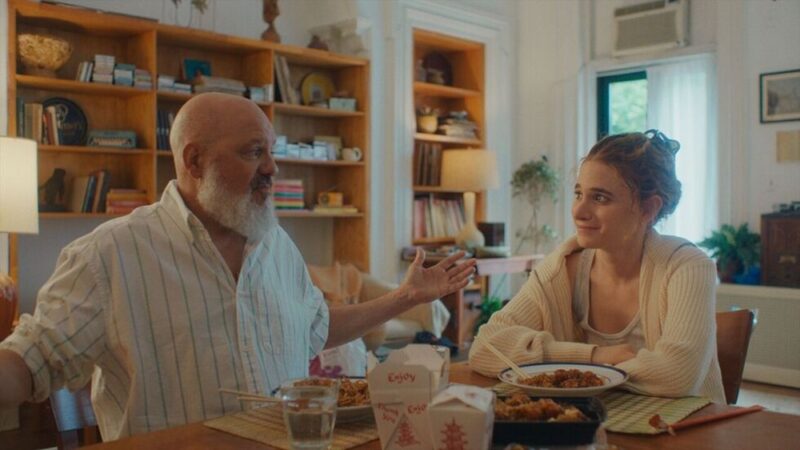
1,000%. That’s exactly what it is. That’s a really nice way of putting it. Yeah, I think (Lucy) just really puts her eggs in other people’s baskets. She’s avoiding herself in a really big way. Not to jump topics, but I think that one of the things about the film is her relationship with her dad. That’s really the first time we learn about how to love and what love is…we learn from our family. She has a pretty unique family unit where it’s just her and her dad, and he’s everything for her. It’s a little monkey-see-monkey-do. The apple doesn’t fall far from the tree. And it’s a problem.
But it’s also very sweet and funny and idiosyncratic. I just wanted to be mindful about painting a picture of this unique girl with this interesting story, and I think, in a way, a lot of people do this, where they lose themselves in relationships. But I wanted to create an interesting pathology for Lucy. How exactly did we get her here?
Lucy spends so much of the film trying to be chosen. At what point did you realise the story wasn’t actually about finding the right person, but becoming capable of choosing herself?
Yes, I think that was the thing that I wanted to really do. As I was embarking on writing the film, I think I had this stuff with her friends and her family and the guys pretty locked in from early on. But the thing that I added, and I’m hopeful that it helps tell the story and illustrate it, is the whole through-line with work. She’s got this dead-end job at this shitty bookstore, Sandrine (Holt) is wonderful, and so mean (as my boss), it’s chilling. And then there’s Eisa Davis, who plays AJ, who’s this celebrated, cool author, and she says, “Lucy, you’ve worked here for a long time…like, what’s your deal, girl?”
I’m hopeful that it’s an effective storyline in showing this self-abandonment. One of the first things we learn about Lucy is when Hasan Minhaj’s character says to her, “I love all these additions in this speech, it’s like I have my own little editor.”
That moment you mentioned, where she’s editing his sexts…it was one of those jokes that’s delivered so naturally and so beautifully. It’s so funny. It made me think how writing comedy is difficult, and everything’s got to be so methodical and thought out, but delivered so casually, almost flippantly. Is that difficult to write something that has to seem so impulsive?
I love that question. Yeah. I’m very much a novice at this. I’m still learning. But I think that one of the most important things about comedy is if the character thinks it’s funny, it stops being funny, right? So Lucy, the line between drama and comedy, in tragedy and comedies, is a very thin line. I hope that first scene does that. Like, it’s tragic, but what’s happening is also really fucking funny. Lucy doesn’t know it’s funny, and I think that her response and how serious and methodical she is, (and) asking all these weird questions, she’s trying to parse through it. I think that the comedy comes from how seriously she takes the situation, and how she doesn’t realise that it’s funny yet.
Looking at that relationship, the feels incredibly contemporary. Not because of the apps or social media, but it’s Lucy struggling with something a lot of experience now, which is building an identity when there are endless versions of who you could become. Do you think modern adulthood as made self-definition harder?
Totally. I love that question. I don’t know if Lucy has that exact problem, but I do think that’s very much in the water right now. I think for Lucy, her crime here is that she knows she wants to be an editor, she knows she wants to work at a fancy publishing house, and she’s just not doing it, because it’s easier to maybe organise her boyfriend’s art supplies, or punch up her other boyfriend’s speech, or, you know, just sort of fuck off and not do what she’s supposed to do. I think she knows what she wants. She does not go after it.
You’re writing, directing, and starring in a story that is clearly asking some uncomfortable questions about yourself. Were there moments where the writer in you wanted to be brutally honest, but then the actor and director wanted to soften the edges? Or vice versa?
Lucy’s not me. This is very much a character, and I just went for it. I think I did her pretty dirty, in a good way.
You’ve said that this is the film you wish you saw in your early 20s. What scene do you think that 22-year-old Ellie would have resisted the most, because it was the truth that she wasn’t ready to hear yet?
I think it’s the sequence when Lucy’s shopping with her best friend for the bridal shower, and then the girls go for lunch and she skips out on lunch to go cook dinner for her boyfriend and his friends. She ditches her friends and her life and her interests in the process. That’s a thing that I haven’t seen a lot of. I’m hopeful that I’ve touched on something that maybe we haven’t seen a ton of. I think that if I had seen that at 24 I might have been, like, “Oh, she shouldn’t do that. Maybe I shouldn’t do that.”
The film challenges the famous Barbara Streisand idea that “people who need people are the luckiest people.” After living with this story for so long, do you think maturity is learning that love isn’t about finding someone who completes you, it’s more about finding someone who doesn’t require you to become less of yourself?
Yeah, definitely. I think that the ultimate test in love is can you be in a partnership with somebody else and still retain all of the things that make you you? I think that’s probably what real, true love is. I think when we meet Lucy she’s not capable of that, but by the end of the movie, she’s hopefully a little closer to that.
And I imagine many women will see themselves in Lucy. I wonder whether you also do hope that men leave the film with a different understanding of the emotional labor and self-erasure some women perform inside relationships? Is that something you’ve thought about at all?
You know? No (laughs). But a few people have asked me that, and I am really curious to see. I tested the movie with mostly young women. I’ll be really curious to see how men react to the film. Not a ton of guys have seen it yet.
Lucy Schulman is screening as part of this year’s Tribeca Film Festival, running between June 3rd and 14th, 2026. For more information on the festival, head to the official site here.
