

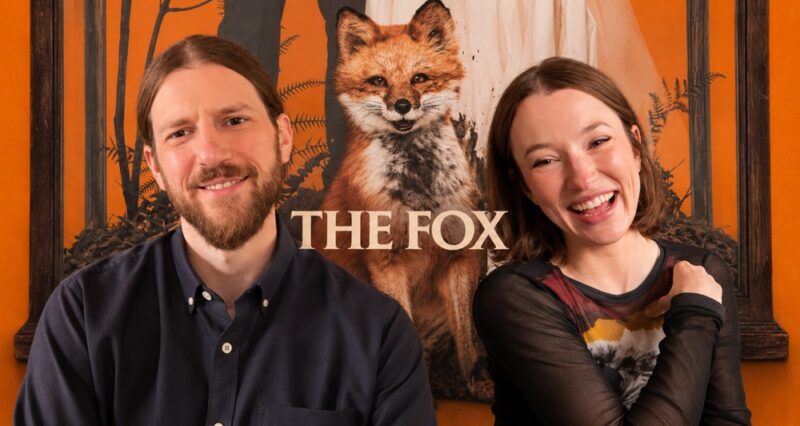
What if the greatest obstacle to finding happiness in a relationship isn’t the person you’re with, but your own unwillingness to confront who you are? In writer/director Dario Russo‘s wickedly absurd Australian dark comedy The Fox, the pursuit of romantic perfection becomes a deliciously twisted examination of self-delusion, social conformity and the lengths we’ll go to avoid doing the difficult work of looking inward.
When affable heir to a wealthy rural landowner Nick (Jai Courtney) discovers his fiancée, Kori (Emily Browning), is cheating on him, salvation seemingly arrives in the form of a talking fox (voiced by Olivia Colman), who offers him an unconventional solution: push Kori into a magical hole and she’ll emerge as the perfect partner. Naturally, getting exactly what he wishes for proves considerably more problematic than the relationship he was trying to save.
Beneath its surrealist humour and gleefully questionable morality, however, The Fox is interested in something far more recognisably human. Speaking with our Peter Gray ahead of the film’s theatrical release, Russo and Browning reflected on the frightening nature of genuine self-examination, the liberation of playing women unconcerned with their own likeability, the conflict between individuality and social acceptance, and why the freedom to define happiness on our own terms can sometimes be more terrifying than the conventions that keep us miserable.
One of the things that I wanted to ask first is about the idea that we can convince ourselves we’d be happier if our partner just changed a few things about themselves. When Nick is effectively offered that perfect version of Kori, it becomes quite horrifying. I wondered whether you, Dario, see the tragedy of their relationship as Nick not really loving Kori for who she is, but loving the idea of who she could become? And Emily, did you feel Kori was equally guilty of falling in love with an idea rather than an actual person?
Emily Browning: That’s a good question. You go first, Dario, and then I’ll have time to think.
Dario Russo: Ideally, this is a story about people who are all in a state of self-denial, one way or another. I think the only person in the entire narrative who’s telling the truth, or has the wherewithal to understand their own situation, is Kori’s dad. Everyone is kidding themselves. Everyone’s fucked in the head, and they have sold themselves on a version of reality that allows them to justify their situation. I think when we start the story, Nick and Kori are in that position.
Emily Browning: Yeah, and I think yes, for Kori, I imagine she’s going along with the story that she’s been told. This is what you do on paper. This guy’s great. He’s the ideal Aussie man, you know? You see it in real time in the opening of the film. She’s proposed to, and it’s so clear she wants to say no, and she just says yes because it’s what you do. I think she is equally guilty of deluding herself. However, she’s doesn’t push him in a hole (laughs), so I don’t know if she’s quite as guilty.
One of the things that I really appreciated about Kori is that the film isn’t interested in making her likeable all the time, or it’s not asking us to excuse her behaviour. She’s a bit selfish. She’s a bit dissatisfied. But that’s so recognisably human. As an actor, is there something liberating about playing a woman whose contradictions don’t need to be softened for the audience?
Emily Browning: Yeah, absolutely. I would go as far as to say that when I am playing a character who is expected to be likeable, I don’t really enjoy myself. And that’s not something I want to be concerned with at all. Maybe because in my own life I am deeply conditioned to try and be likeable, because I’ve grown up in the film industry and because I’m a woman. It is my favourite thing to do. I’ve definitely played some really unlikeable characters, and I don’t think Kori is one of them. She’s flawed. It’s great.
It is one of those things where because in comparison to Jai’s character you seem a lot worse, but, as you said, you didn’t push him into a hole. And Jai gets away with it because you look at him and think, “Oh, Jai.”
Dario Russo: Jai did a magic trick with the character. He should be absolutely reprehensible. He’s this dude who chucks his fiancé in a hole and then doubles down on it, yet you like him the whole time. And that’s all Jai Courtney. That’s not my writing. There’s no accounting for charisma. Every cult leader in the world has depended on charisma to sell people on their fucking cradle (laughs).
Emily Browning: Yeah, I wouldn’t be organised enough to run a cult.
Dario Russo: No, I know exactly. He doesn’t have the spreadsheet skills (laughs). But I think that goes for just about the whole cast. Everybody in this story is doing something unlikable in one way or another, and yet you’re with them and you want to see more of them. Claudia Doumit’s character, Diana, is kind of evil in a lot of ways, but she’s one of the most energetic, hilarious presences in the story. When you’re putting a movie together, hopefully you write something that makes sense, and then you pick people who the audience want to look at the whole time, who do all these things in interesting and charismatic ways. I feel very lucky that I ended up with a whole squad of people who did exactly that.
And one of the ideas I took away from the film is that these characters are constantly looking for an external solution to an internal problem. They change partners, they pursue excitement, they literally try to replace people. Nobody seems particularly interested in confronting themselves. I wondered whether underneath all the absurdity, do you both see The Fox as a story about how frightening genuine self-examination can be?
Emily Browning: I hadn’t before, but I’m going to use that in my answers now.
Dario Russo: Yeah, but it is terrifying, and I think, unfortunately, most people experience exactly this crisis in their lives. You find yourself in a place, possibly midlife or even earlier, where you don’t quite understand how you’ve arrived at these conditions, and it’s more painful to do the internal work required to get yourself to a place you’d rather be. Instead, you start meddling with the people around you and your external circumstances. So I think it’s a highly relatable condition.
Emily Browning: And especially because there are levels to it. Jai’s character is maybe not even aware that he needs to change something about himself or fix shit internally. Kori, I think, is aware, but she can’t, and I think that’s really human as well. It’s like, “I know what the problem with me is, but I’m not really willing to do the scary work of fixing it, so I’ll just say yes when I want to say no.”
Looking at the horror of getting what you asked for, Dario, what’s quite deliciously cruel about the wish Nick is granted is that the reality of having it fulfilled is worse than the problem he’s trying to solve. I wondered whether you find something inherently funny about human beings so convinced they know what will make them happy, only to discover they have no idea?
Dario Russo: Yeah, absolutely. That’s funny. I mean, it’s the ultimate schadenfreude, right? You make somebody make a lot of really stupid decisions in a story and then watch as the consequences unfold. Nick only wants these things for reasons that are based on self-delusion. If he wanted things based on some kind of truth about what was actually right for Kori in that situation, and he actually cared about her as a human being, then it would’ve been okay. But no, he didn’t do any of those things, and that’s the comedy. Otherwise, it wouldn’t be a very funny movie if they just broke up, or if Kori just said no to the proposal. The credits roll, and that’s it. It’s a four-minute movie.
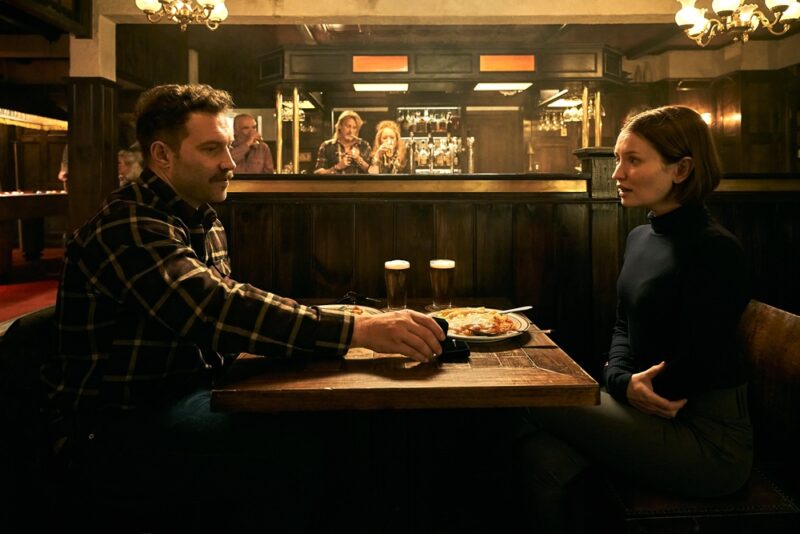
One of the things that fascinated me about Kori is that you’re effectively playing someone who is being impersonated, but that impersonation is in many ways more expressive and uninhibited than the original Kori. Did that change allow you to explore qualities that the “real” Kori might secretly possess, but would never give herself permission to express?
Emily Browning: Yeah, that’s interesting because I also think it’s funny that the Fox is trying to impersonate Kori, and yet she doesn’t try that hard. Even that moment at the pub where Nick’s like, “She’s a fox, Dad,” and then he’s like, “Is this true, Kor?” And she’s like, “Yeah, pretty much. I’m here now. What are you gonna do?” Obviously, the Fox is a manipulator and she’s kind of fucking up these people’s lives, but she’s also this embodiment of everything that women aren’t really allowed to be. So I do wonder if Kori was less trapped by her desire to go along with the conventions of her society and her town, maybe she would be a little bit more like Fox Kori (laughs). On the durries and the pokies (laughs).
It made me think about if the film is secretly about conformity? Because one of the things that I loved about this world that you’ve created is that talking animals are completely normalized. I wondered whether there’s a little satire of small town conformity in that idea, where something objectively horrifying becomes acceptable simply because everybody agreed not to question it?
Dario Russo: I don’t think it’s even small-town conformity. I think it’s broad, sweeping cultural conformity. I think many of us fight the battle of individuality versus acceptance in society, because often they can be at odds with each other. I often find myself at odds with Australian mainstream culture in general. I’m not into footy, and there’s no shade on anybody who likes it because it’s a huge cultural force in this country, but I always feel very alienated when I’m not there screaming as well.
I don’t like most of my local pubs. That’s why we had to build one in the movie, because in my work, like Danger 5 and this, I’m forever building my ideal bar and pub. There’s one in every episode of Danger 5, and now there’s one in the movie. I’m always trying to construct that place that I want.
So I think the issues of conformity and social identity, and what you have to do in order to feel like you belong in a place, are very relevant to the story. Not just on a rural level. It’s just that often the smaller the setting, the more concentrated those issues become for people. I guess the more immediate they become.
And something I kept coming back to is that these characters seem torn between two completely contradictory desires. They want the comfort of being loved unconditionally, but they also want the excitement of never having to answer to anybody. Dario, do you think those desires are fundamentally compatible, or is the tragedy that these people simply haven’t learned how to reconcile them? And Emily, do you feel Kori was frightened of the freedom she thought she wanted?
Dario Russo: Yeah, no, I do think anybody who has experienced long-term monogamy, especially if you’ve been a young person going through that, is familiar with the conflict between the need for spontaneity, excitement and adventure, and the need for security, comfort and the meaningful, deeper relationship that comes with being with somebody for a long time. Depending on your ability to communicate with your significant other, and also your own sense of responsibility and obligation – and obligation is a complicated issue in a relationship – those two things can be at odds with each other.
But I don’t think they’re forces that always lead to destruction. I think communication is the key component, and two people who really talk honestly about their needs can make things work, no matter who needs what. But then you get into a situation where nobody talks about anything, like our couple at the beginning of the movie…
Emily Browning: Yeah, I think the question of being afraid of freedom is interesting, because to go against the grain, to actually choose to move outside of the conventions and the steps along the way that you’ve been told are correct, it’s hard work. If you don’t follow the regular, expected pattern, you have to come up with your own pattern, and that’s a lot of work to do.
Sometimes it just feels a little bit easier to be like, “Ah, whatever. I guess I’ll just do this because the alternative is that I have to work really hard to create my own thing, and fuck, that seems like a lot.” And it’s scary. Even if you’re not happy in your relationship, sometimes it’s scarier to be alone, you know?
Dario Russo: Somebody described this movie as hetero-pessimism the other day…
Emily Browning: And someone else said hetero-fatalism (laughs).
Dario Russo: I also wanted to talk about the fact that, yes, this story is told from the perspective of heterosexual couples, but it’s not designed to discredit any other kind of sexuality, nor is it supposed to discredit any other form of relationship structure. Polyamory exists, and many people would be like, “What are they doing? There are easy fixes to these problems.” But for some people, that’s not a very easy thing to do. Hopefully, the movie has something to say about these relationship dynamics that can transcend the boundaries of sexuality.
Emily Browning: When you’re heterosexual, you’re naturally in this group where you’re told, “This is what the relationship model is.” I feel like for people of different sexualities, you’re already in a place where it’s easier to ask, “What do I want this to look like? I already don’t fit into the convention, so I don’t need to conform as much.”
The Fox is screening in Australian theatres from November 26th, 2026, before opening in the United States on December 4th.
