

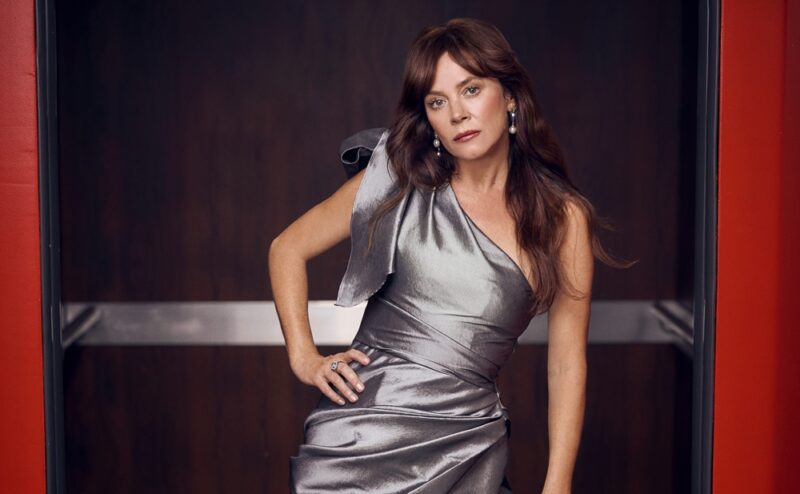
When lives are on the line, there’s little room for hesitation. Stan’s new Australian drama The F Ward throws audiences into the chaotic reality of Sydney’s underfunded Pines Hospital, where a group of failed medical interns are handed one final opportunity to prove they deserve to become doctors. Battling impossible workloads, life-or-death emergencies and the emotional baggage that derailed their first attempt at medicine, they’re forced to learn on the job under the watchful eye of formidable head of surgery Dr Gloria Wall.
Played by Anna Friel, Gloria is a mentor who demands excellence above all else. She’s uncompromising, intimidating and unashamedly blunt, but beneath her hardened exterior lies a woman shaped by her own mistakes and determined to ensure her interns don’t repeat them. As the series explores redemption, resilience and the cost of working within a struggling public health system, it continually asks whether toughness and compassion can coexist.
Ahead of The F Ward‘s premiere, Peter Gray spoke with Friel about portraying such a divisive character, why Gloria believes accountability matters more than popularity, the challenge of mastering complex surgical procedures, and why she believes Australian television is setting the benchmark for the rest of the world.
There’s a line in the first episode where Gloria says, “This isn’t a safe space. It’s a hospital.” It’s such an ironic line, and it’s confronting because I feel like we’ve become so used to talking about workspaces as needing to feel safe. Do you think Gloria believes emotional safety can actually be dangerous if it gets in the way of accountability?
That’s such a good question. It’s something I was talking about today, because I think we’re all now investing in a safe work place, and I think from Gloria’s perspective, she’s saying there’s no room for that here. We’ve barely got enough money to save people’s lives, so if you can’t be tough enough to survive this environment, then don’t be here. It’s a matter of life and death. I think it’s factual. It’s not her not caring about people’s mental health or well-being. It’s a matter of practicality and having a degree of common sense. As the person who talks about it being a safe space, you will see what happens in the way she conducts herself, and whether Gloria was right to point that out, and what was perhaps she seeing that the audience might not at that point. Of course, I think we should all expect a safe space in work. It’s always been the case. It isn’t necessarily the case in so many environments that exist today, but we’re all hopefully working towards a communal safe space.
I feel like a lot of people will call Gloria tough because she doesn’t spend time trying to be liked. She spends all of her energy trying to make these interns into doctors. Did you come to see her as a compassionate character who’s mistaken for being cold, or do you think she consciously sacrifices being liked because patients ultimately benefit from it?
I so love you asking these questions. So, I was like, “Fuck! Is she just an absolute bitch? She’s so hard.” And being the oldest member of the cast when you’re surrounded by these wonderful actors of my daughter’s age, who has just turned 21, some of the things she comes out with are absolutely outrageous. But it’s the character; it’s not Anna. You have to watch the series and judge at the end of it, was she too harsh? I think they’re the questions that Kelsey (Munro), the writer, has begged the audience to ask. I’m really glad that you’re asking that. At some point, I did have to apologise for how horrible she is (laughs), but I think we also can’t play characters that are always the hero. As it unfolds, does she deserve a comeuppance? Does she get a comeuppance? That’s for the audience to ask and answer.
I feel like the series is very much built on second chances, and Gloria has built an entire program believing people deserve another opportunity, yet she seems much harsher on herself than anyone else. Why do you think she’s so much better at forgiving everyone else except herself?
She’s been there and done that. She’s been called out herself, and she’s learned from it. As the story unfolds, you understand what happened to her and why she is the way she is. Has it given her a thicker skin? Absolutely. But it’s also because she knows this environment is incredibly tough – it’s survival of the fittest. These are doctors who’ve all been given a second chance, and she’s basically saying, “Don’t mess it up.” Nobody’s perfect. We have to create a safe space where people can make mistakes and, more importantly, learn from them. We’re not born perfect. Surely the journey of life is making mistakes, hopefully not too many, and finding redemption by learning from them.
She’s also reminding them that this isn’t one of the world’s best-equipped hospitals. They’re working in a place where there isn’t always enough electricity, where sometimes they don’t even have the machines they need to save people. I remember asking Kelsey, “Surely places like this don’t really exist?” And she said, “Oh yes, they do.” If you’re a patient, all you care about is someone saving your life. This is the only hospital you’ve got. So Gloria’s philosophy is to choose your battles. Not everything can become a problem, because life isn’t perfect. It’s difficult.
And Gloria has spent all these years fighting this very patriarchal surgical culture, and then she suddenly catches herself wondering whether she’s become another Geoffrey (Jeremy Sims’ character), this shady star surgeon. I found that kind of terrifying, because it feels like something that can happen to anyone in a position of authority. What interested you about exploring that kind of fear?
Well, as someone who was a child actress, I’ve been through a lot of challenges. Whether you choose to talk about them publicly or not, you still learn from them. Now, as an actress in my adult years – I turned 50 on Sunday – I’m constantly playing mothers or people in positions of authority, and behind the scenes it’s always about protecting the younger actors.
There are things I went through that I would never want my daughter, or anyone else, to experience. It’s about protection, sharing those lessons, and asking the right questions: “How was that? What happened? What did you do?”
I don’t think we can make blanket statements about any industry because it all comes down to the individual workplace. But it’s tough out there. People are competing for jobs, and we have to make sure we’re able to stand up for ourselves and say, “No, this isn’t okay.” It may have been accepted once, but things have changed.
At the same time, it’s important to recognise what did work. I’m Gen X – I was born in 1976 – and there are aspects of how we worked that were valuable. I think that’s why younger generations are so fascinated by the ’90s, watching shows set in or made during that era. There was a real sense of camaraderie. There was no social media, none of the constant scrutiny that comes with it now.
It wasn’t necessarily survival of the fittest. There were simply more opportunities back then. It’s such a huge topic – I could talk about it for hours – and I think it’s one of the many themes this series explores so well.
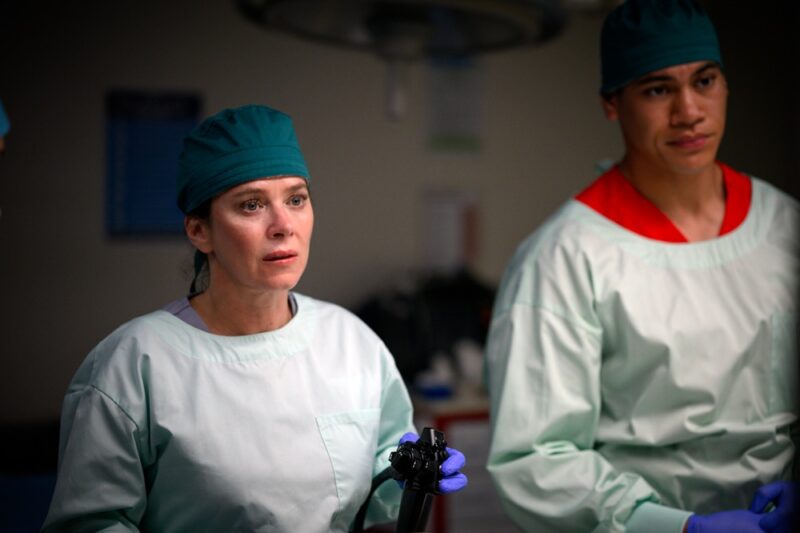
I know you’ve spoken about learning surgery was almost like choreography. Once you start performing those scenes, do you find yourself thinking less like an actor delivering dialogue, and more like a musician trying to keep rhythm under pressure?
The most shocking thing was performing an operation I’d actually had myself. I was able to call my surgeon and ask, “Oh my God, did that really happen to me?” You don’t realise how incredibly fast everything is because time is of the essence. We worked with real surgeons on set, and even while filming they kept reminding us how quickly everything happens. They’d say, “Australian television moves so fast!” We were constantly jumping from one scene to the next while trying to learn these incredibly complex procedures.
Sometimes we’d be practising with nothing more than a tennis ball and a few sausages, which sounds pretty basic, but it gave me enormous empathy and respect for the surgeons who save lives every day under that kind of pressure. If we couldn’t get it right with sausages and tennis balls, imagine doing it on a real patient. They’d constantly correct us: “Hold that steadier.” I also learned that, especially during endoscopic surgery, you’re not actually looking at the patient’s body – you’re looking at the screen the entire time.
But the biggest challenge, by far, was the medical dialogue. I’ve played lawyers, I’ve done Shakespeare, and I’ve had to memorise some incredibly demanding scripts over the years, but medical terminology is easily the hardest language I’ve ever had to learn. After every long shooting day I’d go home and study for another three or four hours. I barely saw any of Australia because we filmed almost entirely in the studio. Apart from one trip to the Northern Beaches, I was completely immersed in learning the scripts. I’d wanted to come to Australia my whole life, and I deliberately waited until I had a job here because I wanted to experience the culture through the people I was working with.
We only had Saturdays and Sundays off, and one of those days was always dedicated to learning the next week’s dialogue. My brother is a doctor and my sister-in-law is a consultant radiologist, so before filming I’d get them to read through all the medical dialogue with me. I don’t think you can convincingly say words you don’t understand.
It was an enormous amount of learning in a very short space of time, and I just hope surgeons aren’t embarrassed by what we’ve done.
As you mentioned before about wanting to see the Northern Beaches, we obviously get scenes of you and the lovely Jimmy, played by Ioane Sa’ula…
He’s brilliant – an incredible discovery. By the time I arrived, everyone had already been shooting for about three weeks, and all I kept hearing was, “He’s such a lovely man.” So I was expecting that because the word had spread around the set. Ioane really is a lovely man, and visually he’s quite something to behold. But beyond that, he’s a wonderful actor – very delicate, very nuanced, with a real complexity to his performances. I genuinely think he’s one of Australia’s next big discoveries, if I was to hedge a bet.
As a proud gay man, I was like, “Gloria, when it comes to Jimmy, I get it!” But what I found interesting wasn’t whether Gloria loved Jimmy, but whether she resented herself for being vulnerable. Was that the emotional conflict you were playing with?
Yeah, and I think because there have been so many conversations around relationships between older women and younger men, I didn’t want that to become the focus. I was joking, “She’s not a MILF… she’d be a cougar, wouldn’t she?” and thinking, “I’m not sure how comfortable I feel about this.”
But Kelsey said, “Men have been doing this with younger women forever.” My immediate reaction was, “But what about the power imbalance? Is she abusing that?” And that’s certainly how some of the other doctors would view the relationship.
As the story unfolds, though, you realise it’s much deeper than that. They connect on a soul level. They find common ground and a real sense of understanding. Neither of them gets caught up in the hospital drama, and there’s a natural affinity between them, alongside a very strong sexual attraction.
It’s just so great to see an Australian show like this, and Stan makes such incredible Australian shows.
I loved Bump. That’s really what sold me on it in the first place. I watched Kelsey’s work and thought, “Oh, this is so great.” Right now, I honestly think Australia is dominating Hollywood. So many of the great actors and actresses are Australian, and I think that’s down to an incredible work ethic and this constant drive to keep getting better.
Setting a hospital drama against the backdrop of the beautiful Northern Beaches also gives the show something unique. We just don’t have that in England. Even in places like Italy or Spain you get more of that lifestyle than we do, unless you’re living somewhere like Brighton.
There’s something really special about combining the intensity of a hospital drama with that stunning coastal setting. I think that’s one of the reasons Australian shows have captured audiences in England so successfully.
It’s not too heavy. It’s not too loaded. You can sit back and watch something that’s visually bright. It’s got character. It’s full of really wonderful actors. I think it’s just a really lovely, entertaining, sweet show.
The F Ward is available to stream on Stan Australia from July 17th, 2026.
