

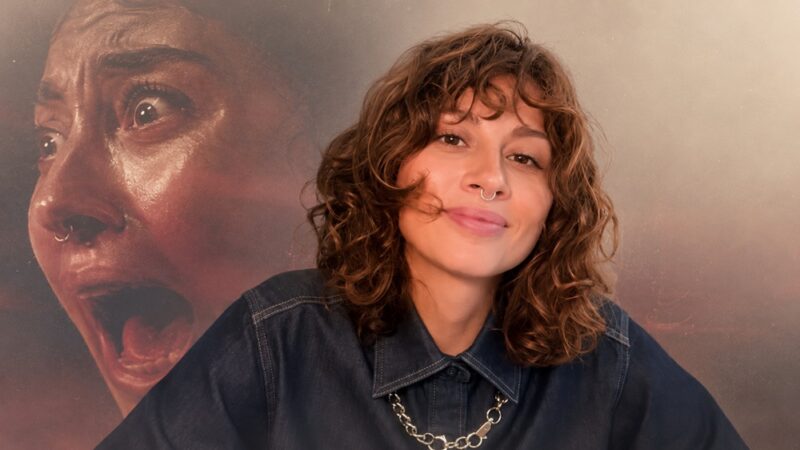
Pregnancy has long been fertile ground for horror cinema, but Son of Sara transforms familiar fears into something far more intimate. As Sara, a woman whose increasingly disturbing cravings coincide with the return of her estranged boyfriend and the terrifying possibility that something sinister is growing inside her, Chloe Van Landschoot delivers a performance that is as emotionally raw as it is physically fearless.
Drawing on her background in healthcare and embracing the film’s unflinching body horror, Van Landschoot committed wholeheartedly to portraying a woman whose own body becomes both prison and battleground. Speaking with our Peter Gray, the actor discusses finding truth in the grotesque, surrendering to the demands of horror, and why the genre continues to offer women some of its most daring and uncompromising roles.
One of the things that I found fascinating about Son of Sara is that Sara’s body almost becomes a second character. At what point in your preparation did you stop thinking about acting pregnant and start thinking about portraying someone whose own body is betraying her?
Yeah, that was a huge part of my preparation, and it’s typically how I work as an actor. I’m a very sensorial, instinctual performer, and I come from a strong dance background, so a lot of my world-building starts with this vessel – my body. That’s why I was so excited about this character, because that’s exactly what the film is about. It’s about a body betraying someone and becoming a vessel, and that’s what pregnancy is. Being able to explore that physically and find it within my own body was really exciting.
I’ve never been pregnant, so I didn’t have that personal experience to draw from. But I have pregnant friends, and I worked in healthcare for a long time, so I’d been around a lot of very sick pregnant people. I had plenty to observe in the world around me.
I actually asked for the pregnancy belly – it was this giant prosthetic you basically wore like a pair of pants – and I walked around my city wearing it for about a week. I wanted to see how people treated pregnant people. Most of the time, people were incredibly kind. Someone even gave up their seat for me on public transport.
People also wanted to touch my belly, which felt really invasive. I’d have to say, ‘No, don’t touch it. It’s not real, and you’ll know straight away.’ Then I’d feel guilty for denying them, which created this really interesting psychology. I was pretending, but at the same time it was starting to feel real to me.
I also worked on developing the way she walked- the waddle, how she sat down, what it felt like to get into bed or stand up again with this huge apparatus strapped to me. All of that physicality was going to inform who she was, and then what happened when her own body started turning against her.
Houston (Bone, writer/director) and I mapped out exactly when that shift would begin. Interestingly, I built her emotional journey based on the script as written, but the final edit approaches it a little differently. We hit the ground running. Within the first ten minutes she’s coughing up a hairball and a blood clot, and I remember thinking, ‘Okay… we’re doing this.’
But honestly, every pregnant person I’ve spoken to describes pregnancy in similar terms. You become a vessel. There’s this little parasite inside you that’s constantly taking from you, and it completely dictates what your body does. Grounding myself in that reality is what kept the performance truthful. Then, because we’d already done so much workshopping of the physicality beforehand, I could simply arrive on set and let her rip.
I feel like pain is notoriously difficult to perform, because audiences know what fake pain looks like. What conversations did you have with yourself about showing pain versus resisting it? Because Sara spends so much of the film trying to function, despite what she’s experiencing…
Yeah, totally. I actually think pain and pleasure exist on a very thin line. Even the way you breathe when you’re experiencing pleasure has a lot of parallels with how you breathe when you’re in pain.
As a person, I’ve experienced both, so for me it was about figuring out where Sara sat on that spectrum. What does a 12-out-of-10 feel like for her? What’s her baseline? Where is she in each scene in terms of her pain, discomfort or even pleasure? And where do those sensations start to blur together and become something new? I wanted to create a different physical texture for her.
A lot of that preparation came through breathing. I also worked in healthcare, so I’ve cared for people in excruciating pain. When you really tune into those experiences, your body remembers those sensations, because everyone has experienced both pain and pleasure.
As an actor, it’s then your job to decide just how much you’re going to turn those sensations up.
I feel like there’s a point where horror performances stop being about reacting to monsters and become about convincing us something impossible is happening inside you. How did you find a physical language for something that has no real world reference point?
Yeah, I think a lot of it was about tuning inward. During my preparation, there were a few intellectual, more cerebral things I worked out first – what her attachment style was, what her parents were like, what her relationship with herself was. Does she have high self-esteem or low self-esteem? Does she hate herself?
Once I had those answers, the rest was really about listening to my body – paying attention to how it reacted as I read the script, making notes, and getting in touch with that subliminal place you can enter when you’re in extreme pain or extreme pleasure. That’s where Sara spends most of the film – mostly in extreme pain.
You’re no longer really thinking when you’re in those places. So for me, a lot of the work was about entering a kind of meditative state so I could access that.
One of the things that fascinated me was the voice, because it’s not that Sara is exhausted. It’s almost as though something else is beginng to influence the way she speaks. Was that something you consciously built? Or did that emerge from the physicality of the performance?
Yeah, I mean, I think your body has access to that. We all do, if you spend the time doing the work to let it live. I think a lot of the time, as humans, we spend so much energy trying to hide it, trying to put it away, like, “That has no place here.” But then, all right, I’m shooting a horror film where this woman is about to give birth to the spawn of Satan, so we’ve got to have access to this ancestral shit that lives in me.
So yeah, I mean, being tied up in the barn for four days definitely helped (laughs). It let me just become a nerve ending and let it all out. But yeah, I mean, I think I’m a pretty… not pent-up person, but there’s a lot going on in here, and I play a lot of contained characters. So to play someone like Sarah, and to let myself have full access to that kind of ancestral wail and experience, was… yeah, there was a weird liberation to it in a lot of ways.
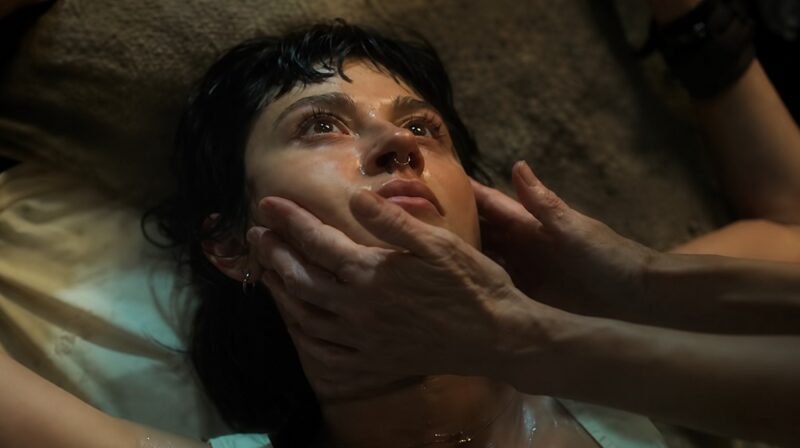
One of the things that I really appreciated was that with Sara, it’s never this performance of victimhood. Even when she’s at her weakest, there’s resilience there. How important was it to make sure the audience never lost sight of the person fighting back beneath all that suffering?
Yeah, cool question. I mean, I think Sara spends a lot of the film letting things kind of happen to her. She’s quite avoidant. She’s not letting (her girlfriend) in on the meat of it all, or the heart of it all. She’s very internal with everything because, yeah, that’s what we do when we’re scared. That’s certainly what she does when she’s scared. I don’t think she wanted to worry her partner, and I think she wanted to feel like she could take care of herself. But eventually all of that starts to dissolve, and you have no choice but to let someone into the trauma of it all.
The film asks the audience to believe this increasingly impossible physical transformation. Were there moments where you and the director would say, “We’ve gone too far?” Or was the goal always to push the performance right to the edge of believability?
Yeah, the second one. I mean, Houston never really yelled, “Cut.” I was used to working in TV, where you go, you hit your mark, you say your lines, and then it’s, “Cut,” straight on to the next thing. It moves so quickly, and they know exactly when they want to call it. They don’t let anything linger because that just costs money.
So to work on a film where everything was allowed to linger was really interesting. Interesting things start to emerge that you simply can’t plan for. A lot of it was also that I was just deeply curious, as a person, about how far I could push this. So yeah, it was interesting. People would say, “You must have been so tired,” and I was like, “No.” It felt like this playground where I could ask, “Where else can I go with this?” because there was permission to do all of it.
That probably answers my next question, because I feel like horror often rewards actors who are willing to look vulnerable, uncomfortable, unattractive. Was there a point making this film were you realised that you had to completely surrender to whatever the performance needed?
Totally, yeah. I think that’s where I found the joy, because I just stopped caring about what I was going to look like, or about being gross. Again, a lot of my experiences working in healthcare meant I’d seen people at their most vulnerable and at their most messy. So there was a part of me that wanted to honour that. They actually had to live through the reality of that vulnerability, that discomfort, that grotesqueness.
So yeah, it’s a weird privilege that I get to take on, to be able to say, “Okay, no, let’s go there. Let’s not fake this. Let’s really survive it. Let’s make people feel something.” That’s the job.
As you mentioned living in that grotesqueness and that discomfort, because this film has moments of genuine body horror, but it’s the emotional exhaustion that lingers. After particularly demanding scenes, is there something that helped you switch back to Chloe once the cameras stopped?
I mean, the lines between me and her blurred for about 13 or 14 days. We shot the film in that time, so I actually really appreciated that because I was just in it. I was in it to win it. Then I had a couple of weeks off before I went straight back to filming From. I don’t think I fully caught back up to myself before I was back on set again, and that was a bit of a trip, for sure. Yeah, I think in future I’d maybe give myself a bit of a ritual to leave a character behind. But this time I just went from one thing to the next very quickly.
And just before letting you go, and thank you so much for taking the time to chat, I’m always curious about those in horror films as to what their gateway into the genre was? If there was one at all…
I mean, horror keeps finding me. I’m not always seeking it out, especially when I first started my journey as an actor. But I’ve come to love it so much, and I think there’s so much incredible horror being made right now. It’s an amazing time for cinema, and for horror in particular.
Seeing Inde’s (Navarrette) work in Obsession… I mean, that film has only just come out yet, but watching her performance – her absolute abandon of self, her range, how willing she was to use all of herself, to be gross and compelling, but also hot, sexy, terrifying and bizarre – I was like, “Yes. This is it. This is what’s going to make people lean in.” Especially for women in horror, it’s not just, “I’m demure, I need help from the monster.” It’s real shit. It’s hot, it’s gross, and it’s completely fearless.
Son of Sara is now available on Digital and On Demand in the United States.
