
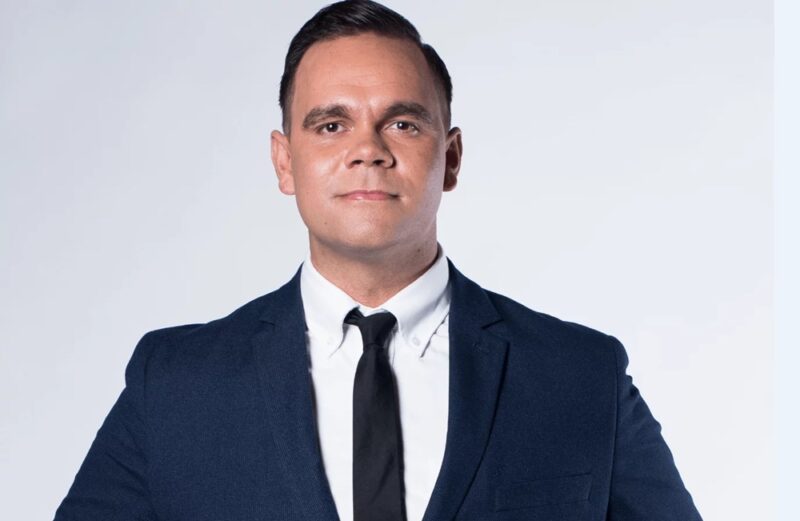
For Allan Clarke, documentary filmmaking isn’t simply about preserving history – it’s about challenging audiences to confront the stories they’ve long ignored.
The award-winning Muruwari and Gomeroi filmmaker, journalist and writer has built a career giving voice to communities too often left out of Australia’s national conversation, from The Bowraville Murders and The Dark Emu Story to Blood on the Tracks. Now, as he prepares to join the Bearing Witness: Queensland Documentaries in the Spotlight panel at the AIDC, Clarke is also developing Hey Brother, an intimate feature documentary exploring the life and legacy of Far North Queensland-born queer Blak pioneer Malcolm Cole through the eyes of his twin brother, Robert.
Speaking with our Peter Gray, Clarke discusses why documentaries should do more than simply retell history, how journalism shaped his filmmaking philosophy, why regional stories often reveal Australia’s biggest truths, and the importance of reclaiming overlooked Indigenous and queer histories through deeply human storytelling.
Thank you for taking the time to chat with me. I wanted to start with the theme of your session, ‘Bearing Witness.’ Do you see a difference between documenting history and bearing witness to it? Does the idea of witnessing come with a different responsibility?
Yes, I do. What really drives me is looking back at untold histories, or at people who deserve to have their stories told in a way that gives agency back to them and their communities. I think my work holds up a mirror. In that sense, it’s forcing people to bear witness to things we’d often rather not think about.
My aim is never just to record history or simply retell it. It’s about offering a different perspective and asking why these stories matter today. A lot of my work centres on Indigenous agency and storytelling, and historically there’s been very little appetite for those stories in Australia and around the world.
These stories can shift perspectives, spark conversations and create a national dialogue. Many of them are historical events that people refused to bear witness to at the time, or events where dominant narratives became unbalanced. My job is to go back, examine not only the story itself, but also the much bigger conversation we should be having around it.
That leads nicely into my next question. Many of your films explore stories that have been overlooked, ignored or actively suppressed. How do you balance uncovering painful truths while ensuring the people sharing them retain ownership of their own stories?
I come to filmmaking from journalism. I worked as a journalist for many years before becoming an investigative journalist because I found the traditional parameters of journalism limiting. I wanted to spend more time with people and explore stories more deeply.
Becoming an investigative journalist allowed me to place people at the centre of their own stories, rather than treating them as just one part of a story. A lot of my journalism focused on Aboriginal cold cases, and my goal was to redress the imbalance in the way authorities, the justice system and the media treated Aboriginal people and their stories.
Ultimately, though, I became dissatisfied with those journalistic constraints. Documentary filmmaking gave me the space to spend time with people, to give proper weight to their experiences—whether that’s the individual themselves, their family or their community.
It naturally became the right medium because it’s fundamentally about human stories and humanising people whose experiences have historically been ignored.
Take The Bowraville Murders. It’s about three Aboriginal children who were murdered and whose cases were effectively dismissed by police. My first question was always: why haven’t people heard about this? Why has there been so little interest?
As an Aboriginal person, I know that if those victims had been white, we would all know their names. We know cases like Daniel Morcombe or the Beaumont children. So for me it’s about correcting that imbalance, generating public interest and encouraging audiences to push for change.
That’s true across all my work. There has to be some way of moving the needle and bringing these stories to audiences who historically haven’t been encouraged to engage with them.
When people hear the phrase “regional documentary”, they sometimes assume those are small stories. But often those stories reveal much bigger national issues. Why do you think local stories have such an extraordinary ability to speak to something universal?
I think it’s the word “regional” that creates that perception. People wonder why those stories matter. But regional communities are often microcosms of much larger national issues. Historically, the voices from those places have either been watered down or never placed at the centre of the narrative.
For me, it’s deeply personal. I’m from Bourke in far western New South Wales – a town of about 3,000 people. Growing up in the 1990s, I watched newspapers like The Daily Telegraph portray my community as a place overrun by crime and out-of-control Aboriginal people. As a teenager, I couldn’t reconcile that version of my community with the one I actually lived in.
When I went to university, I realised I wanted to give people an entry point into regional and remote Australia. I wanted to give communities that historically hadn’t had a voice the opportunity to speak on a national stage and create meaningful conversations. That’s always been at the heart of what I do.
Because I grew up in those places, I understand the power of simply sitting down with people who are rarely listened to and giving them the chance to tell their stories. And the appetite is there. Whether it’s Bowraville, Tamworth or any number of small communities I’ve worked in, audiences constantly ask, “Why haven’t we heard this before? Why is this happening in our own backyard?” We tend to become very metro-centric in the stories we tell, but what’s happening beyond those cities is often every bit as fascinating – and just as important.
You’ve recently been announced as the director of Hey Brother, exploring the legacy of Malcolm Cole. Malcolm challenged Australia in ways that still feel incredibly contemporary today. What was it about his story that made you feel, “This is a film I have to help tell?”
There were really two reasons. On a personal level, I’m gay and Aboriginal, so Malcolm’s story immediately resonated with me. I also came from a small town before moving to Sydney, so there were parallels in our experiences.
I’d always known the iconic image of Malcolm dressed as Captain Cook at the 1988 Mardi Gras, but I never really knew the story behind that image or who he was. The more I read about him and the more time I spent speaking with his twin brother, Robert, the more I found myself asking, “Why don’t I know this story?” He lived an extraordinary life. He was a trailblazer in so many ways, yet after dying from AIDS he was never truly recognised for the contribution he made to Sydney’s LGBTQIA+ community. That really shocked me.
Over the years I’d become familiar with the history of Mardi Gras and those first protests, but those stories were almost always centred on white gay men. Growing up, that was the version of history I’d been taught. When I started researching Malcolm and speaking to some of those original protesters, they all talked about how diverse that movement really was. There were Aboriginal people, trans people and people from all kinds of backgrounds. There was also a natural connection between the early Mardi Gras movement and the Aboriginal community because so many people lived around Kings Cross and both communities experienced regular clashes with police.
I kept wondering, if everyone involved remembers this diversity, why has nobody ever explored it? Why has no filmmaker or journalist followed that thread? For me, the film isn’t simply about retelling history. It’s about correcting the imbalance in how we’ve told that history and giving Malcolm the recognition he deserves. It’s also about interrogating what we think we know about Australia’s LGBTQIA+ history.
Malcolm himself spoke about being Black and gay as carrying prejudice from multiple directions. There was racism within the queer community, while the wider public often struggled to even acknowledge that Aboriginal and queer identities could exist together. Even today, particularly after the referendum, Australia still struggles to fully recognise Indigenous people as central figures in many of our defining historical moments.
For Hey Brother, I spent a lot of time with Robert. We travelled back to Ayr, just outside Townsville, where they grew up, and I found his journey incredibly moving. Their family were Aboriginal and South Sea Islanders whose ancestors had been brought to Australia through blackbirding – forced labour in the sugar cane industry. They literally grew up on the edge of those plantations.
They dreamed of something bigger. They left Ayr together for Sydney, worked at the Eveleigh Railway Workshops, and eventually found themselves immersed in the freedom of Kings Cross. Robert spoke about those years with such joy. As he puts it, they were simply “having fun” – dating men and women, singing, living life.
Eventually Robert married and returned home, while Malcolm remained in Sydney.
One of the emotional threads of the film is Robert, now much older and dealing with his own health challenges, reconnecting with the memory of his twin brother. Through Robert’s journey, audiences have someone to connect with emotionally while discovering Malcolm’s story. That’s always what I’m looking for – a way to invite audiences into someone’s life so they become emotionally invested in the person, not just the history.
I sometimes feel like a bad gay man because there are so many parts of Australia’s queer history that I simply wasn’t taught.
Reading about Malcolm changed that for me, and then learning he was from Ayr – where I actually have family – made it feel even more personal. These are exactly the kinds of stories we need to keep telling. We can’t keep putting Australian history aside, and queer Australians especially deserve to know these stories.
It’s wonderful to see a filmmaker like yourself bringing Malcolm’s story to such a significant platform, so congratulations – and thank you.
Thanks, I really appreciate that. I don’t think it’s anyone’s fault if they only know Malcolm through that one famous image, or have maybe heard his name without knowing his story. What it really highlights is where we’ve traditionally chosen to invest our resources when telling stories about change in Australia.
So often those stories focus on non-Indigenous figures, while Aboriginal people, migrants and other marginalised communities are left out. We’ve been denied those stories ourselves. That’s why I was never interested in making a straightforward biography. I’m much more interested in interrogating the past while humanising the people within it.
I’m constantly invited into extraordinary places and entrusted with people’s most personal experiences – the greatest tragedies of their lives. I want audiences to feel what I felt when those people trusted me enough to share those stories.
It’s almost like opening the front door and inviting the audience into someone’s living room, their community or their town. Once people feel they’ve truly been there, the story stays with them. Whether that’s inspiring change in the justice system or reshaping how we understand Australia’s LGBTQIA+ history, that’s where documentary filmmaking can do something journalism often can’t.
My work has a journalistic backbone, but it’s wrapped inside a much more cinematic, emotionally driven narrative. That’s the combination I always try to achieve.
Allan Clarke will be a speaker at the Bearing Witness: Queensland Documentaries in the Spotlight session as part of this year’s Regionality Sunshine Coast program, presented by the Australian International Documentary Conference and Screen Queensland.
