
Just as thrilling to look at as its two predecessors, but perhaps the most narratively frustrating of them all, James Cameron‘s Avatar: Fire and Ash continues to make a good case for theatrical 3D technology and IMAX screen formats, but, as with both 2009’s Avatar and 2022’s The Way of Water, if you take away the sumptuous visuals, how memorable are proceedings, really?
From the opening, Fire and Ash proves wonderfully immersive as it welcomes us back to the expansive world of Pandora, where Marine-turned-Na’vi warrior Jake Sully (Sam Worthington), his wife Neytiri (Zoe Saldaña, once again delivering a stellar motion-capture performance) and their family have earned a win over the evil corporation-cum-military group who are wanting to colonize Pandora as a new home for humanity. However, their eldest son, Neteyam, died in the battle, so there’s a sense of grief and lingering trauma that laces the film’s otherwise grand opening.
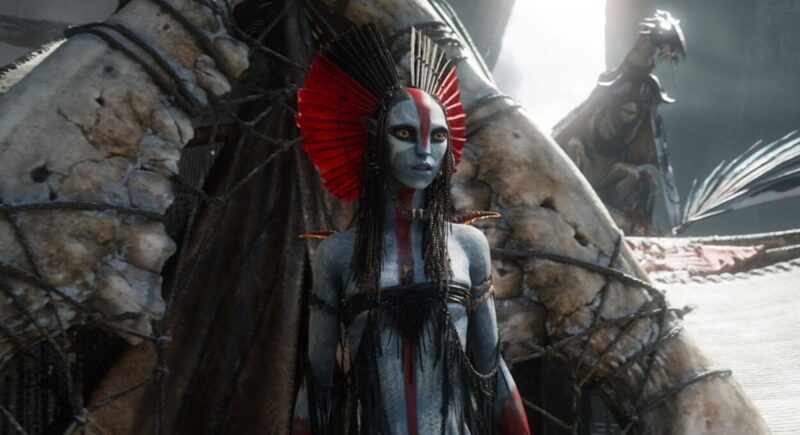
Despite an extremely grand (i.e. extended) running time of 197 minutes, Cameron’s script – written in collaboration with Rick Jaffa and Amanda Silver (the duo having shared credits across such films as The Relic, Jurassic World, and the live-action Mulan) – moves proceedings along at a surprising breakneck pace, with the Sully clan soon aligning with another subsect of Pandora – the Wind Traders – in their bid to return home with their quasi-adopted human “son”, Spider (Jack Champion), in tow. It’s not long before this travel plan is interrupted by the Mangkwan clan, also known as the Ash People, led by the hardened, somewhat sexually-charged sadist Varang (Oona Chaplin), who joins villainous forces with Quaritch (Stephen Lang), very much enjoying his new life as an Avatar recombinant, who is still intent on hunting and capturing Jake.
Had the film focused mainly on Varang and her team-up with the military, as well as the backstory regarding her anger at the Eywa, a Na’vi deity that exists in the natural elements of the planet, for not assisting when a volcano wiped out her clan, Fire and Ash would have had enough of a narrative to wholly devote itself to. Chaplin injects such fire (pun not intended) into the film as well that she walks away as its MVP, and if she wasn’t an ingredient, it would be difficult to imagine swallowing this threequel as easily. But such is the indulgent nature of Cameron that Fire and Ash can’t help but birth a multitude of separate storylines that never feel entirely necessary.
Neytiri’s distrust of humans means her complicated emotions around Spider are justified, but the weighty implications of this never feel fully realised. The curiousity of teenaged Kiri (Sigourney Weaver, sadly not delivering the strongest turn) has a purpose in her relationship with Eywa, but it only feels necessary when the story calls for it. And Lo’ak (Britain Dalton), Jake and Neytiri’s second son, spends the majority of the film hoping to help the whale-like species Tulkun, which not only feels as if it’s retreading the same water as the prior sequel, but, similar to Kiri’s strand, only truly has importance when mixed with the action stakes of the film’s admittedly spectacular finale.
Of course, to get to said spectacular finale, you have to sit through all the minutes prior, and, more than ever with Fire and Ash, this is one Avatar that feels as if its diminishing returns will be felt far sooner. These films have always been spectacle first and story second, but it feels more obvious here that there’s only so much one can be distracted by before realising none of it is retaining. It’s a shame that Fire and Ash doesn’t linger, as Saldaña and Chaplin truly deliver stunning turns (hell, even Worthington isn’t terrible), and there are some of the series’ most exciting sequences put forth, but in such amazement we see genuinely intriguing themes of spirituality, family and revenge get lost in the technological haze.
With storylines that both feel as if they’re filler and recycled from The Way of Water, Fire and Ash is an unfortunate step down in intellectual quality, but, my word, is it still not an absolute marvel to look at. No one can take away the fact that Cameron is a master of pushing technology to its limits in the realm of big screen cinema, but, in the form of the Avatar world, a script to match the vision is still in need. Sure, most people don’t go to an Avatar film for the dialogue, but Fire and Ash felt the most noticeable of the three films thus far in how basic the construction inside the action was.


TWO AND A HALF STARS (OUT OF FIVE)
Avatar: Fire and Ash is screening in Australian theatres from December 18th, 2025.
