

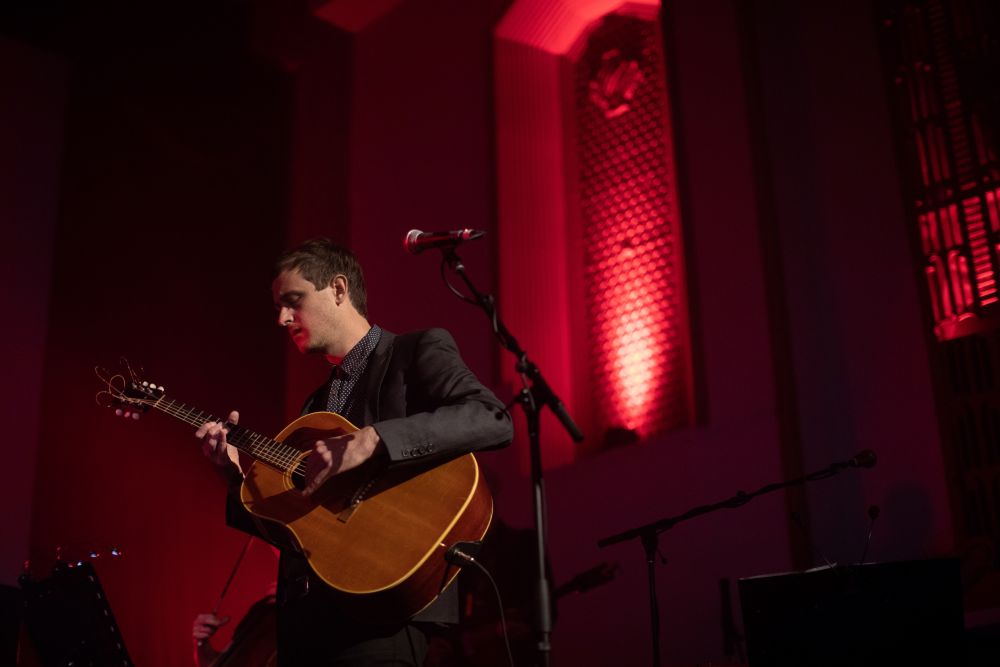
Brisbane songwriter Simon Munro has spent more than a decade turning poetry into song, and with his literary-folk project Nausicaä he’s now given a whole album over to one poet. The Burning Glass, out 27 November, sets twelve poems by Judith Wright to music, and today we’re premiering the animated clip for the single, “Child and Wattle Tree”, ahead of its release on Saturday, 3rd October.
The poem is one of Wright’s most tender, tracing two childhoods side by side, her own and her daughter Meredith’s, through the imagery of the natural world. Munro sets it as a soft, flowing waltz that shifts and breathes with each verse.
It’s a beautiful piece of music: restrained and elegant, built around lovely keys, gentle harmonies and strings, and carrying you back to a kinder, gentler time. Nothing is overplayed, and Wright’s words are given all the room they need.
For the clip, he turned to Melbourne designer and animator Eva Harbridge, whose earlier experiments with wattle imagery convinced him that animation, not live action, was the way to carry the song’s mythic quality onto the screen.
“I felt animation, and Eva’s bright yet surreal aesthetic, would help create a mythical landscape for the song,” Munro says. “It gave us a lot more scope for how the wattles play on screen. The wattle transforming into sun, for instance — it felt more natural in an animated context.”
The Burning Glass was recorded on location at an old hall near Hallston in South Gippsland with producer Greg Walker (Machine Translations), whose credits include Paul Kelly, C.W. Stoneking, Jess Ribeiro and Tiny Ruins. We spoke to Munro about Wright, the making of the record, and the albums that pointed the way.
What drew you to Judith Wright?
As long as I’ve been reading poetry, Judith Wright has been one of those rare poets whose words have leapt from the page. In all the Aussie poetry collections that found their way to my bookcase, Judith’s poems were usually the best, and the ones that cut the deepest.
For over ten years now I’ve been adapting a range of poetry into song, versions of poems by Pablo Neruda, T.S. Eliot and Rimbaud, amongst others. Judith Wright’s poems have been a constant spring I’ve returned to. After writing 30 or so songs based on her poems, I decided it was time to put together a collection of 12 that felt like they belonged together.
How did you approach turning her poems into music?
One of the beautiful discoveries in getting inside Judith Wright’s poems was how she captures the fundamental notes of life. Birth, growth, childhood, night, silence, to mention just a few. Her poems connect so intimately with the dance of life. They have a closeness and a familiarity, yet they transport us to realms beyond.
I’ve tried, as much as possible, to capture this connection to the beauties and struggles of life, as well as the transcendent travels beyond. Over time, the songs started to find a natural sequence, beginning with the myth of “Eden”, to the “Dark Gift” of life, through the soothing powers of love (in “Song” and “The Watcher”), to the cocoon of “Night” and “Silence”.
What was the recording process like?
Working with Greg was a rare joy. He brought unfathomable creativity to the project as producer, engineer, multi-instrumentalist and all-round lovely soul. We worked towards a shared vision: an album that takes the listener into the transcendent landscapes of Judith Wright’s poetry. To avoid the done-to-death “singer on a stage” sound, and take them to imagined, ethereal spaces.
Recording on location in regional Victoria helped take us out of that stuffy studio headspace. At an old hall near the town of Hallston, we were in a playground away from home, and our playground was filled with a wide range of sonic toys, from clarinets to Chinese violins, from dulcimers to drumkits.
Which songs stand out for you?
“Dark Gift” is a poem of birth, of growth. It’s such a personal poem too, written while Judith Wright was pregnant with her daughter Meredith, who I’ve been in touch with regularly throughout this process. A real full-circle moment. I feel the song captures this spirit of birth. It’s a real lifting-up moment early on the album, strumming its way to cloudy crescendos before picking its way back to land.
“Child and Wattle Tree” is another personal poem, revolving around the journey of childhood, her own and her daughter’s. And, as with so many of her poems, it links these tender human struggles and joys to the nature surrounding us. It’s such a gentle poem. I tried to keep that tenderness in a soft, flowing waltz. The music came naturally, such is the musicality of so many of her words.
Which albums inspired The Burning Glass?
Creating folk-influenced songs based on poems is very much a niche, but one I adore, and one with notable forerunners.
Paul Kelly‘s Thirteen Ways to Look at Birds and Conversations with Ghosts both showed me what was possible in turning poetry into folk music. Not only did Kelly adapt Judith Wright, along with a range of other Australian poets, but he collaborated with classical composers, as I have done on this album, to widen the palette and evoke more from each poem.
Rufus Wainwright‘s Take All My Loves: 9 Shakespeare Sonnets is another. Like Kelly, he’s experimented with contemporary poetry but also much, much older poetry. His capacity to get inside those sonnets, which don’t naturally lend themselves to contemporary song, showed me ways into poems that don’t necessarily look like song lyrics on the page.
And Leonard Cohen, particularly his late-’60s and early-’70s albums. While Cohen didn’t adapt poetry himself, he’s as much a poet as a songwriter; he started out as a poet before turning to music. Every word is carefully placed and lovingly delivered, with his signature tone always at the forefront, directly into the ear of the listener.

Before Nausicaä, Munro released five albums as Alex Bell between 2006 and 2017, and he commissioned and produced the Borrowed Verse album (ABC Music), which featured Augie March’s Glenn Richards, Ben Salter and Tin Pan Orange’s Emily Lubitz adapting poets including Wright, Dorothy Porter, Kenneth Slessor and Herb Wharton. Nausicaä has shared stages with Tiny Ruins and Frente’s Angie Hart, and premiered work at Dark Mofo, Brisbane Festival and Woodford Folk Festival.
The Burning Glass will be released on the 27th of November.
You can keep up to date with Nausicaä via Instagram, Facebook, Spotify, Apple Music and Bandcamp
Header image supplied
