

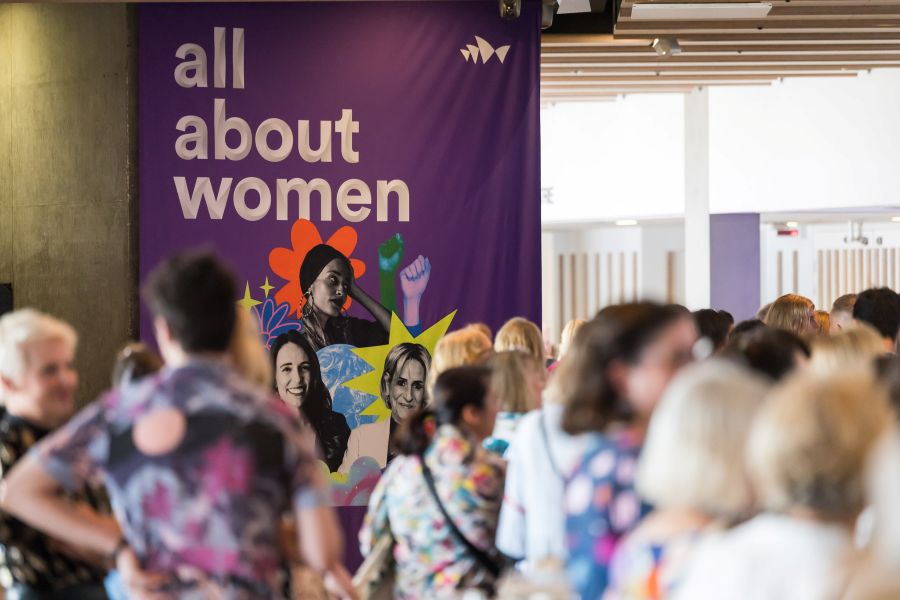
It’s been 115 years since the first International Women’s Day in 1911. A day that celebrates women’s achievements and raises awareness about discrimination. 115 years of fighting for equality, for fundamental human rights, for basic respect. I wonder what our foremothers would say if they had a glimpse of our world today. A world where one woman is killed every week by a current or former partner, where the “leader of the free world” starts a war to distract from his sexual misconduct (allegedly) and where almost a third of Gen Z men (born between 1997 and 2012) believe a woman should obey her husband (read about the study).
It’s fucking embarrassing.
So it was with a slightly heavy heart that I attended three talks at All About Women at the Sydney Opera House on this International Women’s Day.
This year’s line-up covered a range of topics from the rise of “heterofatalism”, the trauma of postpartum psychosis and the latest drought to ravage Australia – sperm.
Raising Boys
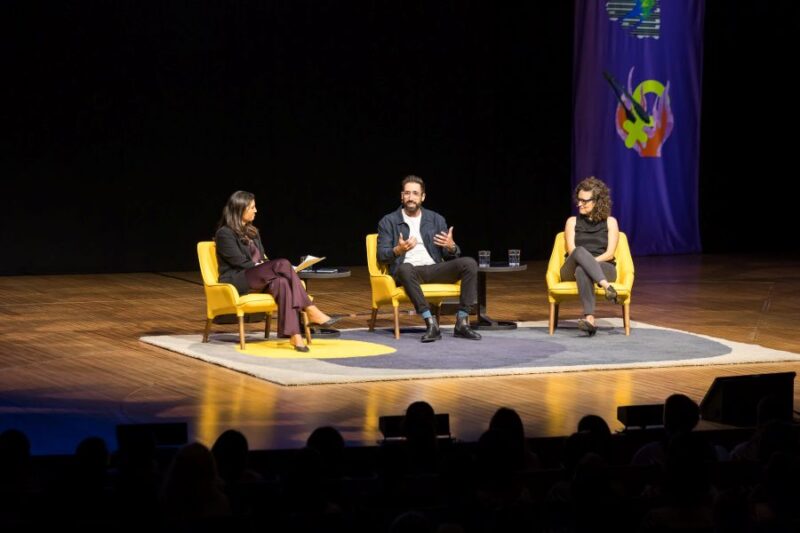
Although I do not have children myself, I do have young nephews, so a discussion about how the world today, in particular the online space, is shaping their lives was one I wanted to see. As author, public speaker, and today’s moderator Jamila Rizvi (she/her) states at the start, “Caring about boys is a feminist issue.”
Investigative journalist Jess Hill (she/her) raised an interesting point early on when she commented that “Boys are becoming a site of contestation.” She elaborates that women and girls are well acquainted with being a site of contestation and being exploited and we have created feminism as a means to push back against it. However, boys have no recourse to push back. And while you could argue that feminism could provide them with the same benefits it has women in this space, the content they are being exposed to online would never allow that. Feminist’s are the devil with two heads.
Clinical psychologist, researcher and men’s health advocate Dr Zac Seidler (he/him), adds to this when he discusses how women’s struggles are largely internalised – they don’t take it out on the world around them. Men and boys seek out certainty in online spaces, where extremist content is no longer something they need to search for, it is freely served to them. The social media algorithm is a dangerous tool that quickly learns what makes us angry and therefore engaged and will continue to feed that to us. For a young boy it would be easy to assume this content is a mirror of what society expects them to be.
“The greatest fear for a young man is ostracism,” comments Seidler, and peer pressure has come a long way since I was at school. Young boys are exposed to, as Hill calls them, “manfluencers”, whose entire personality is working out at the gym (alone), taking supplements, making money and degrading women. But when the algorithm refuses to promote the ‘good’ men, where can they go?
One of the most heart-breaking things that was discussed was how young boys loose their sense of joy. As Seidler comments, “Modern masculinity is a process of grief and loss”. As young boys grow into adulthood, they learn early on that to be a “real man” is to reject anything that is perceived as feminine or “girly”. Something Hill terms “biological determinism” – the regressive idea that men are one thing and women are another. So boys will reject parts of themselves, hide that love of glitter away, until all that is left is a shell of who they used to be.
Seidler also discussed how men and boys do not like to sit in the grey – everything is black and white, it’s either one thing or another – and this is such a limiting belief. Growth comes from sitting in discomfort.
Hill raises an interesting point when she says that for the first time we are seeing men’s insecurities being profiteered off in a similar way that women have been experiencing for centuries. Grifters online are selling men and boys what they desire most – certainty and simplicity – a chance to escape the grey.
So why do so many men turn to these “manfluencers” for support? Hill believes that largely men feel that their struggles aren’t recognised by society in the same what that women’s are. Then you have the monosphere trying to “sell itself as the new Punk”, as some sort of rebellion against this, when in fact, as Hill states, it’s just exploitation.
It’s easy to become overwhelmed and despondent when addressing this issue, however there is a small beacon of hope. Hill informed the room that on 9 March 2026 (the day after this talk) Australia will introduce age restrictions on all online porn websites. Under 18s will no longer be able to access porn online in Australia. This seems way overdue but it’s a step.
Seidler’s advice to the (few) men in the audience was to humanise yourself to the young boys in your life. Men, particularly father’s, need to model behaviours to their sons and sit in their own vulnerability. What does that look like? If you’re nervous about a job interview, tell them, if you’re sad because a friend moved to another country, show them that emotion. You can’t be what you can’t see and if all boys are seeing is Andrew fucking Tate with no alternative to push against that behaviour then I hate to think what our society will look like in 20 – 30 years time. A way to be able to have difficult conversations with boys and men is what Seidler calls “shoulder to shoulder”. Go for a walk, sit together at a sports game, go for a drive – it’s a way to create a safe and open situation.
Something else we can do, as Hill states, is build accountability for everyone, from parents to friends. We need to have greater expectations on men and boys instead of expecting them to be sexist or toxic. We know that men and boys can be better, that they are better than this, so lets hold them to account. As Seidler says, “The past is not their fault but the present is their responsibility.”
Money Matters
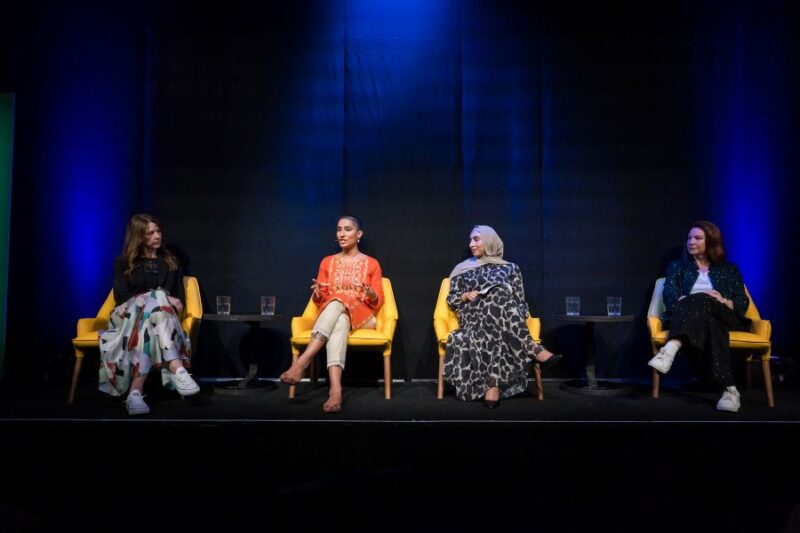
Growing up, my mother always told me to have my own money. Having been married at a young age and subsequently divorced, she learnt the hard way not to tie up all your finances in joint accounts. I am eternally grateful for her advice, because financial independence for women isn’t a nice to have, it’s a must have.
As social entrepreneur Catherine Fitzpatrick (she/her) says, “When you get into a relationship you don’t have to share your money.” Fitzpatrick is a former bank executive who uncovered widespread abuse in online banking and lead industry-wide reforms to stop it. In 2019 she discovered that perpetrators of violence were making deposits and using the payment description for threats of violence and abuse. She had her team of data scientists investigate the issue. They analysed 11 million transactions over a three-month period, and found 8,000 customers had received concerning messages which included threats, abuse and intimidation. Now, financial abuse is stated explicitly in the fine print, and the bank will take action against it.
Fitzpatrick also discussed how the banking system is designed for healthy relationships and with the expectation that men will be the “breadwinner”. She emphasised that women should have their own credit cards, because if you are the secondary card holder on a joint card you have no rights.
Co-founder of MoneyGirl, Australia’s first evidence-based financial education program for women, Zee Heart (she/her), continues this discussion of finances in relationships when she suggests that if you can’t have conversations about how your relationship will end, and what that will look like, it’s a red flag. Whether through heartbreak or death, the end of a relationship is inevitable, and it’s important to discuss the impacts of that financially.
Heart comments that financial independence is the foundation on which liberation and freedom is built. Part of the work that MoneyGirl does with women is helping them to unlearn the financial narratives they learnt as children. We each have story around money that is imprinted in our brains from when we’re young, for some women, it is that women are bad with finances and it’s a man job to manage. A key point Heart makes is that “Net worth is also about self worth.” We need to stop saying ‘I’m bad at money’ and build self worth and self trust, as she continues, women need to “feel worthy of independence.” Her advice for when those negative stories come up around money is to “ask whose voice is it in my head, who is saying that?” Where does this belief come from? Does it serve you?
Tasnia Alam Hannan (she/her) reiterates the importance of unlearning the false narratives, and what she terms our “financial identity.” Hannan is a social impact leader, academic and advocate for women’s economic justice. She is Co-Founder and Co-CEO of the Arise Foundation which focuses on the recovery phase after abuse. The Foundation provides trauma informed employment coaching, helping women to secure employment after leaving an abusive relationship. It was uplifting to learn that of all the women that have been placed through the organisation, zero have returned to their perpetrators. The services provided by Arise are free of charge and the demand has increased by 200% since 2025, yet the recovery space for abuse survivors is severely underfunded.
Fitzpatrick believes that digital literacy and financial safety is a way for women to obtain financial independence. You can’t just walk into a bank and open an account anymore – everything is handled online making it easier to agree to conditions you don’t understand. She also suggests that if it’s an option, you should make voluntary contributions to your superannuation fund. Even with the advent of paid parental leave, women who have children are still at a financial disadvantage. As today’s moderator and Founding Editor of Women’s Agenda, Angela Priestley (she/her) informs us, a 25 year old woman with one child will have 2 million dollars less than a 25 year old man with a child when they retire.
While it would be nice for paid parental leave to be compulsory for both parents, as Fitzpatrick suggests, or for the Government to introduce mandatory superannuation payments for women who have children, women need to take their financial future into their own hands. But how do we do this? A general consensus across the panel seems to be a focus on investing and compound interest, an area where women generally tend to be more risk-averse. Above all else, it’s important for women to be curious about their finances, don’t be afraid to ask questions and protect yourself in relationships. As Fitzpatrick says, “What’s mine, what’s yours, what’s ours?”
Inside the Epstein Files
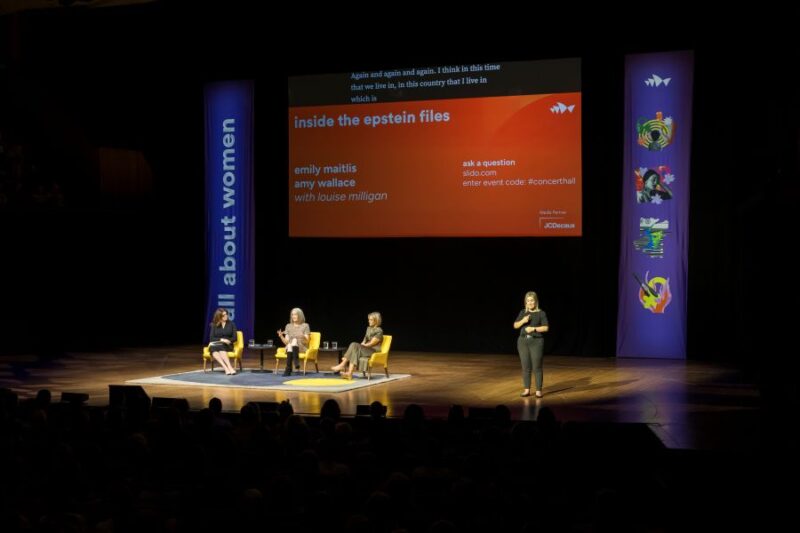
There would be very few people unfamiliar with the Epstein Files. The partially released collection of documents, images, videos, and emails detail the activities of convicted child sex offender and trafficker Jeffrey Epstein, including those complicit in his crimes from public figures, politicians and celebrities.
American journalist and author Amy Wallace (she/her) is the co-author of Virginia Giuffre’s memoir, Nobody’s Girl (2025). Giuffre was one of the most vocal survivors of Epstein and his accomplice Ghislaine Maxwell’s abuse and sex trafficking, positioning herself as an advocate for survivors. For more than four years Wallace worked with Giuffre on her memoir, with a large part of her role to corroborate the information she was told. She comments, her “memory was incredible”. Sadly Giuffre lost her life to suicide in 2025 before the book was officially released.
Issues around class were discussed, and how the victims of Epstein and Maxwell were from lower socio-economic backgrounds. They exploited vulnerabilities and had girls, including Giuffre, recruit others to be trafficked, effectively making it more difficult for them to leave. Once they did, non-disclosure agreements (NDAs) made it impossible for them to speak up. It was universally agreed by the panel that NDAs should not be allowed to be used to cover up criminal activity, with award-winning journalist and broadcaster for the BBC, Emily Maitlis (she/her), calling it “monetised silence.”
Maitlis is perhaps best known for her 2019 interview with Andrew Mountbatten-Windsor (then Prince Andrew) in which she questioned his relationship with Epstein. She believes there are thousands of victims and at least three dozen perpetrators. Andrew Mountbatten-Windsor is just one.
On his recent arrest, Maitlis emphasised that in the UK, arrests of the British Royal Family simply do not happen, so while the arrest had nothing to do with the sexual assault allegations against him, it’s seen as a means to get him. Though she does admit that 6 years is far too long to wait for a result.
When asked if she believes more arrests will be made, Maitlis is firm, “Yes, I do,” she continues, “I do believe this will bring good. I do believe this will result in something, otherwise what’s the point?”
An optimistic sentiment, but how realistic is it? And if it took 6 years for one man to be arrested, how many years will it take until justice is served when we are dealing with dozens of powerful and wealthy men who are, in turn, protected by one of the most powerful men in the world?
Wallace was asked whether she thought the recent attacks on Iran by the United States are a calculated distraction by President Donald Trump. “Absolutely”, she responds. Maitlis adds, “The words of the President of the United States are immaterial. What matters is how people respond to him.” What does it say when his own people are distancing themselves.
Investigative journalist for ABC TV’s Four Corners, and moderator of this session, Louise Milligan (she/her), asked Wallace if there was anything she thinks Giuffre would want people to know. “She would want everyone to know that your own individual outrage matters.” Don’t feel weak or cowed when the bad guys win. She reiterates emphatically, “Do not underestimate the power of your own outrage.”
The theme of this year’s International Women’s Day is ‘Give to Gain’, and in many ways, that really sums up what All About Women does. It is a day where incredible advocates, survivors, crusaders and truth-tellers gather to impart knowledge and inspire change. They give their time and their story so that we might gain a different perspective, a new insight, a better understanding.
Would I have liked to see more men in Raising Boys – absolutely.
Was it frustrating but in no way surprising that there were more men keen to hear about the Epstein files than how we can stop boys from being turned into misogynists – definitely.
Did I leave today determined to invest in something and research WTF compound interest is – 100%
But did I leave with a lighter heart than when I started the day – not really.
To be clear, this is not a reflection on the talks I attended or the event itself, which still remains one of my favourite ways to acknowledge International Women’s Day. What it is a reflection of is the current state of the world and the 24 hour media cycle that won’t let us forget about it. Between stories of two women in Sydney being brutally attacked in their apartment block by a man who was already facing several domestic violence-related charges, to the Iranian Women’s Football team forced to seek asylum in Australia to escape persecution in their home country for not singing their national anthem at the AFC Women’s Asian Cup – where is the hope, the reprieve, the light at the end of this shitty, misogynistic tunnel?
I feel as if I’m perpetually pissed off all the time, but not in an obvious way, in a way that quietly hums beneath the surface. A way that’s constant without being all consuming – at least not yet. Frustration combined with anger and an overwhelming sense of hopelessness. But tuning out is not the answer. Staying silent is not the answer. Giving up is not the answer. Because while existing in this state of hyper-awareness is exhausting, it’s better than the alternative. It’s better than being numb.
Much like financial independence, All About Women isn’t a nice to have, it’s a must have. We need to keep sharing women’s stories, we need to continue to challenge the structures that hold us back, we need to speak up, get angry, challenge the status quo – because it’s always going to better than the alternative.

FIVE STARS (OUT OF FIVE)
All About Women was held on 8 March 2026.
For more information head to the Sydney Opera House website.
Photos by Anna Kucera.
