

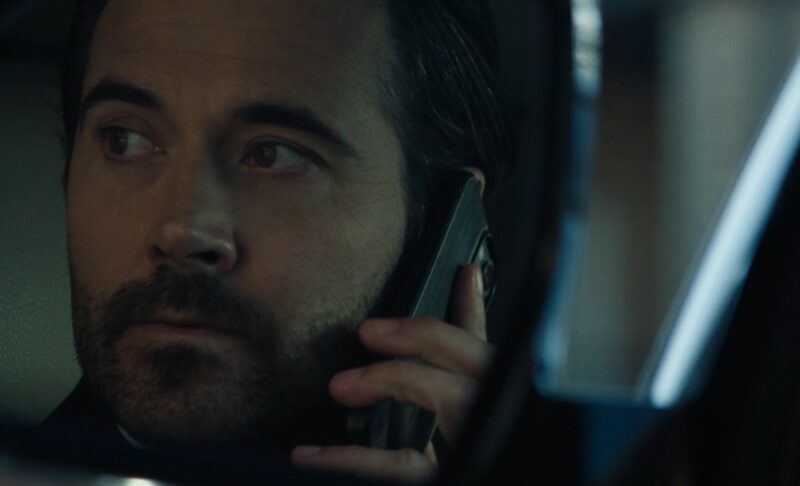
For Leonidas Gulaptis, the opportunity to step into the darker territory of The Florist proved as creatively liberating as it was personally rewarding. Trading the familiarity of romantic comedies for the moral complexities of a corrupt detective, the actor stars opposite Dennis Quaid and Jean Reno in director Babak Najafi’s suspense-driven action thriller, which follows a hitman posing as a neighbourhood florist who must protect a teenage witness (Sky Katz). But beneath the film’s explosive action lies a fascinating character study in Woodrock, a man whose desperation to maintain control only accelerates his undoing.
Speaking with our Peter Gray as the film releases digitally, Gulaptis reflected on finding humanity in a morally compromised character, the importance of approaching villainy without judgment, the creative freedom afforded by playing someone so removed from his own sensibilities, and the emotional significance of finally being entrusted with the kind of role he’s long wanted to explore.
One of the things that I found interesting about your character is that he’s a man whose entire existence seems built around maintaining control, but every decision he makes seems to push him further towards losing that control. I wondered when you were approaching him, did you see someone who genuinely believed he could still find a way out of his situation? Or someone who had already kind of accepted his own destruction, but was too proud to admit?
It’s a good question. I’m personally an optimistic person, so that’s how I approached him. I describe his situation as being like quicksand, where every decision takes him from bad to worse, but he’s desperately trying to get out. I think he has to have hope; otherwise, it would just feel like he’s on a crash course. Even though we see things progressively getting worse, I always approached him with the hope that he’s going to do everything he can to see his family again.
What’s fascinating about someone like Woodrock is that corruption rarely begins with someone deciding that they’re going to become a villain. It’s often a series of smaller compromises that gradually become impossible to undo. Did you create a sense of who he might have been before he crossed that first moral line, and do you think there’s a part of him that believes he’s a good man? Or has he kind of abandoned that version of himself at this point?
Definitely, there was a little bit of that. I probably had two or three days to prepare for this role, so you try to do as much as you can with the little time you have. We talked about the fact that he was a good guy, but somewhere along the line… I don’t know what a police salary is, but I don’t think it’s that good. I remember a police officer years ago saying, “If you put a chop in front of a starving dog, what do you think he’s going to do?” I think Woodrock’s a little bit like that. Eventually, he’s seeing these people live more extravagant lives than him, and he’s thinking, “I want to dabble in this. Who do you think you are? I’m hardly getting by.” And that one choice is what’s going to change everything for him.
Looking at that distinction between performing authority and then actually possessing it, I feel like your character needs to be feared, because being understood would almost make him vulnerable. When you’re playing him, did you find that his aggression came from a genuine sense of power? Or was it actually a way of disguising how frightened he was of losing everything he had?
I think it’s more that he has the power because he’s a cop. He’s got the badge, he’s got the gun, and he can hide behind that badge. I think that’s the angle Woodrock approaches it from, but deep down, he knows that the longer this goes on with this girl, the greater the chances are that he’ll never see his family again. So there is that vulnerability to him, but at the end of the day, he’s got the power because he’s a cop.
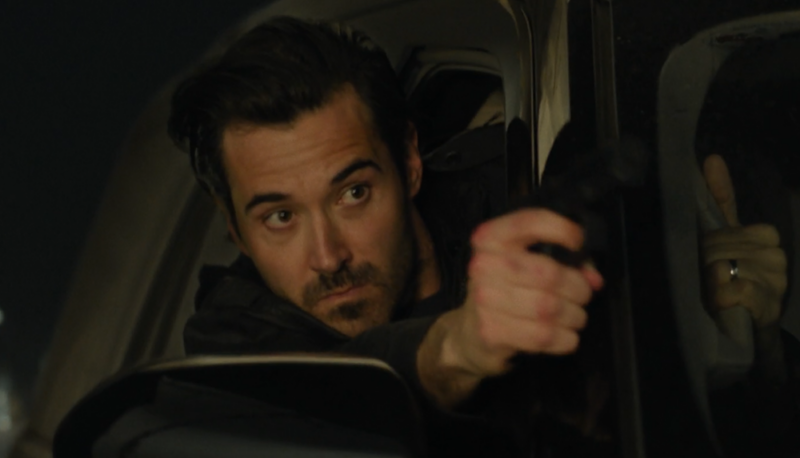
One things I love about these kind of movies is that there’s always the “good guy” and the “villain,” but the villain is never the villain in their story. Obviously, as an actor you can’t approach him from the perspective of being a villain. Did you have to find a version of the story where Woodrock was actually the protagonist – where everything he did, however reprehensible, made complete sense to him?
Absolutely. You have to. It’s like, there are no bad people, right? They just do bad things. With Woodrock, I had to find his perspective and understand where he’s coming from and why he would do the things he does, without any judgment. There were a few little cards up my sleeve that I felt I could tap into, and once I did, it was just a matter of building on that until I reached a point where, from his perspective, what he’s doing is 100% right. I’m not going to judge him. And I think once you get to that point, the gloves are off.
As you said, there wasn’t a lot of time between getting the role and starting to film. I imagine, with your career, you’ve worked towards something that’s finally coming together. I’m curious whether emotional significance changed the way you approached the performance? Did you feel a responsibility to prove what you were capable of? Was there something quite liberating about finally being given the opportunity to play the kind of character you’ve always wanted to explore as an actor?
Absolutely. Jina Panebianco is a producer on this, and she’s also my manager now. I’ve done probably four or five films with her, predominantly in the rom-com and comedy space. I originally sent her a tape for Deckard, who’s played by Jim Klock, an incredible actor. She went into bat for me, so I felt I had a lot to prove to her because she’d stuck her neck out for me. I’ll never forget, after one of the big scenes in the movie, she came up to me and said, “Honey, I’m so proud of you.” That just meant so much to me. It was incredibly rewarding because this is the kind of genre I want to step into in my career.
And something that struck me about your journey is how much your career is built on taking risks and embracing the unknown. Woodrock is someone who seems absolutely terrified of uncertainty and will do almost anything to control his circumstances. Was there something creatively interesting about playing a man whose relationship with risk is almost the opposite of your own?
I think that’s the exciting thing. It’s like being in a playground where you can do these things without any consequences. Going in with that mindset allows you to explore who this person is without judging them or their actions. In real life, there are consequences for our actions, and I’m someone who, if I’ve hurt someone’s feelings, won’t be able to sleep at night. I’m such a worrier. But to take that away and step into the world of this guy, I love that. It’s like, let’s just go and play, because that’s the whole point. As actors, we’re just big kids who haven’t grown up, right? And I love being able to do that.
As you mentioned that you were going to play Deckard and then you ended up getting Woodrock. I imagine that affects your instincts? Did having so little time to prepare allow you to make bolder choices? Less calculated choices? And looking back, is there something in the performance you might have overthought if you had more time to prepare?
I don’t know if I would have overthought it, but it definitely does, because you’re now the lead antagonist. One of the biggest things for me was making it believable that I could step into a scene with Jean Reno and Dennis and be threatening. But with actors like that, you don’t have to do anything because they’re so good. You’re watching them react, you’re reacting to them, and you’re just like, “Whoa, they’re at the top of their game.” They make you look good. There were a couple of things I had to dig into from my character’s perspective, trying different angles, because I think the worst thing you can do is push that idea of, “I’m tough and I’m bad.” An audience will read that straight away and go, “I’m not buying it.” So there are a few little elements that have to come into play to make that believable on screen.
The Florist is now available on Digital and On Demand.
