
In a film penned by Quentin Tarantino, a filmmaker whose dialogue has become almost a cinematic language unto itself, it seems somewhat wonderfully ironic that one of Elizabeth Debicki‘s most creatively fulfilling experiences on The Further Mis-Adventures of Cliff Booth came courtesy of a scene in which she had comparatively little to say.
The Australian actress, an Emmy Award winner for her portrayal of Princess Diana in The Crown, finds herself at the intersection of two of contemporary cinema’s most distinctive creative voices, with David Fincher directing Tarantino’s return to the world he so lovingly realised in 2019’s Once Upon a Time… in Hollywood. And whilst the prospect of those two filmmakers collaborating is enough to excite any cinephile, for Debicki, the marriage of Tarantino’s linguistic exuberance and Fincher’s meticulous visual sensibilities afforded her an opportunity to explore not only what her character says, but the considerable weight of what she chooses not to.
Picking up in 1977, eight years after the revisionist fairy tale that earned Brad Pitt an Academy Award, The Further Mis-Adventures of Cliff Booth finds its titular character navigating a considerably different Hollywood. With age and injury having largely put an end to his career as a stuntman, Cliff divides his time between bartending, working as a cinema projectionist and offering his particular set of skills as a fixer for those whose problems are perhaps best resolved outside the confines of the law.
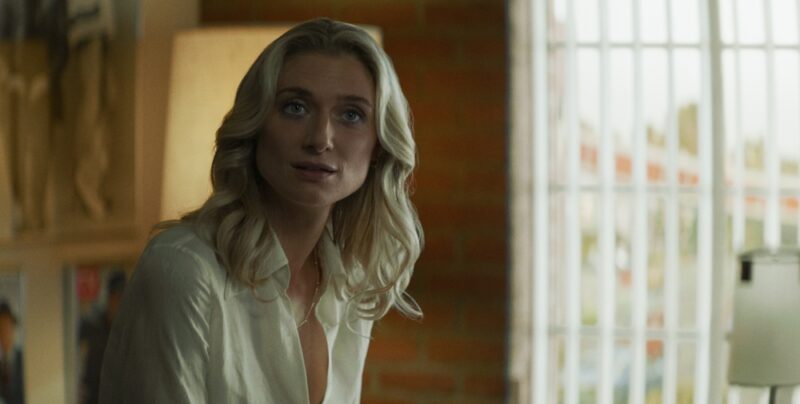
One such problem comes courtesy of Karen Crosby (Debicki), a sharp, self-possessed talent agent whose client, television megastar Charlie Peters (Scott Caan), requires Cliff’s assistance. What initially appears to be another professional undertaking soon draws Cliff into an increasingly complicated web of criminality, ambition and desire, populated by Charlie’s wife – and Cliff’s former flame – Toni Becka (Carla Gugino), football champion-turned-screen star Roderick “Hot Rod” Harrison (Yahya Abdul-Mateen II), and a pair of mysterious gangster brothers wreaking havoc across Los Angeles.
For Karen, a woman whose professional existence necessitates the constant management of other people’s egos, Cliff represents something of an anomaly. His apparent indifference to the Hollywood hierarchy, his lack of self-importance and his rather uncomplicated acceptance of whatever life throws at him make for an appealing contrast to the personalities she has spent her career accommodating. Debicki has described Karen as someone whose proximity to the industry has gradually altered her relationship with the world, making her attraction to a man seemingly immune to its preoccupations all the more understandable.
Drawing inspiration from the formidable women who populate the crime novels of Elmore Leonard, Tarantino has afforded Karen an intelligence, wit and capacity for contradiction that allows her to exist beyond the parameters of a conventional romantic interest. And in Fincher’s hands, that intelligence is communicated as much through Debicki’s reactions as it is through Tarantino’s words.
Speaking with our Peter Gray ahead of the film’s release, Debicki was asked about the fascinating creative intersection between the two filmmakers. Having previously likened Tarantino’s writing to an ever-expanding world within a world, and Fincher’s filmmaking to the precision of Swiss watchmaking, the actress was invited to reflect on a particular scene that seemingly encapsulates the strengths of both.
As the film’s Academy Award-winning editor Kirk Baxter had observed, during an early sit-down between Cliff and Charlie, Karen has the least dialogue of the principal participants, yet the scene is considerably informed by her perspective and judgement. With Fincher’s penchant for multiple takes in mind, was there a particular joy or challenge in acting in the margins of a scene where silence was doing so much of the heavy lifting?
“Oh, what a glorious question!” Debicki enthused. “I love to do both things. The dialogue that I was given to play in this film is truly some of the best, best, best writing that you will ever get given as an actor. So, to have a 10-page scene with Brad on the balcony is a dream. I mean, it’s all you want as an actor. You want really good dialogue. You want an amazing scene partner. You want a genius director. So I was very happy to go to work on those days.”
But the opportunity to communicate without the luxury of language presented Debicki with an altogether different creative proposition. Rather than approaching the scene with a view to what she could introduce into it, the actress found herself considering what she could contain within it.
“To have a scene like that, it’s also so fun for me because it challenges me. It challenges you in a way that is just really creative and generative. It’s not, ‘What can I come up with?’ It’s, ‘What can I hold?’ How can I hold the space between these two men? How can I hold the idea up in the air and land it with the audience at the same time?”
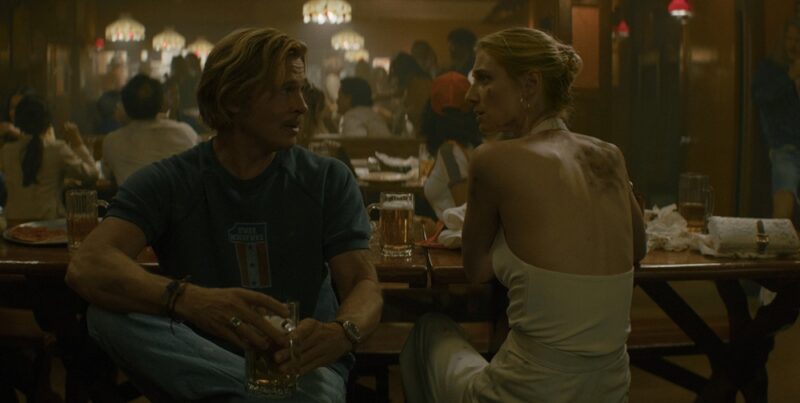
She continued, “It’s like this dance of something sort of invisible, like the elastic band getting pulled really tight and snapping shut. It’s so fun to do that.”
Perhaps most revealing about Debicki’s experience was how it challenged the conventional understanding of Fincher’s much-discussed working methods. The director’s reputation for an exhaustive number of takes has long been a source of fascination, but what can so easily be characterised as an uncompromising pursuit of technical perfection was, in this instance, an acknowledgement of the importance of an actor whose character wasn’t necessarily commanding the conversation.
As one of the first scenes Debicki filmed, it proved something of an education in the director’s sensibilities.
“When you read that scene and you read the amount of dialogue a character has in a scene like that, it’s not that you automatically think, ‘Oh, we’ll just kind of pop a few bits of coverage in, and then Bob’s your uncle.’ But to some degree you do,” she admitted. “But I hadn’t worked with David Fincher yet.”
What followed was four different camera setups and ten takes per setup devoted to Karen alone – a considerable investment in a performance that, on the page, might not have appeared to demand such attention.
“At first, I thought, ‘What is happening here?’ And then I realised I was being given an incredible opportunity by my director to be the audience’s eyes, like you said, like Kirk very graciously was saying the other day. And I had so much fun.”
It’s a particularly telling insight into the collaboration between Tarantino and Fincher. Where the former has constructed a woman sufficiently intelligent to recognise the absurdities of the men around her, the latter has ensured that the audience is afforded the opportunity to recognise those absurdities through her. Karen’s relative silence is not an indication of her diminished significance within the scene; if anything, it becomes the very source of her authority.
And for Debicki, the pleasure of playing Karen extended to the character’s ability to navigate an environment populated by men whose considerable professional accomplishments don’t necessarily translate to emotional maturity.
“I love Karen for so many reasons, but I also love that she’s so frequently the only grown-up in the room,” she laughed. “People sort of ask, ‘Being a woman in Hollywood in 1977, how was that to play?’ I’m like, ‘Well, Quentin wrote it.’ He wrote these moments of, like, ‘Take care of my boy.’ ‘I’ll do my best.’ I mean, it’s all in the dialogue. It’s just so funny and great. I loved playing that scene.”
In a movie concerned with the personalities that exist both in front of the camera and behind the machinery of Hollywood, it’s fitting that one of its most interesting performances should emerge from a woman whose profession so often demands that she facilitate someone else’s moment in the spotlight.
Tarantino’s words may have given Karen Crosby her voice, but Fincher’s camera has afforded Debicki the space to demonstrate that a woman doesn’t necessarily need to speak to command a room. And in a cinematic world so gloriously enamoured with the sound of its own dialogue, that might just be one of the most compelling things an actor can communicate.
The Further Mis-Adventures of Cliff Booth is playing exclusively in IMAX theatres across Australia and the United States for a limited engagement before streaming on Netflix from December 23rd, 2026.
