

Every teacher has undoubtedly encountered that one student who tests their patience beyond reasonable limits. The one who turns an otherwise manageable classroom into a daily exercise in damage control, leaving even the most dedicated educator questioning their career choices. But what if removing that student from the equation was all it took to make everything better? It’s a thoroughly inappropriate question, and one that director Jonatan Etzler has an absolute field day exploring in Bad Apples, a deliciously twisted black comedy that takes the frustrations of an increasingly broken education system and pushes them towards a moral precipice. It’s outrageous, frequently hilarious and just uncomfortable enough to make you question your own willingness to laugh along.
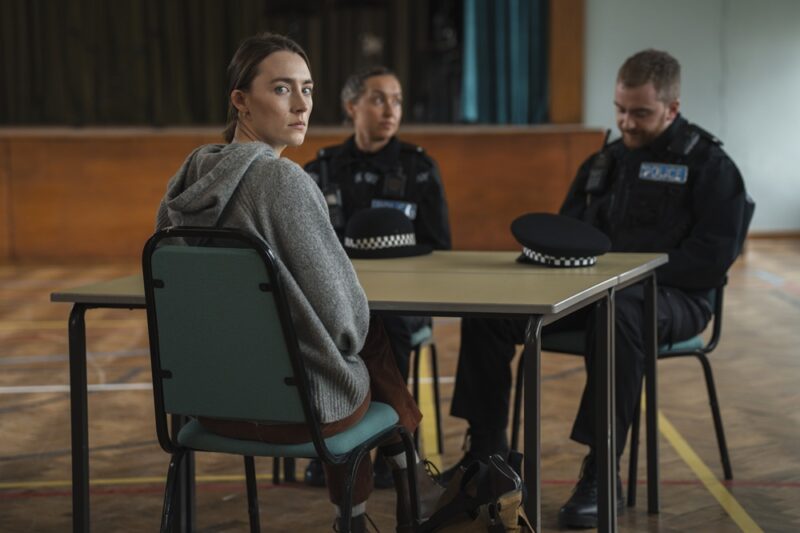
Saoirse Ronan plays Maria Spencer, a well-meaning primary school teacher in Somerset whose professional enthusiasm is being systematically dismantled by Danny (Eddie Waller), a ten-year-old menace whose capacity for disruption seemingly knows no bounds. Whether he’s sabotaging a school excursion, tormenting his classmates or openly defying authority, Danny has turned Maria’s classroom into something resembling a war zone. His father appears largely uninterested in addressing his behaviour, while the school’s administration offers little beyond the expectation that Maria should somehow manage the situation herself.
When Danny’s escalating aggression results in another student being injured, Maria finds herself at breaking point. A subsequent encounter outside school takes an unfortunate turn, and through a combination of panic, desperation and spectacularly poor judgement, she ends up with her most troublesome pupil locked in her basement. The situation is obviously indefensible, but when Maria returns to work and discovers that her previously chaotic classroom is suddenly thriving, the temptation to leave well enough alone becomes rather difficult to resist.
What makes Bad Apples particularly effective is how confidently it invites the audience to entertain an idea they would ordinarily find abhorrent. Adapted by screenwriter Jess O’Kane from the novel “De Oönskade,” the film isn’t necessarily interested in presenting Maria as someone deserving of forgiveness, but rather in examining how easily questionable behaviour can be justified when the outcome appears beneficial. Etzler cleverly uses the absurdity of the premise to interrogate an education system where teachers are expected to accommodate increasingly challenging behaviour without adequate resources, support or consideration for the other children whose learning suffers as a result.
There’s also something especially pointed about the film’s suggestion that compassion is often conditional, and that our commitment to doing the right thing can become remarkably flexible when doing the wrong thing proves more convenient. It’s a nasty little observation, delivered with enough humour to disguise just how cynical the film is prepared to become.
Ronan is absolutely terrific, demonstrating a flair for physical comedy and increasingly frantic desperation that feels refreshingly removed from the more emotionally restrained performances for which she’s often celebrated. Her Maria is a fascinating contradiction; someone who genuinely cares about her students and believes in the importance of education, yet possesses an alarming ability to convince herself that her increasingly irrational decisions are somehow in everyone’s best interests. Ronan never overplays the character’s moral deterioration, instead finding humour in her nervous expressions, awkward attempts at maintaining normality and the extraordinary mental gymnastics required to keep her conscience relatively intact.
Waller, meanwhile, is an impressively assured young performer, making Danny sufficiently infuriating that Maria’s exhaustion feels entirely understandable, whilst occasionally revealing the vulnerability of a child who has seemingly been failed by every adult around him. Their scenes together are among the film’s strongest, particularly as the traditional relationship between teacher and student becomes something far more complicated.
Etzler maintains an enjoyably unpredictable rhythm throughout, shifting between farcical comedy, psychological discomfort and moments of genuine suspense without completely sacrificing the film’s underlying social commentary. The increasingly ridiculous circumstances demand a considerable suspension of disbelief, and there are occasions where the screenplay’s determination to escalate the madness comes at the expense of credibility. Danny, too, could have benefited from greater psychological depth, as the film occasionally seems more invested in exploiting his behaviour for comedic effect than understanding its origins.
But perhaps that’s part of the point. Bad Apples is less concerned with offering practical solutions than exposing the absurdity of a system that allows its most vulnerable participants to become problems that everyone else would rather ignore. And while the satire isn’t always as incisive as it could be, there’s an undeniable pleasure in watching Etzler push his characters further into territory from which any reasonable person would have retreated long ago.
For all its gleeful cruelty, Bad Apples ultimately succeeds because there’s something recognisably human beneath its increasingly preposterous developments. Maria’s actions are impossible to defend, yet the frustrations that lead her there are presented with enough understanding that our sympathies remain uncomfortably divided. It’s this moral uncertainty, rather than the outrageousness of the central premise itself, that gives the film its lingering sting.
Anchored by one of Ronan’s most unexpectedly entertaining performances, Etzler’s wickedly amusing satire may not always know when to exercise restraint, but its willingness to make audiences complicit in the joke is precisely what makes it so effective. Teachers, in particular, may find themselves appreciating its darker observations more than they’d care to admit. Just don’t go getting any ideas.


THREE AND A HALF STARS (OUT OF FIVE)
Bad Apples is screening in Australian theatres from November 19th, 2026.
