
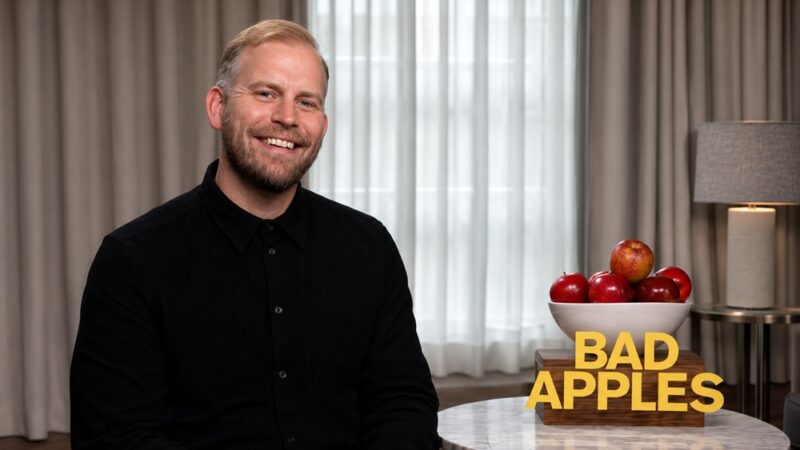
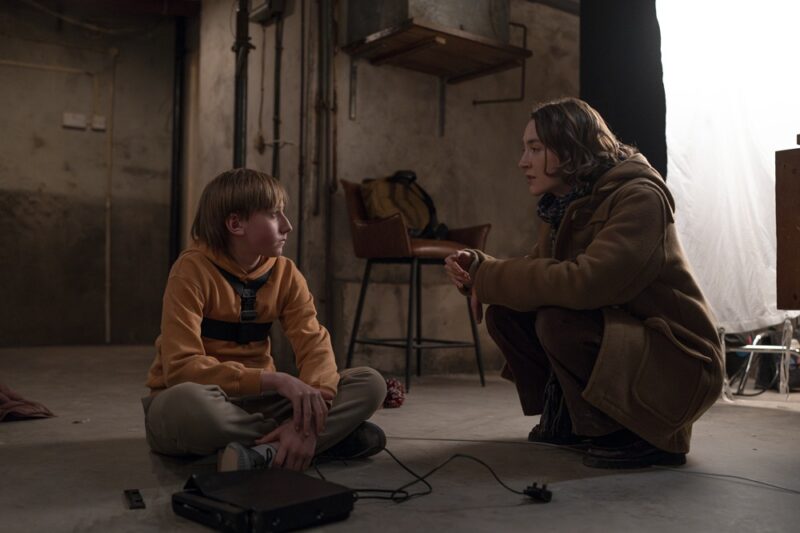
How far can we bend our moral convictions when doing the wrong thing starts producing the right results? It’s the deliciously uncomfortable question at the heart of Bad Apples, director Jonatan Etzler‘s wickedly funny black comedy starring Saoirse Ronan as Maria, a primary school teacher whose increasingly desperate attempts to manage a particularly disruptive student (Eddie Waller) lead to an extraordinary lapse in judgement. When the child’s unexpected absence transforms her once-chaotic classroom into a thriving learning environment, Maria finds herself confronting a predicament that becomes more morally questionable with every passing decision. It’s an outrageous premise, but beneath the film’s escalating absurdity lies a pointed examination of an education system that places impossible expectations on teachers, and a society perhaps a little too willing to overlook the suffering of one individual when everyone else stands to benefit.
Following the film’s enthusiastically received screening at the Toronto International Film Festival, our Peter Gray spoke with Etzler about the importance of allowing audiences to navigate their own moral boundaries, how his and screenwriter Jess O’Kane’s experiences as teachers informed the film’s frustrations, and why he was more interested in questioning the institutions surrounding Maria than simply condemning her actions.
Jonatan, I know that you’ve said the moral dilemma of Rasmus Lindgren’s novel was what immediately grabbed you, and what I love about this film is that it keeps making Maria’s indefensible choices feel very understandable. As a filmmaker, where do you draw the line between asking an audience to understand someone and then kind of accidentally ask them to forgive them?
I usually like to watch films that don’t point fingers at me. Who am I supposed to sympathise with? I hope that the people who watch this film have a moral compass of their own. To me, it was a lot more about asking questions than giving answers.
I know that you and (writer) Jess O’Kane both worked as teachers before this film. Was there anything you understood from being inside that system that you felt films about teachers usually get wrong? Particularly about that gap between wanting to help a child and simply reaching a point where you can’t anymore…
One film I talked to Saoirse about before we made this film was Dead Poet’s Society, which sort of paints out the dream of being a teacher. I think it’s every teacher’s dream to basically be Robin Williams in Dead Poet’s Society. But the reality is usually a lot more difficult, because you don’t really have any of the resources or possibilities to inspire children. And instead, you’re under a tough pressure all the time from how this system works. I think Maria is in this film, too. To me it was important to show that side of teaching.
Personally, I think we need a crossover with this and Bad Teacher…
(Laughs) Yeah, that would make a good double feature.
I love that there’s a point where the film dares us to imagine how much easier everyone’s life would be if one particular person disappeared. For you, is the uncomfortable joke ultimately on Maria, or is it the institutions that can become so dysfunctional that an obviously monstrous solution starts producing results?
Yeah, to me, it’s about the institution and the system that drives Maria to do this. I think you know she’s under so much pressure in the beginning of the film, so, to me, the film then examines what happens when we take the results of this system to its extreme. As far as I know, there’s not that many teachers who have locked up their students (laughs). But I think a lot of teachers who watch this film will feel it’s relatable and that they’ve dreamed about doing this sort of thing. It’s definitely about the system and this world we live in, and are we comfortable with that? Are we comfortable living in a world where it’s actually beneficial for others to suffer so that we can live a good life?
It was so exciting to watch this with a full audience as I did last year in Toronto. It’s really the kind of film where everybody needs to go on the journey, and the laughter and applause that this generated was so amazing. Congratulations again. I can’t wait to see what kind of conversations this generates.
I hope it creates a lot of conversations. It’s definitely a film that you should see in the cinema. I just want to add, it’s such a physical experience, and when you watch it with a group of people it just becomes this collective, intense experience. It’s great and so much fun. So, I really hope a lot of people go see it in the theatres.
Bad Apples is screening in Australian theatres from November 19th, 2026.
