

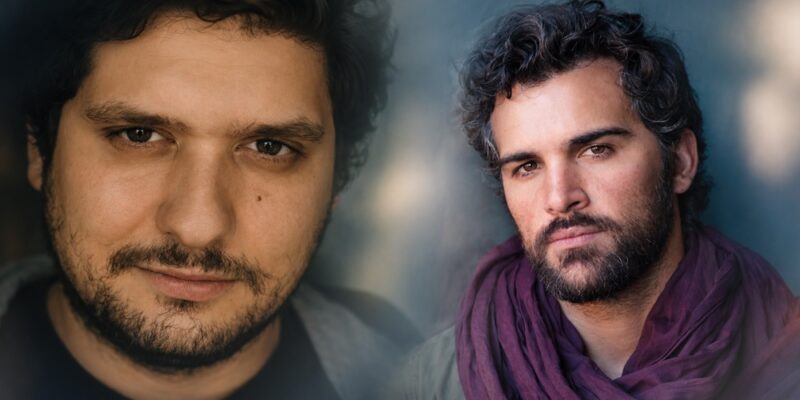
Memory is a curious thing. It rarely returns to us chronologically or completely. A face, a photograph, a fleeting glance, or a feeling we didn’t quite understand at the time can suddenly transport us back to a version of ourselves we thought we’d left behind. And perhaps the greatest cruelty of nostalgia is that, no matter how vividly we remember a person or a moment, we can never truly return to the way it once felt. It’s this bittersweet understanding of memory, longing and the emotional complexities of first love that informs Before We Forget, the tender and deeply personal feature directorial debut of Juan Pablo Di Pace and Andrés P. Estrada. Executive produced by the late Norman Lear, the film follows Matthias (Di Pace), an Argentine filmmaker struggling to complete a movie inspired by his unrequited teenage love for Alexander, a Swedish boy he befriended at boarding school in 1997. When an unexpected invitation offers him the opportunity to revisit that formative relationship some 25 years later, Matthias finds himself confronting not only the boy he once loved, but the potentially unreliable memories that have shaped his understanding of their time together.
Drawing from Di Pace’s own experiences, Before We Forget is more than a conventional queer coming-of-age story. Moving fluidly between past and present, reality and cinematic reconstruction, the film explores the peculiar way we romanticise our adolescence, the feelings we only learn to articulate through hindsight, and the painful realisation that the people we’ve preserved in our memories have continued changing without us. Speaking with our Peter Gray, Di Pace and Estrada reflect on the delicate relationship between memory and fiction, the creative intimacy afforded by their decades-long friendship, and how their own filmmaking process began mirroring the emotional journey of their central character.
First of all, congratulations to you both. I found the film incredibly beautiful and affecting. What fascinates me is how the story explores the subjectivity of memory, yet you’ve created it together as writers and directors. Did you ever find yourselves interpreting the same scene or emotional moment differently? And did those differences help you discover a greater truth within the story?
Juan Pablo Di Pace: There were definitely a lot of conversations with Andrés because we based the story on something that actually happened, and, of course, we had two different points of view. It was an interesting exercise to test each other’s memories, but also to acknowledge that, yes, that’s what happened, but this is a movie. So what’s the most effective way to tell that scene or capture that moment cinematically? Andrés was always reminding me that sometimes reality is less interesting than fiction.
Andrés P. Estrada: We were discovering our different perspectives on things that had happened, but ultimately, it was about finding that third version, which became the fictional version of the story.
There’s something wonderfully meta about editing a film about a man who’s essentially editing his own life. Matthias is a filmmaker attempting to piece together his emotional history, while you both literally had to piece that history together yourselves. Did you ever find yourselves making creative decisions that mirrored what Matthias was experiencing? Perhaps discovering that the version of a memory you wanted to preserve wasn’t necessarily the most truthful?
Juan Pablo Di Pace: I think there was definitely a mirroring of experiences because, yes, the movie is very meta, but the actual shooting of it was meta as well. We found ourselves recreating things even after we’d already started filming.
We shot for about four weeks, and even though the script was already set, we had a break between filming in Italy and Argentina. During that month off, we actually rewrote everything we were about to shoot in Argentina because our experience as co-directors had been so informed by what we’d just lived through. We wanted to incorporate some of that into the present-day story. So our actual experiences while shooting ended up influencing the film itself.
Andrés P. Estrada: We also wrote several scenes before shooting in which the characters were editing the very movie we were making. So we eventually found ourselves in situations that were remarkably parallel to what was happening in the story. As we often said, it felt like reality was copying the fiction we’d already created.
One of the things that stayed with me is how Matthias has carried this particular version of Alex with him for so many years, but the person we remember isn’t necessarily the person who exists today. This might be more for you, Juan Pablo, but do you think Matthias is ultimately searching for Alex, or is he searching for the version of himself that only existed when they were together?
Juan Pablo Di Pace: Well, I think you’ve kind of answered that yourself. When Matthias goes back and sees Alex as he is now, it was a deliberate choice to cast August Wittgenstein, who has a very different energy from the younger Alexander. It’s almost as though the person Matthias remembers has become an entirely different human being.
And I think that’s what happens in life. You can idealise or romanticise a place, a person or an experience, but the reality, the flesh and bones of it, is often very different from what you remember. So it’s really about trying to recapture that feeling. But when you go back, you can end up shattering the very memory you’ve held onto.
Andrés P. Estrada: I think we also reconsidered Alexander’s character a little because August was so different. Ultimately, we found a way to use those differences to explore how time changes people. That became another important theme within the film.
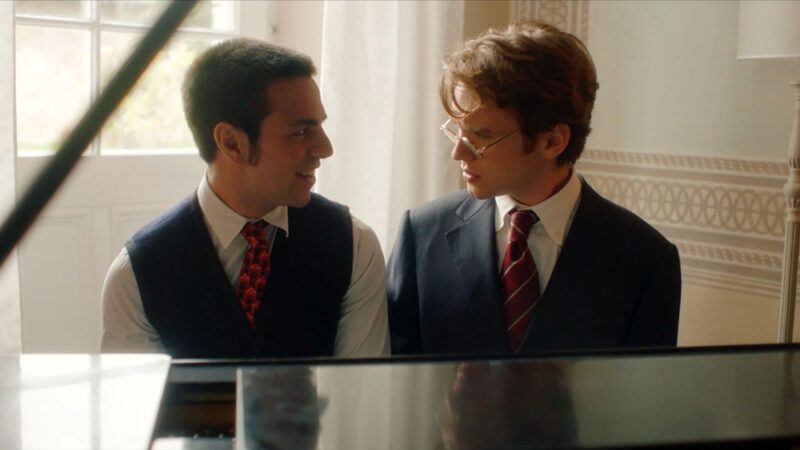
Watching this film, there’s something that really resonated with me as a gay man, and that’s the queer experience of hindsight. We sometimes revisit our adolescence with an emotional vocabulary we didn’t have at the time, recognising looks, gestures and feelings we couldn’t fully understand back then. For both of you, was that experience of rediscovering the meaning of your own past something you consciously wanted to explore together?
Juan Pablo Di Pace: Andrés and I have been friends since we were 13 years old, and our paths have always been somewhat parallel because we’re both in the film industry. I went down the acting and performing route, while he pursued editing. But we originally connected through our shared passion for directing, and we always said we had to make a film together.
So this film represents many things. It’s our feature directorial debut, but it’s also a love letter to our friendship and to those years we both experienced that are so deeply ingrained in our memories. When you’re 17 years old, everything just feels bigger.
Andrés P. Estrada: It was also about rediscovering certain memories and, in my case, understanding more deeply what those experiences were like for Juan Pablo. We’d talked about them over the years, but making the film allowed me to discover so much more about what that time really meant to him.
Making a movie is very different from simply having a conversation about something. It’s a much deeper process. We spent years talking about those experiences, revisiting them and really reliving those moments together. So, in many ways, the filmmaking process became an act of rediscovery itself.
What I really admired about the film is that it doesn’t unfold in a conventional chronology. It feels as though we’re experiencing memories the way Matthias does, with images triggering other images and emotions dictating where we go. Andrés, when you were shaping that structure, how did you know when to let the audience feel disoriented and when to give them something to hold on to?
Andrés P. Estrada: The editing process was really long. They always say that editing is the third writing of a movie, but in this case, it genuinely was. If I remember correctly, we went through three major different cuts before arriving at the final structure.
I think we found that structure quite intuitively because the first two cuts were very calculated. We were consciously searching for something specific, but eventually we decided to approach it differently. It became more about feeling the story, understanding what was happening to these characters and allowing ourselves to be a little freer.
So we ultimately found the structure through the emotions of Matthias, but also those of his parents, because they have such an important perspective in the film as well. It was really those emotions that dictated the shifts in the narrative and the changes in point of view.
As an editor working on such an intimate story, I imagine there are moments when being slightly removed from the character allows you to see something the actor might not recognise themselves. Was there a moment when you discovered something in Juan Pablo’s performance that perhaps he hadn’t realised he’d given you?
Andrés P. Estrada: Yeah, I think that was really my main goal during the shoot: to be there for Juan Pablo when he was in front of the camera. I don’t know if I necessarily discovered something he wasn’t aware of, or if I simply gave him the space to develop the character.
But what I can say is that, ultimately, we created this character together. It wasn’t Juan Pablo anymore; it was Matthias. We constructed this new character throughout the entire filmmaking process, including the editing, where we actually changed quite a lot.
I think in the earlier versions, Matthias was more anxious, more lost. But by the end, he had become stronger. That was really the process for us: allowing Matthias to grow stronger and ultimately find himself.
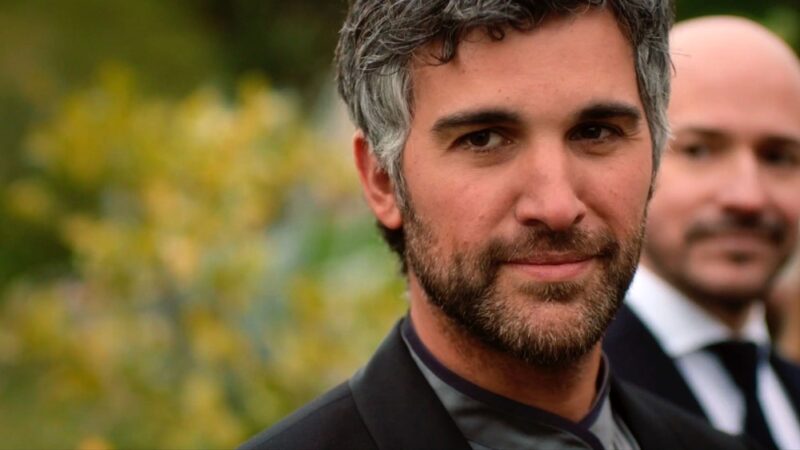
I think that speaks to your creative relationship, because you’ve both worked across several disciplines on this film, and I imagine you’ve developed a certain creative shorthand. Do you think your greatest strength as collaborators is that you see the world similarly, or that you see it differently?
Juan Pablo Di Pace: Andrés and I are like brothers because we know each other incredibly well, but at the same time, we’re very different in how we see the world, and sometimes even in our tastes. Yet beneath those differences, there’s a sensibility that is very much aligned.
Whenever we talk about the feeling we want a scene to evoke, we’re always on the same page. So he’s an incredible person to work with. I’ve worked with plenty of people where you have to explain everything, but with Andrés, we don’t even need to do that. Sometimes we just look at each other and it’s like, “Yep, yep.” We just know.
I imagine that creative understanding would have been particularly valuable for certain scenes. There’s a moment following Christmas between Matthias and his mother that I found incredibly affecting. What’s so beautiful about it is how much of the emotion comes from what she understands without him ever having to explain himself. From both an acting and directing perspective, how did you approach that scene together, particularly knowing that its power depended on restraint rather than dialogue?
Juan Pablo Di Pace: From my perspective, there were many versions of that scene, and it kept getting trimmed down until we were left with just the essential moments. At one point, the scene actually involved both parents having a conversation, but that was eventually removed.
What I really love about working with Andrés is that process of chipping away at the excess, which I think is essential in any form of art. The worst thing you can do is simply settle for the first version of something. Sometimes that first version is amazing, but there’s something so valuable about continuing to refine it, digging deeper and deeper until you find exactly what it needs to be, and nothing more.
That’s probably what I’ve enjoyed most about our collaboration. It’s almost like being a doctor, trying to get to the root of something. You keep questioning it, thinking, “But could this be better? Could we go further?” And you continue that process until you find what really works.
Andrés P. Estrada: With scenes like that, I think I approached the work more from an editor’s perspective, particularly because that moment was taken very closely from reality. It’s very similar to something Juan Pablo actually experienced.
I initially edited the scene myself and then brought it to him, saying, “Okay, this is how I see it. This is how I think the scene could work. Now let’s explore how you feel about it.”
That became quite a long process because I was approaching it as an editor, trying to discover what the fictional version of that experience could achieve. I wasn’t there when the real moment happened, so I had a certain distance from it. My role was to explore what the fiction could bring to the scene, and then allow Juan Pablo to bring the emotional truth of his own experience into it.
It’s clear that your longstanding friendship and creative relationship have translated beautifully to the screen. There’s something heartbreaking about the idea that Matthias can recreate the locations, images and even the people from his adolescence through filmmaking, but he can never truly recreate what it felt like to be that age. And given how much nostalgia seems to shape our culture right now, do you think part of its tragedy is that we’re often longing for a feeling rather than an actual moment?
Juan Pablo Di Pace: Yeah, absolutely. We’re living in an age of nostalgia, and I think you can even see it in architecture. I was in Italy last month, and looking at the piazzas, the buildings, the windows and the bathrooms, everything felt so much more beautiful. You look around and get this feeling that we’ve lost something. Now everything seems to be glass and [unclear], and there’s this desire to return to a time or a feeling that seemed more beautiful.
With this film, it was a very deliberate choice to avoid screens. There’s only one computer screen in the entire movie. I didn’t want phones or iPhones appearing because we’re already so saturated with that world. We wanted to make a film that felt, in a way, more essential, where technology wasn’t such a dominant part of life.
So nostalgia is a huge element of the film, and I think there’s something universal about that feeling right now. We all have this sense that perhaps things were a little better when we were younger.
Before We Forget is now available on Digital and On Demand in the United States.
