
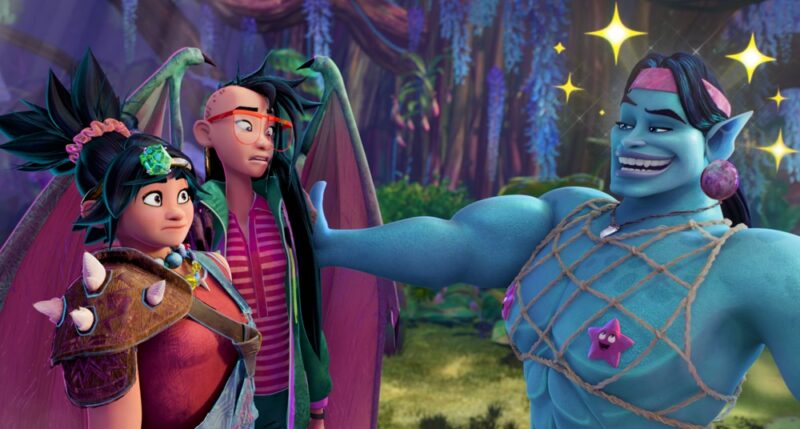
DreamWorks has been enjoying something of a creative renaissance in recent years, but even with the studio increasingly willing to push its visual language, Forgotten Island feels like a particularly special swing. Vibrant, wonderfully strange and ultimately far more emotional than its chaotic adventure initially suggests, Joel Crawford and Januel Mercado’s Filipino mythology-inspired feature takes a familiar story about friendship and growing up and finds something remarkably fresh within it.
Set in the 1990s, the film centres on lifelong best friends Jo (voiced by H.E.R.) and Raissa (Liza Soberano), two young women standing at that uncomfortable point where growing up threatens to mean growing apart. Raissa is preparing to leave for America to study at Caltech, while Jo’s future is considerably less mapped out. Their friendship remains loving, but the imbalance between where their lives appear to be heading has created a tension neither particularly wants to acknowledge.
Their final night together takes an unexpected turn when stories told to them by Jo’s late grandmother (Dolly de Leon) prove considerably less fanciful than they once believed. A portal transports the pair to Nakali, a hidden island populated by creatures drawn from Filipino mythology, and what should have been one last evening together becomes an increasingly unhinged journey home.
And unhinged is often the appropriate word.
After waking with only fractured memories of the previous night – and, in Raissa’s case, considerably less hair – Jo and Raissa have to retrace their steps across the island. The premise allows Crawford and Mercado to indulge in some delightfully bizarre comic detours, helped enormously by a supporting cast that includes Dave Franco as the lovably neurotic weredog Raww, alongside Manny Jacinto, Jenny Slate, Jo Koy and Ronny Chieng.
Then there’s Lea Salonga as the Dreaded Manananggal, a creation whose design alone should ensure younger viewers spend at least a few nights reconsidering what might be lurking in the dark. She’s threatening without pushing the film outside its family-friendly boundaries, and Salonga lends the character exactly the theatrical menace you’d hope for.
As entertaining as Nakali proves, however, the mythology never feels like decoration.
That cultural specificity is arguably Forgotten Island’s greatest strength. Filipino folklore, family traditions, food, music and humour aren’t additions applied to an otherwise generic fantasy framework; they’re embedded in the film’s identity. Nakali feels as though it has grown from stories handed down through generations, and the filmmakers clearly understand that mythology is as much about who tells these stories, and why they continue telling them, as it is about the creatures themselves.
It consequently gives Forgotten Island an identity that separates it from the countless animated adventures built around magical worlds and reluctant heroes. The film is proudly Filipino without feeling as if it needs to stop and translate itself for an international audience. Its specificity becomes its accessibility.
Visually, it’s equally confident.
Following the stylistic experimentation of Puss in Boots: The Last Wish, DreamWorks continues moving away from the polished uniformity that once dominated major studio animation. Forgotten Island is bursting with colour and texture, shifting between painterly 3D animation, flashes of anime influence, comic-book framing and exaggerated visual flourishes that allow words and sounds to become part of the environment itself.
It sounds busy – and occasionally it is – but rarely does it feel undisciplined. Crawford and Mercado integrate those different influences into a remarkably cohesive whole. The animation changes because the storytelling demands it, rather than because the filmmakers simply want to demonstrate another visual trick.
For all that technical bravado, though, the film’s greatest achievement is surprisingly intimate. At its core, Forgotten Island understands that losing a friendship doesn’t necessarily require betrayal. Sometimes people simply move. Their ambitions change. New relationships arrive. Someone who once knew everything about you gradually becomes someone you have to update. Jo and Raissa love each other deeply, which makes the possibility of their separation hurt more, not less.
The film eventually literalises that fear through its treatment of memory, represented beautifully through the charms collected on the pair’s friendship bracelets. Each charm signifies an adventure, a joke, a mistake or some seemingly insignificant moment that became significant simply because they experienced it together. What initially appears to be a cute visual motif gradually becomes central to the film’s emotional argument: our memories of other people aren’t merely things we possess. They have helped construct the people we became.
That idea gives the increasingly spectacular final act an unexpected emotional weight.
Without venturing too deeply into spoiler territory, Forgotten Island eventually asks Jo and Raissa to confront what their friendship actually means beyond nostalgia. It’s here that the film moves past the expected “best friends forever” messaging and finds something more mature. Loving someone doesn’t mean demanding that they remain exactly where you left them. Sometimes preserving a relationship means allowing it to change.
H.E.R. and Soberano are instrumental in making that land. They give Jo and Raissa the easy shorthand of people who have spent years together, but also communicate the tiny resentments that can emerge when one person appears ready to move forward and the other feels left behind. Their younger counterparts similarly establish enough history that the friendship feels genuinely lived-in rather than merely asserted by the screenplay.
And when Forgotten Island starts digging through that history, it hits considerably harder than expected.
The film’s exploration of Jo’s grandmother, childhood and the memories binding these characters together gives its final stretch a genuine emotional wallop. What begins with the energy of an animated The Hangover gradually transforms into something closer to an adventure through the architecture of memory itself. It’s funny until it suddenly isn’t, and the transition proves remarkably effective.
If anything, Forgotten Island occasionally has too much imagination for its own good. Nakali is populated with so many creatures, ideas and visual eccentricities that certain elements inevitably receive less attention than others, and the frenetic middle stretch can sometimes threaten to overwhelm the quieter relationship sitting underneath it.
But what a lovely problem for an animated film to have.
At a time when so much family entertainment seems engineered around recognisable properties and easily marketable familiarity, Forgotten Island feels thrillingly personal. Crawford and Mercado have taken the universal anxiety of watching a formative friendship enter uncertain territory and filtered it through Filipino mythology, irreverent humour and some of the most expressive animation DreamWorks has produced.
It’s colourful, chaotic and frequently hilarious, but underneath all that spectacle is a deceptively simple observation: we are, in part, collections of everyone who has mattered to us. People leave. Friendships change. Memories fade. But that doesn’t make what they gave us any less real.
Forgotten Island may be concerned with things being lost to memory, but this wonderfully weird, culturally rich and unexpectedly moving adventure has little chance of suffering that fate.


THREE AND A HALF STARS (OUT OF FIVE)
Forgotten Island is screening in Australian theatres from September 17th, 2026.
