
Friendships don’t necessarily end with an argument or betrayal. Sometimes life simply starts pulling two people in different directions, and the fear of what might be lost along the way can prove just as painful.
That anxiety sits at the emotional centre of DreamWorks Animation’s Forgotten Island, a vibrant fantasy adventure that sends lifelong best friends Jo (H.E.R.) and Raissa (Liza Soberano) to the magical island of Nakali just as their lives are threatening to separate them. Raissa is preparing to leave home and pursue her ambitions at Caltech, while Jo is confronting the possibility that the person who has defined so much of her life may no longer be there in the same way. Their fantastical predicament ultimately gives that fear devastatingly literal stakes: escaping the island could cost them the memories of their friendship entirely.
But for Soberano, who grew up in the Philippines, the film’s emotional resonance extends beyond the idea of lifelong friendship. It’s in what she describes as the “Filipino heart”: the cultural instinct to care deeply for your community and consider the people you love when making decisions about your own future. It’s a quality woven throughout Forgotten Island, which embraces Filipino mythology and culture whilst exploring the difficult truth that loving someone doesn’t mean your lives always have to move in the same direction.
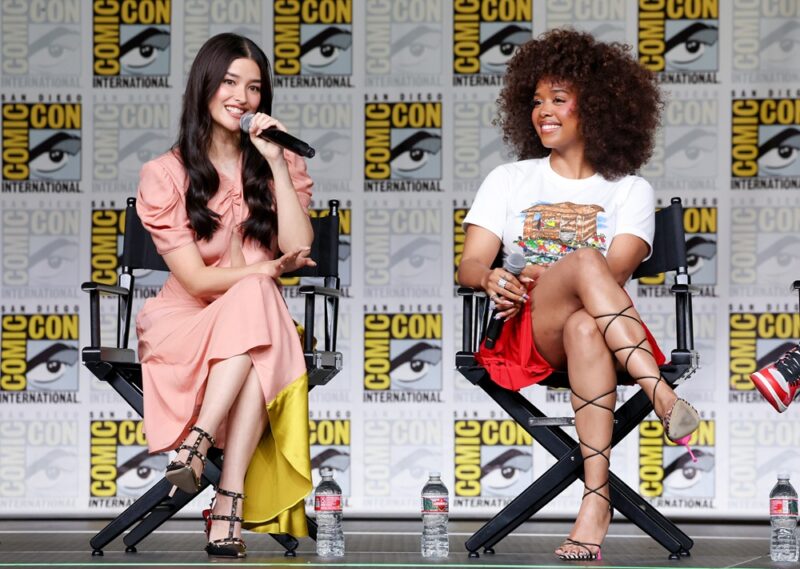
That connection proved just as organic between its two leads. In a rarity for animated filmmaking, Soberano and H.E.R. were able to record together, allowing their own personalities to bleed into Jo and Raissa. From encouraging each other through the film’s playful moments to finding the emotional weight behind its Polaroids, friendship bracelets and distinctly ’90s absence of FaceTime, their chemistry became another reflection of a film about learning that distance doesn’t have to mean losing someone.
Speaking with our Peter Gray, Liza Soberano and H.E.R. discussed bringing that Filipino heart to Forgotten Island, recognising their own best friendships in Jo and Raissa, the freedom of performing together in the recording booth, and why pursuing your own dreams doesn’t have to mean sacrificing the relationships that helped shape you.
The film is obviously about chemistry and friendship, and this story very much lives or dies on whether we believe Jo and Raissa’s bond. What did you each recognise in your own lives that helped you understand that kind of lifelong friendship?
Liza Soberano: I think, more than the lifelong friendship, it’s about recognising that Filipino heart for the people you care about. That’s what I personally resonated with most. Growing up in the Philippines, there’s so much importance and intentionality placed on taking care of the people around you, whether they’re family, friends or extended family. You’re always considering how the decisions you make in your own life might affect them. So it was about bringing that nuance of our culture into the film.
But I also have a best friend, and I understand the difficulties and the journey you go through together. There’s something magical about continually rediscovering each other through the different phases of your lives.
H.E.R.: Yeah, definitely. It was really special to see, like you said, the importance of community in Filipino culture and what it means to have a friend worth fighting for. There’s that fear of being left behind, of being afraid of change – there are so many themes in this film that I think people are going to resonate with.
It really resonated with me personally, too. I have a best friend back home, and we’ve spent a lot of time apart, but every time we get back together, it feels like no time has passed. Those are the kinds of friendships worth fighting for, and you really feel that in Jo and Raissa’s relationship.
On the mention of having best friends, did the two of you build a shorthand or a language while recording? I know that you actually got to record in the booth together, which doesn’t always happen. Did you come up with a way to just know what the other was thinking? A way to bounce off each other?
Liza Soberano: It was actually really interesting. We were watching each other and reacting in the way you would on a live-action set. I’d seen a lot of H.E.R.’s work, so I already had this perception of who she was as a person. But then I got to meet her in real life, and we had a few moments to talk before going into the recording booth.

