

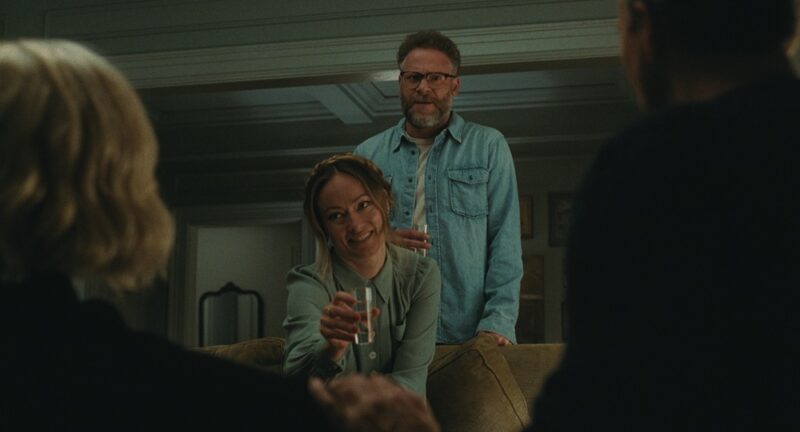
A dinner party where everyone decides to be honest. Is there anything more dangerous?
That deceptively simple premise powers The Invite, Olivia Wilde‘s sharply observed adaptation of Cesc Gay’s The People Upstairs, and what initially resembles an awkward comedy of manners gradually evolves into something richer, sadder and surprisingly profound. Restricting itself almost entirely to a single San Francisco apartment over the course of one evening, the film proves that compelling cinema doesn’t require spectacular physicality. Sometimes all it needs are four remarkable actors, a razor-sharp screenplay and the courage to let uncomfortable conversations play out without flinching.
Joe (Seth Rogen) returns home from another uninspiring day teaching music to discover his wife Angela (Wilde) has invited the couple from the apartment upstairs to dinner. They’re the neighbours whose enthusiastic sex life has kept Joe awake for weeks, though Angela insists the invitation wasn’t some passive-aggressive attempt at revenge. Before long, Hawk (Edward Norton) and Piña (Penélope Cruz) arrive with effortless charm, homemade flan and an openness about relationships that slowly dismantles every emotional wall Joe and Angela have spent years constructing.
From there, The Invite becomes less about the possibility of sexual experimentation than emotional vulnerability. The prospect of an unconventional evening is merely the catalyst for something much more fascinating: a brutally funny examination of what happens when two people realise they’ve been living beside each other rather than with each other.
Writers Rashida Jones and Will McCormack understand that the sharpest comedy often comes from painful truths. Every joke lands because it reveals something about these people, whether it’s Joe masking disappointment behind sarcasm or Angela desperately trying to manufacture the image of a perfect life. The dialogue never feels overwritten despite its theatrical origins, instead flowing with the rhythm of real conversations that gradually become impossible to control. One cutting remark leads to another, long-buried resentments surface, and laughter becomes almost inseparable from heartbreak.
It’s a delicate tonal balancing act that Wilde navigates with remarkable confidence. She understands exactly when to lean into farce and when to simply let silence hang between her characters. Rather than chasing broad comedy, she finds humour in social discomfort, bruised egos and the terrifying prospect of actually saying what you mean to the person you’ve spent decades beside.
As a director, Wilde displays an assurance that suggests she’s found material perfectly suited to her strengths. Working within one location could easily have felt stage-bound, but her camera constantly redefines the emotional geography of the apartment. Hallways suddenly feel restrictive, dining chairs become battlegrounds, and characters frequently occupy the same frame while appearing emotionally worlds apart. The apartment becomes its own pressure cooker, gradually shrinking as every confession removes another layer of polite civility.
Adam Newport-Berra‘s elegant cinematography and Jade Healy‘s immaculate production design reinforce that subtle claustrophobia. Despite the apartment’s generous proportions, it begins to feel increasingly suffocating as the evening spirals. Devonté Hynes‘ understated score likewise resists melodrama, quietly amplifying the mounting unease without ever dictating how the audience should feel.
The performances elevate already exceptional material into something genuinely memorable.
Rogen delivers arguably his finest dramatic work to date. Joe is deeply flawed, frequently petty and often infuriating, yet Rogen never asks the audience to excuse his behaviour. Instead, he reveals the insecurity beneath the sarcasm, allowing us to recognise someone who has quietly settled for a version of adulthood that no longer resembles the future he imagined.
Wilde is equally superb. Angela initially presents herself as someone obsessing over seating arrangements, soufflés and expensive rugs, but those anxieties gradually reveal themselves as symptoms of someone desperate to maintain control over a life she fears is slipping away. Wilde strips away the effortless confidence audiences often associate with her screen persona, exposing a woman whose need for validation has become almost paralysing.
Norton proves to be an inspired comic foil, effortlessly shifting between warmth, sincerity and playful provocation without ever turning Hawk into a smug caricature. His natural charisma makes it believable that he can simultaneously diffuse conflict and unknowingly intensify it.
Yet it is Cruz who quietly steals the film. Piña possesses an emotional intelligence that could easily have been written as mystical or pretentious, but Cruz grounds every observation in genuine empathy. Rather than judging Joe and Angela’s fractured marriage, she simply refuses to let them hide from it. It’s an effortlessly magnetic performance that never demands attention but commands it anyway.
What makes The Invite especially rewarding is its refusal to reduce relationships to easy answers. The film isn’t interested in arguing for or against monogamy, polyamory or any particular lifestyle. Instead, it asks whether comfort has become the enemy of intimacy, and whether many couples eventually stop communicating honestly simply because pretending everything is fine becomes easier.
Those ideas linger well beyond the closing scene, which wisely avoids offering neat resolution. Wilde leaves just enough ambiguity for audiences to project their own experiences onto Joe and Angela’s future. Is this the painful beginning of rebuilding a marriage through honesty, or simply the first time they’ve admitted it’s already over? The film trusts viewers to reach their own conclusion, making its final moments all the more affecting.
In an era where so many studio films mistake volume for substance, The Invite feels almost rebellious. It’s driven by conversation rather than spectacle, character instead of plot mechanics, and emotional intelligence over easy provocation. Its biggest set pieces are arguments around a dining table, yet they’re every bit as gripping as the loudest blockbuster action sequence.
Wilde has delivered a film that’s hilarious without sacrificing sincerity, emotionally devastating without becoming melodramatic, and deeply relatable regardless of your relationship status. It’s the kind of intelligent adult comedy Hollywood rarely makes anymore – and a welcome reminder that some of cinema’s greatest pleasures come simply from watching exceptional actors share a room and tell uncomfortable truths.
A witty, emotionally perceptive triumph that transforms one awkward dinner party into one of the year’s most insightful explorations of love, compromise and the quiet ways relationships unravel, The Invite is one such you should immediately accept.

FIVE STARS (OUT OF FIVE)
The Invite is now screening in Australian theatres.
