
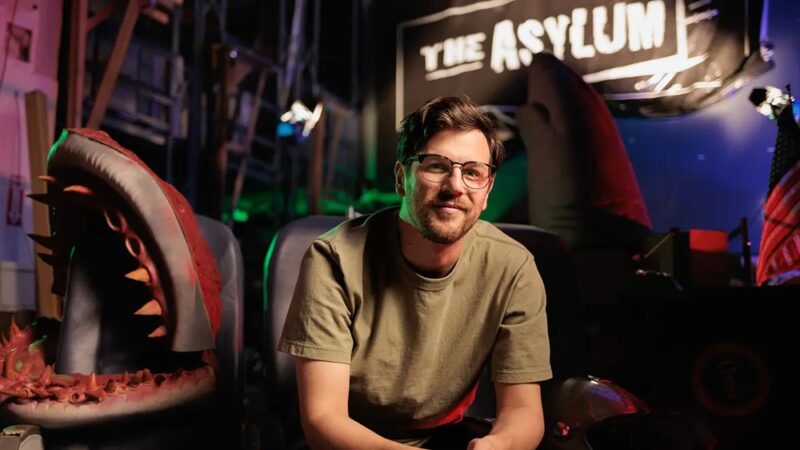
Most aspiring filmmakers spend years imagining the moment someone finally says “yes.” For Australian filmmaker Anthony Frith, that moment came courtesy of The Asylum, the notorious studio behind Sharknado and countless mockbusters. What followed was an offer to direct a dinosaur adventure in suburban Adelaide with just six days to shoot it.
On paper, Mockbuster sounds like the setup to a joke. In practice, it becomes something far more revealing. Equal parts hilarious and heartfelt, Frith’s audience-award-winning documentary follows the chaotic making of The Land That Time Forgot while quietly unpacking the fears, hopes and insecurities that come with finally getting the opportunity you’ve always wanted. Ahead of the film’s festival screening, our Peter Gray spoke with Frith about chasing impossible dreams, finding unexpected lessons in The Asylum’s filmmaking machine, and why the real story was never the dinosaur movie at all.
Before we get into Mockbuster itself, I have to ask: we all have that movie we know isn’t exactly “good,” but we love it anyway. Is there a film you’ll defend to the end of time – whether it’s genuinely bad but incredibly entertaining, or one you think deserves a complete critical reappraisal?
I’m going to be cheeky and pick two. Troll 2 is a masterpiece – the best worst movie ever made. Absolutely incredible. But the real winner for me is Miami Connection. It’s this wonderfully cheesy 80s kung-fu action thriller, and I genuinely cried laughing watching it. Some of the dialogue is so bizarre and unforgettable that it’s stuck with me ever since.
There’s this moment about halfway through where one of the characters is having an emotional breakdown after discovering his father is still alive. The group all live together in a share house and play in a kung-fu rock band – Dragon Sound, I think – and suddenly another character chimes in with something like, “We’re all orphans.” It’s this completely random revelation that comes out of nowhere and somehow explains why they’re all together.
The fact that it’s delivered so casually, so late in the film, is one of the funniest things I’ve ever seen. It’s amazing. I love it.
Is it called Miami Connection because they all live in Miami?
Honestly, I have no idea. But it’s great.
I’m definitely adding that to my watchlist – that sounds completely wild. Looking at Mockbuster, throughout the film you’re chasing what success is supposed to look like: directing a feature, getting a Hollywood opportunity, earning that validation. Yet by the end, it feels like you’ve accidentally discovered something much more valuable. How did you define success before this journey began, and how has that definition changed after going through it?
Yeah, I think when you’re younger, you dream about making movies that everyone sees – films that play in cinemas everywhere, with that idea of global recognition attached to them. But as you get older and become more grounded in your own life, your family, and who you are, the goal gets a lot simpler. It becomes, “I just want to make a movie.”
What’s funny is that the dream itself never really disappeared. What changed was the scale of it. There was something important about knowing it was actually attainable in some form. In a way, that became more meaningful than the size of the dream itself. It wasn’t necessarily about making the biggest movie possible – it was about proving that the dream could become real. If that makes sense.
Every filmmaker dreams of getting that one call that finally opens the door. When The Asylum said yes, did you have a moment of, “This is it, I’ve made it” – before the reality of what you’d agreed to hit and you started wondering, “What have I gotten myself into?”
Oh, that’s a good question. It was so surreal that they said yes that I don’t think it really registered at first. My reaction was basically, “Okay… sure. I guess this is happening now.” The weight of it didn’t hit me until later, as I learned more about The Asylum and how they operate. That’s when the expectations started to feel real – and honestly, a little intimidating.
I think people assume that because everyone knows The Asylum for these wild, low-budget movies, they must not care about quality. But that’s not true at all. They genuinely care, and they’re trying to make the best films they can within the circumstances they have. Once I understood that, I realised there was a responsibility that came with the job. Whether you’re working for Warner Bros. or The Asylum, they’re still the studio, and you’re expected to deliver the film they want. As that reality started to sink in, the pressure became much more obvious – and a lot more daunting.
Yeah, watching it was fascinating because I think most people assume The Asylum is just churning these movies out – “Oh, a big studio releases one thing, and they’ll make a knock-off version of it.” But what really struck me was that they’re completely aware of the kind of movies they’re making, and yet that doesn’t lessen the standards or expectations. Every box still has to be ticked. Every decision still matters.
And the fact that you had seven days to make this thing… I was watching it thinking, “This can’t possibly be real.” But it is, because the film is literally showing us the process. It almost feels like the premise of a joke: an Australian corporate videographer pitches himself to the studio behind Sharknado and somehow gets hired to direct a dinosaur movie.
But somewhere along the way, it stops being about the dinosaur movie. What starts as a filmmaking story becomes something much more personal, and we watch you become increasingly vulnerable throughout the process. At what point did you realise that this wasn’t actually a story about making a dinosaur movie – that it was really a story about you?
Pretty quickly, honestly. The two ideas kind of arrived at the same time: I should see if The Asylum will let me make a movie, and I should document the experience of trying to make that movie. In my head, they were always linked. I’ve always been obsessed with people’s dreams – the things they aspire to, the goals they spend years chasing. So it made sense for the documentary to focus on that rather than just the mechanics of making a film.
I love behind-the-scenes documentaries like American Movie and Burden of Dreams, but I think a lot of filmmaking documentaries can get caught up in the production itself and miss the human side of the story – the passion, the obsession, the emotional investment that drives people to do this in the first place. Obviously American Movie is a great example of one that does capture that.
For me, it just felt right to make a film about the person behind the process. The filmmaking context was fascinating, but what really interested me was the dream underneath it all. That’s the kind of story I love, so it felt natural to make something more human and emotionally grounded rather than a straightforward behind-the-scenes documentary.
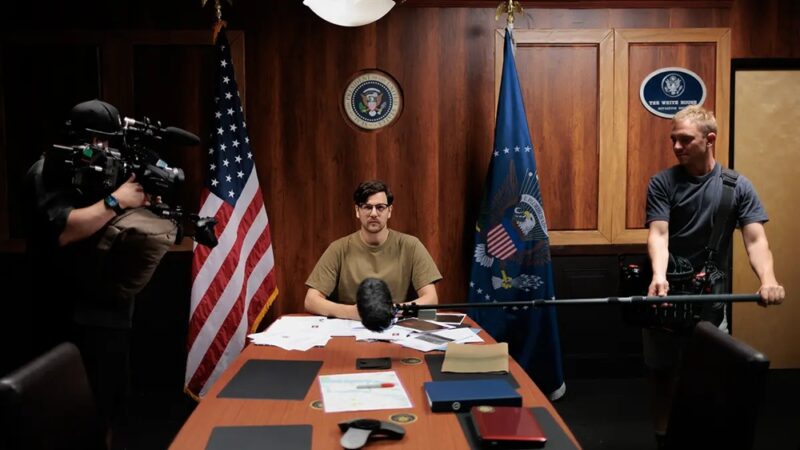
Well, you obviously pitched yourself to The Asylum, but before they handed you The Land That Time Forgot, did you have a movie you were secretly hoping they’d let you make? Was there a particular genre or type of story where you thought, “This is my lane. This is what I’d love to be doing”?
Yeah, I really wanted to do either an alien/sci-fi film or a shark movie. But apparently they only give their shark movies to second-time directors, because you need to step up a rung first (laughs).
Now that you have one under your belt, do you want to make your shark movie with them now?
They’ve actually asked me a few times since The Land That Time Forgot. I haven’t said yes yet. The thing is, I really love making documentaries, so I’m not sure I’m ready to jump back into the scripted-schlock saddle just yet. But it’s nice knowing that option is there. If I never manage to get another feature off the ground, at least I know exactly who I’ll be calling (laughs).
I mean, you could always make a documentary about a second-time filmmaker making another Asylum movie. But it’s funny watching this because The Asylum almost feels like its own film school. People love to laugh at these movies, but so many great filmmakers started in similar environments – working fast, with limited resources, and learning on the job. That’s how people like Scorsese, Coppola, and James Cameron cut their teeth.
Did working with The Asylum change the way you think about success as a filmmaker? Not success in terms of box office or prestige, but what it actually means to successfully make a film and build a career doing it?
Yeah, Roger Corman’s productions were basically film school, and honestly, from my experience, The Asylum is about as deep an end as you can be thrown into. There were real expectations, real money, and real people investing their time and effort into the film, so you had to learn quickly. A lot of the crew felt the same way – it teaches you how to work economically, how to make decisions under pressure, and how to get things done on an incredibly tight budget and schedule.
It was technically the first feature I’d ever directed – although there’s always an argument about whether that was Mockbuster or The Land That Time Forgot. Either way, it was my first experience being in charge of a proper feature set, and I learned an enormous amount from it.
What it really taught me was how to redefine success. Within the context of an Asylum film, success wasn’t necessarily making a perfect movie. It was looking at certain scenes and thinking, “We nailed that.” There are moments in the film that I’m genuinely proud of – scenes the crew and I spent extra time on and elevated beyond what people might expect. Those moments feel like successes to me.
And honestly, another measure of success is much simpler: I’ve got a DVD of the movie sitting in my lounge room. I never thought I’d get to release a real feature on DVD. That’s still incredibly cool to me, and every time I see it, I think, “Yeah, that’s pretty sweet.”
I’m a huge supporter of physical media, so I love that part of the story. But what fascinated me about The Asylum is how brutally honest their business model is. The goal is pretty clear: make movies quickly, make them cheaply, and make them profitable. Was there something strangely liberating about working in a system like that – where nobody’s pretending art and commerce aren’t constantly pulling against each other, and everyone is upfront about the realities of the business?
That’s a good question. Yeah, there was, actually. The thing about The Asylum is that there was a very clear understanding of what the film needed to be. The expectations were defined from the start. If you could exceed them, great – that was the goal. But if you simply met them, then you’d still done your job. You’d delivered a film that fulfilled the brief and fit the product specifications. That clarity was oddly liberating. There wasn’t a lot of ambiguity about what success looked like.
Of course, we still wanted to push beyond those expectations because that’s what filmmakers do – we’re foolish enough to believe we can make something better than it needs to be. But there was also a strange comfort in knowing that if it didn’t completely work, it wasn’t the end of the world. It would just become one film among the hundreds The Asylum has made over the years.
In a weird way, that took some of the pressure off. It gave us permission to take swings and try things, because the stakes felt both incredibly high in the moment and strangely low in the grand scheme of things.
One of the things that really struck me is how emotional Mockbuster is. We see those moments where your confidence is cracking. Was there ever a temptation to protect yourself in the edit and cut those moments out?
There was definitely a point where it felt uncomfortable, but once you get into the edit, you start thinking about yourself less as you and more as a character in the story. That distance takes a little while to develop – probably a few weeks into the edit – but once it clicks, it becomes much easier to be objective.
You stop seeing every moment as a personal reflection and start asking whether it serves the film.
It also helped that I was working with an editor I’d collaborated with before. He knew me really well, which meant he could bring a more objective perspective to the material. We could have honest conversations about what needed to stay in for the sake of the story, even if it was uncomfortable. So it definitely starts out difficult, but as the process goes on, it gets easier. You begin to see the version of yourself on screen as a character you’re shaping rather than simply yourself being exposed.
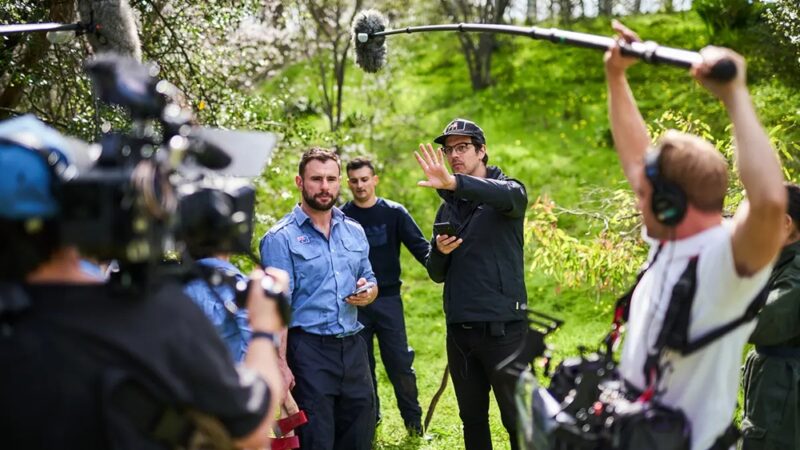
Did you ever have to have a conversation with The Asylum about the documentary itself? Because there’s a funny dynamic at play where you’re documenting the making of the movie, and at a certain point Mockbuster arguably becomes the bigger story. Was there ever any concern from their side about how much access you were getting or what you were capturing behind the scenes?
Or were they completely comfortable with it because The Land That Time Forgot was already going to be out by the time audiences saw the documentary? Was there ever a moment where they said, “Hang on, we’re not sure we want all of this documented”? Or were they surprisingly open to the whole process?
No, they were pretty much on board from the start. They just thought the whole idea was funny. Their attitude was basically, “Yeah, sure, whatever. We’re going to make the movie anyway. We can give you a hundred grand to direct it, and if you want to document the process, why not?” There was never really any resistance to it.
In fact, when we had the North American premiere at the Santa Barbara International Film Festival earlier this year, Paul – one of the heads of The Asylum – came along and did a bunch of media interviews and Q&As with us. He kept joking that I’d made a very good movie about a very shitty movie. So they were completely on board. They understood the joke, they understood what the documentary was doing, and they were happy to be part of it.
Which, honestly, feels like the highest compliment you could get from The Asylum. But what really stayed with me about the documentary is that beneath all the comedy and chaos, there’s a very recognisable fear running through it: “What if I finally get the opportunity I’ve been waiting for and discover I’m not actually good enough?”
That’s a fear a lot of creative people carry around, whether they’re filmmakers or not. Was confronting that fear – and having to test it in the real world – actually harder than making the movie itself?
I guess the weird thing is that I was dealing with that fear twice over, because both films were being made at the same time. On one hand, I wanted The Land That Time Forgot to be good – or at the very least, watchable, entertaining and fun. But I also wanted Mockbuster to be good because that was the film that really reflected the kind of stories I’d love to tell as a filmmaker. In a lot of ways, they were both my first feature. So it felt important that each one worked on its own terms. The Land That Time Forgot needed to succeed as an Asylum movie, while Mockbuster needed to stand on its own as a documentary.
What made it difficult was that there was this constant internal tug-of-war between the two. Some days the dinosaur movie felt like the priority; other days the documentary did. They were separate projects, but they were also completely intertwined. It’s a strange thing to explain because they’re really two different thoughts that somehow became the same thought. The success or failure of one inevitably affected the other, so I was carrying both of those anxieties at the same time.
Watching it, there are so many potential obstacles competing for your attention. You’ve got the tiny budget, the impossible schedule, the expectations of the studio, and then there’s that voice in the back of your head wondering whether this whole thing is a terrible idea. Looking back now, what was the biggest challenge to overcome? Was it one of the practical limitations, or was it actually the mental side of it – the self-doubt and pressure you were putting on yourself?
Yeah, I think the schedule and the fear that came with the schedule were really the same challenge. They were definitely the biggest hurdle. When you’re making a short film, you might shoot three pages a day over five or six days and end up with a ten-minute film. That’s manageable. This was the complete opposite.
Suddenly it was, “You’ve got 25 pages to shoot today. I’ll be watching the rushes tonight, and by the morning you might have notes and need to reshoot half of it.” Just wrapping your head around that felt almost impossible at first. Twenty-five pages a day is brutal. It’s brutal for the director, it’s brutal for the crew, and it’s brutal for the actors, who are trying to learn and perform huge amounts of material under enormous time pressure.
It felt tough because it was tough. There wasn’t really any trick to it – you just had to find a way through it and keep moving forward. That’s what made it so intimidating.
Was there a moment during production where things became so absurd that you thought, “Nobody is ever going to believe this happened”? If the documentary cameras hadn’t been there, you could tell this story for the rest of your life and people would just look at you and say, “Yeah, right, mate. Sure you did.”
Was there a particular day or incident where the whole experience crossed over from stressful into completely unbelievable?
People still don’t believe it (laughs). I met a guy recently who asked where we’d hired the baby from. He thought my son was an actor we’d cast and that the whole thing was a mockumentary. And honestly, I get it. I think the title Mockbuster throws people off if they don’t already know what a mockbuster is. They hear the name and immediately assume it’s a mockumentary.
Then they watch it, and the premise is so absurd that they’re convinced it’s fake. An Australian corporate videographer somehow talks his way into directing a dinosaur movie for The Asylum? It sounds made up.
But as the film goes on, people seem to get more and more confused because it all appears to be real – except there are these genuinely bizarre and ridiculous moments that feel too strange to be true. So I think audiences spend a lot of the film trying to work out what’s real and what isn’t.
The funny thing is, it’s all real. I’ve got about 60 hours of footage sitting next to me that proves it if anyone wants to check.
We’d like to think festival audiences are smart enough to figure out that Mockbuster is its own thing and that this is a documentary about making it – but let’s hope. Speaking of that production, you spent six days trying to create a dinosaur epic in suburban Adelaide, and I know you would’ve wanted a real submarine instead of a shed.
Looking back now, is there a location in The Land That Time Forgot that still makes you laugh because of what it was supposed to be? A place where you watch it and think, “There’s absolutely no way an audience is going to guess what this was meant to represent”?
Yeah, there’s this park near my parents’ house that we used to go to when we were kids. We’d sit there and dream about all the movies we were going to make one day. So when it came time to shoot The Land That Time Forgot, we ended up filming about half the movie there. The funny thing is that when we did the location scout, it actually looked kind of prehistoric. The grass was knee-high, everything felt overgrown, and we thought, “Perfect.”
Then we arrived to shoot and the council had mowed the entire place. If you look closely, you can literally see freshly cut pathways running through the background of some shots. There was also a school about two metres away, with kids constantly wandering over to ask what we were filming. That was probably the most ridiculous location.
The beach was another one. You know the beach I’m talking about – we go there often enough to know there’s usually nobody there. So naturally, the moment we needed it to look like this remote, deserted island, it suddenly seemed like every person in Adelaide decided to show up that day.
Those are the moments that still make me laugh, because you’re trying so hard to sell this grand prehistoric adventure while constantly being reminded that you’re really just shooting in suburban South Australia.
You mentioned earlier that a shark movie was one of the things you really wanted to make. So I’m curious – do you actually have a shark movie idea sitting in a drawer somewhere? And if you got the call tomorrow, is there a shark story you’d want to tell that feels different from what we’ve already seen? Because it feels like sharks are one of those genres where filmmakers are constantly trying to find a new angle.
That’s a good question. The Asylum have already done so many shark movies – 5-Headed Shark Attack, 6-Headed Shark Attack… I mean, how many more heads can a shark realistically have? They’ve done Shark Side of the Moon, and I feel like land sharks have been done too. It’s almost like that Simpsons joke: “The Simpsons did it.“ Except with The Asylum, it’s, “The Asylum already did it.“
They’ve covered so much shark territory that you’d really have to dig deep to find a new angle.
And just quickly before I let you go – if you could make a mockbuster of any current or recent movie, what would it be? Not necessarily because it’s the biggest hit, but because you’d genuinely think it would be the most fun to reinterpret through an Asylum-style lens.
Oh, that’s a good question. I don’t know. Actually, there was one that we spoke about, like on set. We’re kind of mucking around, and we came up with the idea for a movie called World War One versus World War Two, because that’d be two Hitlers, right? Because he fought in World War (laughs). But current blockbuster? Maybe something with Talk To Me or Bring Her Back?
Mockbuster is screening as part of this year’s Sydney Film Festival, running between June 3rd and 14th, 2026. For more information on session times and ticket sales, head to the official site here.
