

In one of the earliest moments of Lucy Schulman, Lucy (Ellie Sachs) reflects on her childhood obsession with mallards. While other kids loved trains or Barbies, she was fixated on the idea that these birds seemed to mate for life – and that when one died, the other often wasn’t far behind. To Lucy, that kind of devotion felt impossibly romantic. It’s a funny little anecdote, delivered with disarming specificity, but it quietly becomes the emotional blueprint for the entire film: a story about a woman who has spent so long defining herself through other people that she barely knows who she is without them.
Written and directed by Sachs in an impressive feature debut, Lucy Schulman is a warm, sharply observed dramedy that understands the peculiar loneliness of centering your life around love. It’s about codependency, self-erasure, and the exhausting process of learning to take yourself as seriously as you take everyone else. Yet despite the weight of those ideas, the film never feels self-important or overly polished. Instead, it moves with the loose, conversational rhythm of real life – awkward, funny, messy, and painfully recognizable.
The film opens with Lucy’s boyfriend, Nikhil (Hasan Minhaj), breaking up with her just before a dinner party they’re hosting together. The breakup itself is humiliating enough, but the scene gains an extra sting when Lucy discovers sexts on his phone with someone listed as “maybe Blair.” Rather than explode dramatically, she critiques the quality of his sexting and begins editing his messages – one of several moments where Sachs finds comedy in emotional devastation. It’s a terrific introduction to Lucy: someone so desperate to maintain emotional closeness that she instinctively softens her own pain into accommodation.
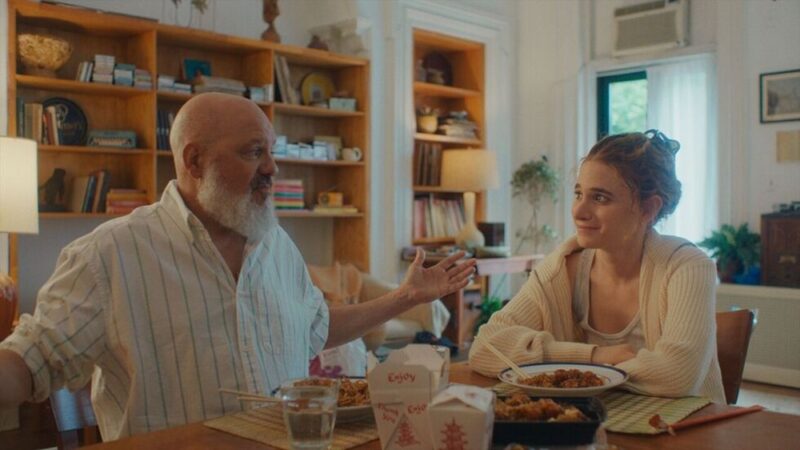
From there, Lucy moves back in with her father, Peter (David Cross, delivering one of the film’s most unexpectedly tender performances). Their relationship becomes the emotional backbone of the movie. Cross brings warmth, eccentricity, and a beautifully understated sadness to a father who adores his daughter perhaps a little too much. The dynamic between them is deeply loving but quietly suffocating – the kind of closeness that makes independence feel almost impossible. Their banter, old routines, and shared comforts create some of the film’s funniest scenes, but Sachs is careful to show how even love can become a place to hide from yourself.
When Lucy eventually begins dating again, including a promising connection with the seemingly charming James (Thomas Mann), the film avoids easy romantic fantasy. Their chemistry is genuine, but the relationship is complicated by Lucy’s tendency to disappear into the people she loves. Mann gives the film a calm emotional counterbalance; he understands Lucy’s intensity without romanticizing it. Importantly, Lucy Schulman never frames romance as the ultimate reward waiting at the end of personal growth. Instead, it argues something much harder and more honest: that intimacy means very little if you don’t exist fully within your own life first.
What makes the film so affecting is how unforced it all feels. Sachs doesn’t strain for grand revelations or heavy-handed speeches. The emotional truths emerge naturally through conversation, behaviour, and small humiliations. The film has a real sense of lived experience to it, particularly in the way Lucy drifts between yearning and avoidance. There’s a recognizable ache in watching someone intelligent and emotionally perceptive continually abandon themselves in pursuit of affection.
At the same time, the film is genuinely funny. Its comedy exists in the specificity of human behaviour rather than punchlines, whether it’s Lucy overcompensating in social situations, the absurd comfort of old family rituals, or the way heartbreak can make even the smallest interaction feel catastrophic. Sachs balances sincerity and humour beautifully, allowing the film to remain light on its feet even while tackling emotionally thorny material.
In a cinematic landscape increasingly dominated by irony and emotional distance, Lucy Schulman feels refreshingly open-hearted. It doesn’t mock vulnerability or treat emotional dependency as something shameful. Instead, it approaches Lucy with compassion, understanding that her flaws stem from a desperate desire to love and be loved completely. The film recognizes how easy it is to confuse devotion with identity, particularly for young women taught to view relationships as validation.
By the time Lucy Schulman reaches its quietly moving conclusion, it becomes less a story about romance and more a story about learning how to exist independently of it. Sachs has crafted something deceptively simple here: a charming, funny, deeply human coming-of-age film about the terrifying process of finally turning your attention inward.
Sweet without becoming sentimental, insightful without becoming preachy, Lucy Schulman is the kind of modest indie that sneaks up on you emotionally. It wears its heart proudly on its sleeve – and is all the more moving because of it.


THREE AND A HALF STARS (OUT OF FIVE)
Lucy Schulman is screening as part of this year’s Tribeca Film Festival, running between June 3rd and 14th, 2026. For more information on the festival, head to the official site here.
