

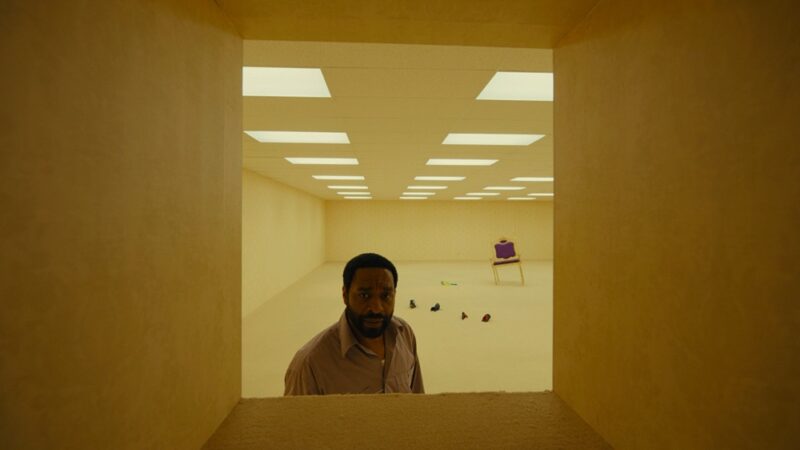
Kane Parsons’ Backrooms understands something many horror films about internet mythology completely miss: the fear was never just the monster. It was the feeling. The wrongness. The sense that you’ve stepped somewhere familiar that suddenly no longer obeys reality. Expanding a concept as abstract and collaborative as the Backrooms into a feature-length narrative was always going to be a near-impossible balancing act, but Parsons delivers something genuinely unnerving, visually hypnotic, and far stranger than most studio horror would ever dare to become.
The film opens with Mary Kline (Renate Reinsve) speaking about behavioural loops, about how people inevitably end up back where they started. It’s a deceptively simple monologue that quietly foreshadows the film’s spiralling emotional and psychological structure over the next 110 minutes. Mary is Clark’s (Chiwetel Ejiofor) therapist, a deeply unhappy man whose dissolved marriage seems to have hollowed him out completely. During one roleplay exercise, the bitterness he holds toward his wife spills out with startling venom, revealing a man who feels trapped inside a life that no longer resembles the one he imagined for himself.
Clark repeatedly clings to the identity of being an architect, insisting he is merely “stuck selling shit furniture,” referring to his dead-end job at Cap’n Clark’s, the retail store that eventually becomes central to the Backrooms investigation. Ejiofor gives Clark a defeated exhaustion that makes him compelling even before the horror fully arrives. He talks about being thrown out of the very house he bought, and there’s a quiet implication that the store itself may now function as his home after hours. Meanwhile, Mary speaks about the distinction between being alone and being lonely, an irony that subtly hangs over her own carefully controlled existence.
Setting the film in the 1990s proves to be one of Parsons’ smartest decisions. The lack of modern technology naturally enhances the mystery surrounding the Backrooms while allowing the film to fully embrace the grainy camcorder aesthetic that made the original Kane Pixels shorts feel so authentic. Clark begins documenting the phenomenon alongside store employees Bobby (Finn Bennett) and Kat (Lukita Maxwell), with the handheld footage amplifying the sense of instability and disorientation.
The opening seven minutes are among the most effective horror filmmaking of the year. Parsons immediately captures the uncanny terror that made the Backrooms mythology resonate online in the first place. The endless hum of fluorescent lighting, the oppressive yellows, the suffocating emptiness; it all feels deeply hostile in a way that’s difficult to articulate but impossible to shake. When the film fully enters the Backrooms themselves, the horror truly comes alive.
What makes the scares work is that Parsons rarely leans on cheap shock tactics. The film understands restraint. Some scares emerge subtly from the environment itself, while others strike with brutal suddenness, but almost never feel manipulative. A sequence involving a Christmas tree stands out as one of the film’s most unnerving moments, not because of overt violence, but because of the profoundly incorrect feeling it creates. Backrooms repeatedly weaponises memory and familiarity, presenting spaces and objects as though they have been half-remembered incorrectly. That idea becomes one of the film’s strongest thematic threads, tying beautifully into the larger lore Parsons explores alongside screenwriter Will Soodik.
Whether viewers connect with where the film ultimately goes may depend on how attached they are to the internet mythology itself. Parsons stepping back from sole writing duties will likely divide some fans, particularly as the film becomes increasingly abstract during its final act. The last 40 minutes are undeniably strange, veering into territory that feels heavily indebted to Twin Peaks and the work of David Lynch. The film abandons straightforward explanations in favour of dream logic, distorted imagery, and deeply unsettling visual fragmentation.
But that refusal to over-explain is precisely what makes Backrooms linger. The film understands that horror often becomes less frightening the moment everything is clarified. Parsons instead embraces ambiguity, allowing the Backrooms to remain unknowable and emotionally disorienting. The final shot is haunting in a way that doesn’t immediately leave your system, lingering long after the credits roll like a memory you can’t fully place.
Rather than reducing the Backrooms into conventional monster horror, Parsons preserves the existential dread that made the original creepypasta resonate so powerfully online. The result is a horror film that feels genuinely singular: eerie, melancholy, deeply uncanny, and willing to trust audiences enough to leave them lost inside its maze.


FOUR STARS (OUT OF FIVE)
Backrooms is screening in Australian theatres from May 28th, 2026, before opening in the United States on May 29th.
