
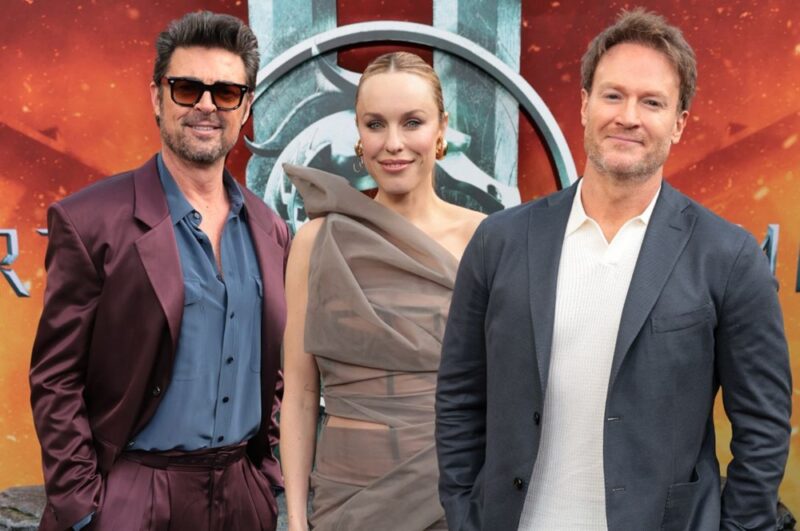
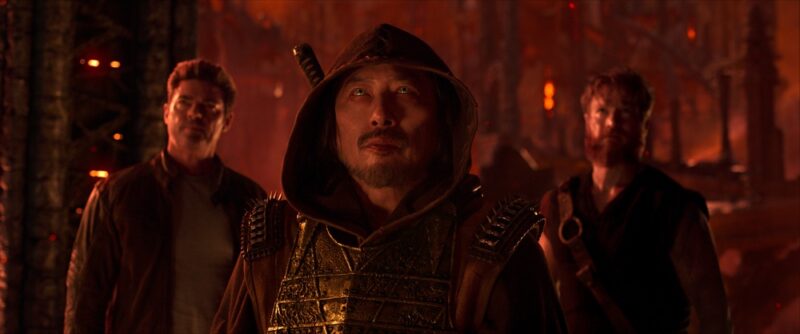
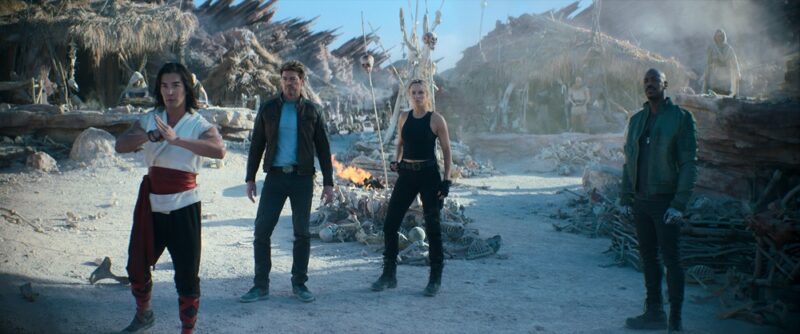
In Mortal Kombat II, Earthrealm’s champions return for a bloodier, louder and far more chaotic showdown against the forces of Shao Kahn – this time with Karl Urban’s swaggering Johnny Cage entering the arena. Leaning fully into the outrageous spirit of the iconic video game franchise, the sequel embraces brutal fatalities, self-aware humour and the kind of crowd-pleasing spectacle designed to be experienced on the biggest screen possible.
Ahead of the film’s release, our Peter Gray sat down with Urban alongside co-stars Jessica McNamee (“Sonya Blade”) and Josh Lawson (“Kano”) to talk about the action heroes that shaped their performances, why modern audiences demand more emotional complexity from their characters, and the challenge of grounding Johnny Cage beneath all the ego and bravado.
As someone who loves what I do, and sees the influencer culture taking over, I felt very seen by Johnny Cage’s disdain during the convention scene. I felt that in my soul. I say that, and then my first question isn’t that hard-hitting, but the original Mortal Kombat films are obviously a guilty pleasure for people. And you see Johnny Cage’s filmography, and in that universe they would be those films for people. For all of you, what is your guilty pleasure movie?
Jessica McNamee: Spaceballs?
Josh Lawson: Oh, that’s not…
Jessica McNamee: Okay, I’m going to change it. I’m going to say Hook. I will defend that to the death. I think it’s my favourite film of all time, and it’s not people’s favourite Spielberg.
Josh Lawson: Yeah, okay. I’m trying to think. Do you have one, Karl?
Karl Urban: I don’t know if it’s a guilty pleasure. It was a great movie when it came out, but I never tire of watching it. That’s Dumb & Dumber.
Josh Lawson: Oh, yeah. It’s great.
Karl Urban: So stupid.
Jessica McNamee: I can’t watch it (laughs).
Josh Lawson: Man, guilty pleasure. Look, honestly, I will defend things like Under Siege as a great movie, even though, in some ways, all the ingredients are terrible. You’ve got Steven Seagal, who is really famously a difficult actor to work with, and not really what you would call a celebrated icon of the acting industry, and he’s alongside Tommy Lee Jones, who is the opposite of that. It’s such a strange (dynamic). And, of course, Gary Busey, who is of a time…
That’s such a great way to describe Gary Busey – “Of a time.”
Josh Lawson: There’ll be generations who will never know that name. But those that know, they know.
Well, getting into a serious question. Did you all find yourself reflecting on what that era of heroes from growing up meant versus what audiences respond to now?
Karl Urban: I can tell you, for me, playing Johnny Cage and what you see in the movie, that movie-within-a-movie, I had to think about not only the acting style of Johnny Cage, but also his influences. Aside from the obvious ones – which would have been your Bruce Lees and your Jackie Chans and, you know, martial artists like Van Damme, as well – he would also look at those actors trying to break out of those movies. He’s looking at Eastwood, Harrison Ford, Stallone…those great plethora of 80s actions movies. He’s essentially stealing their moves and doing them far less successfully.
Josh Lawson: In terms of filmmaking, the 80s have a lot to answer for. The heroes of that day were hyper, hyper, hyper masculine, right? These kind of pretty uncomplex characters. We really didn’t know much about them, you know? Other than, “He doesn’t do things by the book,” you know? “He’s got a dark past. He’s killed a man.” Blah, blah, blah. After things like Unforgiven, where Eastwood was like, “All right, let’s see the life behind the hero, and it’s actually not that sexy.” I think that element if you were to infuse it onto the Johnny Cage character, there’s actually a guy behind all that and it’s not as glamorous as it looks.
By comparison, I think characters these days, the writing has become more complex. I think audiences demand a bit more complexity and dimensionality to their characters. I don’t think (Johnny Cage) could get away with being as shallow as the characters we grew up in the 80s.
Karl Urban: Yeah, I think that’s a testament to Harrison Ford, because he was always very good at infusing his characters with real vulnerability, with fear. So in approaching Johnny, that was important to me that as a character that didn’t have powers, that he would have a response to what was around him as a human. He would have emotions like fear and anxiety.
Jessica McNamee: And I would say that as a woman in this world, there aren’t as many people to draw inspiration from in that space, but they are some of the most iconic ones as well. Sigourney Weaver, Linda Hamilton…there’s some really iconic women that have played very strong characters. I did kind of hone in on them in preparation for this. Even more modern times, like everything Charlize Theron has done, and characters like Lara Croft. But, you know, it’s not a broad spectrum.
Josh Lawson: Yeah, what I loved about, say Bruce Willis in Die Hard, was that he just a dude. He wasn’t ripped. He wasn’t jacked. He was a guy. The success of Die Hard, in some ways, became Bruce Willis’s action style. But to start with…
I think we all forget that he was the Moonlighting guy.
Josh Lawson: Right, he was a rom-com guy.
Karl Urban: I spoke to (John) McTiernan (Die Hard director) once, I was going to do a project. It never happened. But I quizzed him about Die Hard and, specifically, he said the key that unlocked the character for both Bruce and him was John McClane’s self-loathing. Like, he’s not that interesting, you know? So that was particularly interesting, and I have no doubt that it was a massive part of why the film was successful. John McClane has a weakness, and that humanizes him.
Well, I could honestly keep talking to all of you about this, but I know I have to let you go, so thank you all so much. The film is a lot of fun, it knows exactly what it is, and we just need to have this kind of entertainment in cinemas to get away from the shit of the world right now.
Karl Urban: Why, is something wrong in the world? (Laughs)
Mortal Kombat II is now screening in Australian theatres, before opening in the United States on May 8th, 2026.
