
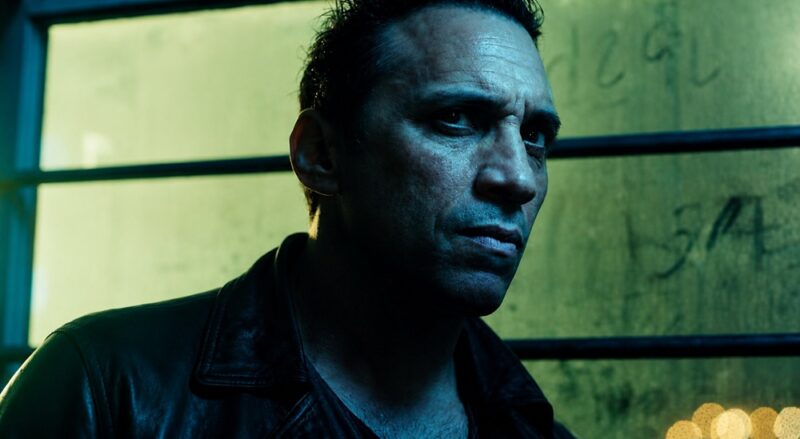
Dirty Hands is a bruising, tightly contained crime thriller that turns a botched drug deal into something far more emotionally volatile. On paper, the story is simple: the Denton brothers, Danny and Richie, have one night to survive after everything goes wrong. But writer-director-star Kevin Interdonato is less interested in the mechanics of survival than the emotional damage that comes with loyalty, family, and blood ties that refuse to break cleanly.
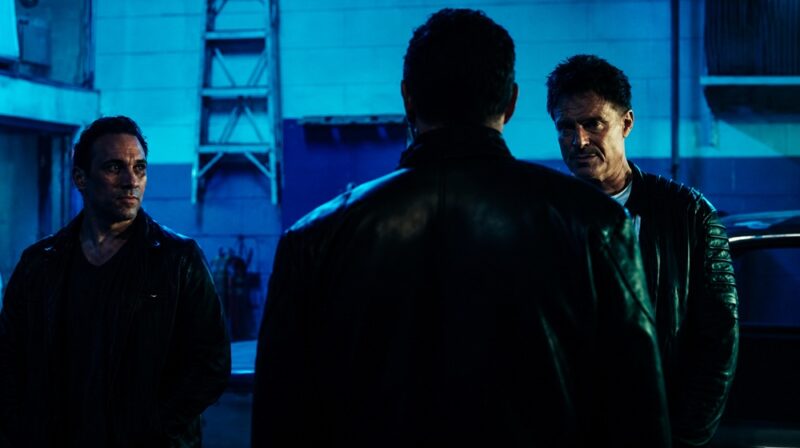
Set largely within a mechanic’s garage, the film uses its limitations as a weapon. The blue-lit space becomes both sanctuary and trap, with flickering lights, uneasy silence, and sudden bursts of violence tightening the pressure around the characters. The fight scenes feel messy and instinctive rather than stylised, giving the film a raw, lived-in edge.
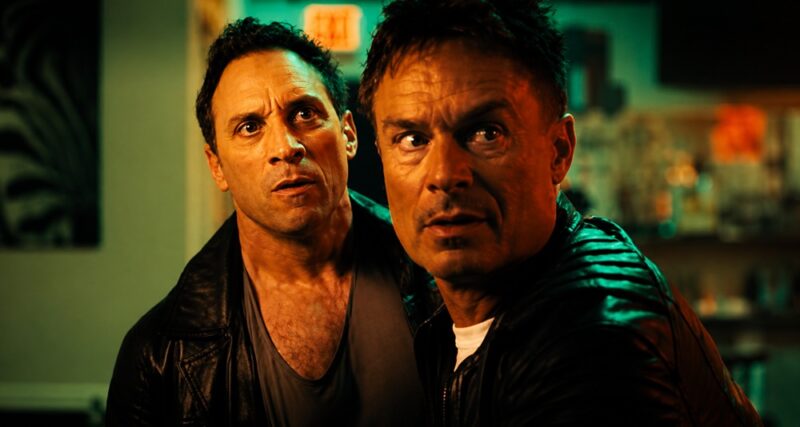
Interdonato brings a reckless, combustible energy to Danny, but it is Patrick Muldoon, in his final performance, who gives the film its aching weight. As Richie, he plays the older brother as a man torn between self-preservation and a loyalty that may destroy him. Their dynamic is brutal, complicated, and unexpectedly moving.
Dirty Hands may unfold like a survival thriller, but its real power lies in its portrait of brotherhood: not sentimental, not clean, but dangerous, damaged, and impossible to walk away from.
As the film releases on Digital and On Demand, our Peter Gray spoke with Interdonato about building tension through character, why he resists the idea of “performance,” capturing violence that feels emotional rather than choreographed, and how Muldoon’s final role has transformed the way the film will be remembered.
I want to thank you for taking the time out to chat with me. Obviously hasn’t been great news the last few weeks with the passing of Patrick, so I appreciate your time.
Of course, man. I appreciate you.
Your connection with Patrick is quite instinctive. Looking back on the film, is there a moment that carries a different weight for you at all?
Yeah, it hits in entirely different ways now. I don’t think many people that make movies have experienced something like this. I don’t wish it on people. It turned into a bittersweet experience, but the clouds are kind of moving away, and the sun’s shining through a little bit more now. We’re celebrating him, and I’m just so happy people are recognising what he did. It’s one thing that it’s his final performance, but God damn, he’s incredible in it.
He played such a nasty dude, but he was so good, and he never got the chance to do that before. He was so proud and so happy. We kept in touch after, obviously, and it’s been a solid two-and-a-half, three years of keeping up with him every day and letting him know what’s going on. He was heavily involved in the production stuff, too. It’s been quite the whirlwind, man. But he’s looking down and smiling. He’s getting sent off with a bang.
I heard nothing but the nicest things about him. With the film, I know that you’ve said it started as “two brothers in a dire situation,” and then you kept raising the stakes. At what point did it stop being an exercise in tension and start revealing something about you, Kevin, as a filmmaker?
Oh, good question. Man, I think for me, I’m not trying to satisfy anybody when I write. It all comes from the most pure, primal, instinctive side of me that’s possible. I don’t limit. The situation was set, the relationships were made, and I just wrote it from a perspective of each cast member as if I was playing that role. It’s kind of hard to avoid my essence on the film. Same thing with the last film I did. It’s funny, because people tell you what you are. People say, “Oh, I can tell you made that.” I’m like, “How?” I’m not thinking about putting my stamp on it.
Once the colours fly and everyone’s loose, you just rock and roll. Things change. And actors bring a lot of things to the table that I was not expecting, which was surprising. And I love to be surprised. But, I’ll say this, Peter, and it’s a great question, I’m not trying to reinvent the wheel. I was just showing people my wheel. And oddly enough, there’s a lot of people, a lot of movie reviewers, that did not get the ending and they missed a lot of things. I think people took it as a cliche thing, and that’s fine. I’m not trying to get mad at anybody for anything. Everyone reviews and views films differently, but I was surprised that reviewers didn’t get it. And just some guy that I know from around the way – like a plumber, or this or that – he’s like, “I caught this, and I heard (the characters) say this, and I saw that, and I think this is the ending.” And they’re right.
I like playing with twists, and making things interesting as I go. And certain type of people will love this movie, and a certain type of people will just like it. I just want to move everybody, and at the end of the day I think the movie, with the combination of everyone involved, has been effective.
There’s a lot of talk about brotherhood in the film, but it’s not sentimental. It’s messy and volatile and dangerous. What truth about family were you trying to explore that maybe audiences don’t always want to admit?
I wanted to get to the core. It’s how I work as an actor. I never read a book on writing, or took a class on directing anything. I just know how to work as an actor. I think playing a good amount of leads through the years, and telling stories, it just enabled me to know what an audience would be locked into. There’s a narrative for each character. It’s more a character journey, and there’s a story sprinkled on top. That’s how I wrote it. Regarding what you mentioned? Man, your questions are killer…
I like to prove that some journalists are still good at their job.
Yeah, it’s great. I wanted to hold a mirror up, you know? There’s a moment in the movie – and I don’t want to give things away – but there’s a moment where (my character) asks “Do I stay? Do I run for?” When I was writing, and I kept tabs on this when I was directing, it was dialed in for me. More me with (Patrick) than as a director. And, ultimately, if he left his brother, he knew his brother would die. There’s no doubt about it.
These characters grew up in a very violent household, in a very violent world, and violence to them is just kind of second nature. That’s why they’re punching each other in the face in the opening. It’s not a big deal. It’s love. I grew up in a rough area with my brother, and we were rough with each other. Always beating the hell out of each other. To me, that’s not a big deal. To this day I jump on my dad’s back and we, you know, wail on each other. As I said before, some people will get it and some people won’t. I read that someone wrote that they couldn’t believe I had these characters punching each other in the face. I’m like, “How did you grow up?” It’s a love language between siblings. I hope that answered your question (laughs). I know I’m going around…
I know you’ve said that you dislike the word “performance”, because it feels results oriented. As a director, you still need to shape the outcome. Where do you draw the line between guiding something and then letting it live?
It’s setting a situation up. God, this is just coming to me right now, but if there’s a car coming, and you’re in the middle of the street and you close your eyes for three seconds until the car is 50 feet away. And then you open your eyes. What do you do? What’s your reaction? Do you freeze? Do you go left? Right? Try to jump? I don’t know, but I’d like to see. That’s my joy as a writer and a director, and that’s the joy I take as an actor. When a director puts me in a situation, it seems like I don’t know what I’ll do, so I don’t write it out on paper. Certain things need to happen for the sake of a story to get to another scene, yes, but this was pretty much an open canvas. Like, I did not know how Denise (Richards) was going to behave as that character. And she was incredible.
All I knew when I was writing (the script) was where she had to be mentally, and Denise brought it. Pat, same thing. Michael Beach? Man, I didn’t need to give Michael any direction at all. He’s just a pro. He came in and crushed. For me, it’s situational. It’s not performance. It’s not outcome. Yes, you have to get from A to B to get to the next scene, C to D. But the life that exists within that? I like to be in that situation and fight my way out. I don’t think of outcomes. I don’t think of performance. I just know where we have to be. That’s in the back of my mind, as an actor and as a storyteller. That’s what I tell everybody, too. Just so and live it.
If you put performance or outcome on it, there’s a result, and I can’t stand it, personally. I even got into it with a director once. He was like, “Oh, man, I can’t wait to see what you do in this scene.” I’m like, “Thanks, but don’t put that pressure on me, because I don’t even know what I’m going to do.” I’m not trying to impress. I just got to live in the moment that you set up to live. I want to give everybody the authority to do that as an actor. If the stakes are high enough, Peter, that’s where the excitement comes from.
On that, because you’ve got the fight sequences where things are coming down to every moment. Obviously there’s rehearsal in that, but you want emotional spontaneity as well. How do you reconcile something that’s technically precise, but have it still feel unpredictable?
Dude, you’re the best fucking interview I’ve had. Yeah, we rehearsed it enough so it became loose, and we weren’t thinking about the moves, and we could live in the moment. I know some actors like to rehearse. A lot of the old-timers, like Pacino, and I understand that mode of rehearsing. It’s like getting ready for theatre, so by the time you’re on stage, you’re loose as a goose. You may have said the words and done the action a thousand times, but you’re not thinking. So the fight sequences, I even hate calling them “action”, because it is just a fight.
I think the spontaneity of the moment conveyed those that were highly rehearsed scenes to the point where we’re not thinking. Our fight choreographer, Jason Mello, was incredible. He’s worked on some big stuff, and we rehearsed it in slow motion over and over and over again with full emotion. So you would take a punch and you’d (react). When I used to get in fights, I was mad. It’s these two mad people fighting. I feel like that’s an emotion that’s lost in these action movies, so I wanted to capture that. And I think we did. These guys are angry. They’re mad at each other. It was so important for me to bring emotion, and the only way to bring emotion was to have technique and the steps down pat so fluid that we knew exactly what we’re doing without thinking.
In the nicest way possible, they are messy fight scenes. Like it does look like everyone’s just reacting on instinct. Very fight or flight.
Thanks, man. A lot of thought when into the script of me thinking about the firsthand of it. It’s messy, you trip, you fall, you miss.
As you have mentioned, you’re carrying a lot of roles here. Writer, director, actor. Was there ever a moment on set where those roles conflicted with each other on set for you?
Producing was the hardest, because of limited funds and the problems that always go out on set. You’re just constantly putting fires out and having solutions to the problem. That mindset puts you in a real hardcore business mode. Directing is still a creative essence. Directing and acting, I’m fairly okay with, especially if you have great actors. We didn’t rehearse anything. We just talked, and (the cast) just got it. I had a good crew. My DP was great. And my producing partner is a gangster, man. He’s incredible. A lot of the things aligned to make it easier for me to make. It’s not an easy task.
When you’re watching yourself back in the edit, are you looking at it as a director judging an actor? Or are you an actor reliving the moment?
No. I usually have this weird, depressing moment, because my phase as an actor is over. That journey is over. It’s sad. When I come out of that, sometimes it can take a week. The last film I did, Lupo, I was down for a month. It was just a really hard moment in my life leaving that role, leaving that character. But that does end, and then that side of my brain switches off, and I look at myself objectively, and I don’t even see myself in it anymore. It’s not even about me. I did my work. (The cast) did their work. I’m watching everything. I’m telling the story and sometimes I’ll watch it, and my editor is my right-hand man, and I’m like, “What the hell am I doing here? Cut that shit out!” (Laughs).
I wanted to ask about the visual and sensory world of the film, because that blue lighting creates this strange contradiction. It’s calm and danger at the same time. Were you consciously trying to lull the audience into a false sense of security with that?
I did, dude, yes! It’s a type of blue that we chose, and my colourist, our gaffer and our DP were dialed in with the colours that I wanted. They even enhanced it even more so, which was great, and they had a lot of fun, because they don’t get the chance to do that (a lot). Usually they’re doing an urban sodium here, and a light there, but here they were playing with this palette and everything. Every person, every vibe, had something to it regarding colour. Especially the blue. When they break in the garage, the music changes and it’s just blue. You think it’s calming, but I wanted this electric kind of boiling. And that also comes with the idea we had for the hanging light that was flickering.
It was this pulsating light, and there’s also a sound design added on that light, where we enhanced that noise all the way up. There’s a lot of layers to this. Thanks for bringing these things up, Peter.
On the mention of the garage, it feels very much like a character in itself. It’s alive, it’s breathing, it’s intrusive. At what point did you realise the space wasn’t just a location, but was something psychological in the story?
We kind of lucked out. My producing partner’s from the Chicago area, so he had a lot of friends from growing up there, and with the locations we got, we didn’t pay a dime. Everybody was so great. With limited budgets, I make sure that there’s extensive work in pre-production. Normal movie productions, they’re funded, they have three months. My development starts 12 months before. I location-scout a year before, because we don’t have the funds to really properly set design and make it our own.
That garage, “Phil’s Auto”, is a real place. That was my partner’s buddy from back home. He closed the doors every day at 4:30pm, threw us the keys, and said, “Have fun, I’ll see you in the morning.” We shot the whole movie overnight. I think it was six nights there straight. We could do whatever we want, just had to put it back to how it was in the morning. We didn’t bring anything to that set, other than the hanging blinking light. Everything was there.
And I promise I’ll let you get back to your day, but I have just one final question. Because I know you have said that goal is to move people the way films moved you growing up. What’s a film moment that still lives in your body when you think about it?
Man. Shame on you for giving me a question where I gotta think (laughs). Not to be cliche, but my two favourite actors of all time are Pacino and De Niro. That iconic moment in Heat when they sat down? It just doesn’t get better than that. But, you know, whether there’s money in a movie or not, it doesn’t dictate if someone can connect. I try to make (movies) that move people. There’s connective tissue there. Whether it’s a big explosion, or something more simple and intimate, that’s the goal. In every capacity. With every hat I wear.
Dirty Hands is now available on Digital and On Demand in the United States.
