
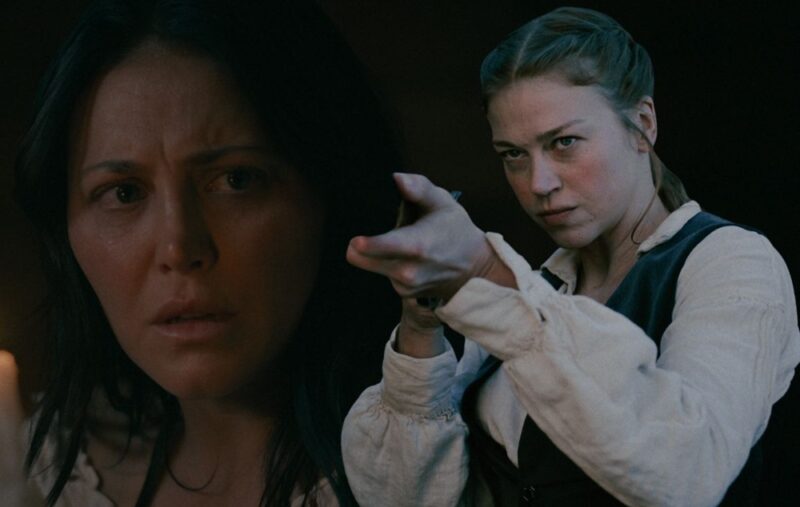
Grief, faith, and folklore collide in The Wolf and the Lamb, a haunting hybrid of western grit and supernatural horror from director Michael Schilf. At its centre is Jo Beckett, a schoolteacher pushed to the brink when her son vanishes, sending her spiralling into a world where belief and paranoia blur. But beneath the film’s eerie surface – its vampires, violence, and creeping dread – lies something more intimate: a story of maternal love, sacrifice, and the lengths one woman will go to reclaim what’s been taken from her.
As the film releases on digital in the United States, our Peter Gray spoke with stars Cassandra Scerbo and Adrianne Palicki. Throughout their conversation it became clear that this balance – between restraint and emotional release, myth and raw human feeling – was just as vital behind the scenes as it is on screen.
Folk horror often feels like it relies on what’s unseen. What did this film teach you about the power of restraint versus revelation – if that was something you thought about?
Cassandra Scerbo: I love that question. For me, I actually tried to restrain as much as possible. There were way fewer tears written into the script, but I became so emotionally attached – to Jaydon (Clark), my on-screen son, to the whole cast and crew – that it just came out. At the heart of it, I see the film as a love story disguised as horror. It’s about sacrifice – how far Jo is willing to go for Henry. When he returns changed, it becomes a fight to get her son back.
I always build a deep backstory – I even write a diary for every character – and the more I journal, the more gets revealed. But because this was an indie film, you don’t always get many takes. Sometimes one or two. So you have to come in fully prepared and just live truthfully in the moment.
Adrianne Palicki: Cassandra, you really carry the film. And I think what’s so striking is how strong all the women are. My character doesn’t really do restraint – she’s like, “I’ve got the shotgun, let’s go.” But across the board, every woman in this film is powerful in a different way. Q’orianka’s character, Cassandra’s, all of them – it’s a real sense of female empowerment.
Cassandra Scerbo: Yeah, it’s such a tight-knit world – a small mining camp – so these women are each other’s family. You’ve got a single mother, a single female saloon owner… it says so much about resilience. Jo might be more emotional, but she represents something pure – almost like this biblical pull between light and dark. And the other women really help carry her through that journey.
I responded a lot to that. Horror often treats women really well – there’s always the “final girl.” It felt like this film leans into that, letting women take charge.
Adrianne Palicki: I can’t disagree with that.
Adrianne, Liz exists in a morally ambiguous space. Do you see her as someone who understands the horror early on, or someone who survives by refusing to fully see it?
Adrianne Palicki: I think she survives moment to moment. She’s very protective of Jo – almost like a big sister or mother figure. If someone threatens her, Liz reacts first and thinks later. And honestly, from day one, Cassandra and I had that connection. It felt like a real bond, which made those scenes feel safe – even in a very unsafe world.
Cassandra Scerbo: And Adrianne is just incredible. Our director called her “the machine” – she brings such strength and command to every scene. It’s such a beautiful contrast to Jo’s vulnerability.
Was there a scene that seemed simple on the page but became more complex or revealing on set?
Adrianne Palicki: The saloon scene with Lagrange. On the page it’s already weighted, but playing it, so much came through in the silence – the looks, the tension. You could feel the history between them without needing dialogue.
Cassandra Scerbo: For me, it was the church scene with the Reverend. I didn’t expect it to hit me so emotionally. When you’re on set – in costume, in the environment – it’s completely different from reading the script. I suddenly had this wave of emotion and even flashed back to my grandfather’s funeral. It just came out. That’s what I love about acting – you never know what’s going to surface.
There was also a moment where I wasn’t meant to speak – I was just supposed to sit with Henry. But I opened the Bible and started reading. I hadn’t prepared those lines in my accent, but it just felt right. And the passage ended up being about a child returning – it perfectly mirrored the story. They kept it in the film. It was one of those magical, unplanned moments you can’t recreate.
Wow. Well, I want to say thank you for taking the time out of your morning to chat with me. And as you were talking about the magic of film, I went through something quite terrible a few years ago, and film was always there to ground me and make me feel like I had a purpose. It was a way to escape, and watching something like this film and talking to you just reiterates that. We need films in the world, so, really, thank you both so much
Cassandra Scerbo: Thank you so much. Sending you lots of love. And that means the world. That’s all we ever want to do as artists. You just want to move people and tell stories, and hope that it resonates. So, if we can touch just one life…job done.
Adrianne Palicki: That’s art. That’s the point.
The Wolf and the Lamb is now available on Digital in the United States.
