

The most popular prestige television shows of recent years have made it clear that we all love to watch rich people being awful, but Chekhov’s 1904 masterpiece is a reminder that this is nothing new.
The action in The Cherry Orchard centres around an aristocratic family in terminal decline, and the coddled individuals who prioritise their whims over the health of the enterprise that safeguards their privilege. To paraphrase Logan Roy, these are not serious people.
Director Simon Stone has mirrored another theme of recent television by transplanting the action from pre-revolutionary Russia to contemporary Korea, even casting Squid Game star Haesoo Park as the rags-to-riches businessman who holds the family’s fate in his hands.
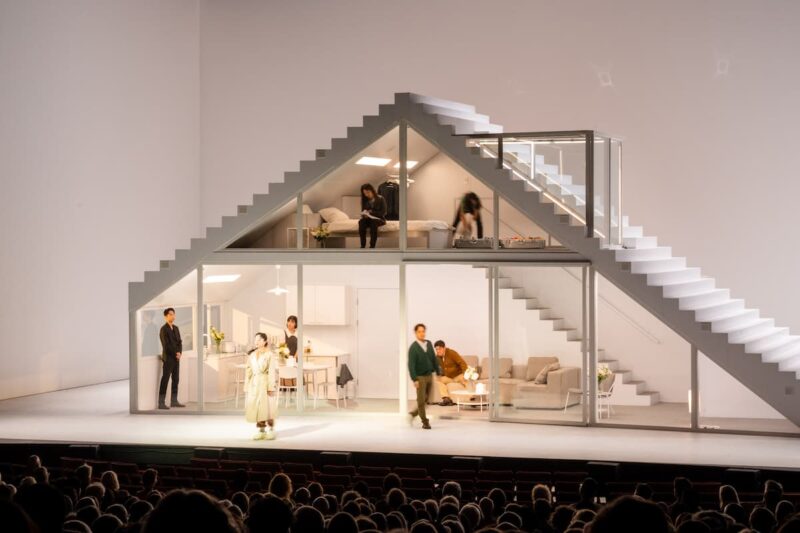
The startlingly minimal set is centred on a ziggurat-like house that acts as a visual metaphor for the rise and fall of the family. Several discreet spaces allow multiple scenes to play out simultaneously, while the stark white backdrop is a canvas for the lighting team to evoke different times of day. But where the set of Stone’s Innocence – the hit of last year’s Adelaide Festival – was noteworthy enough to become a protagonist, this production is carried by the dialogue.
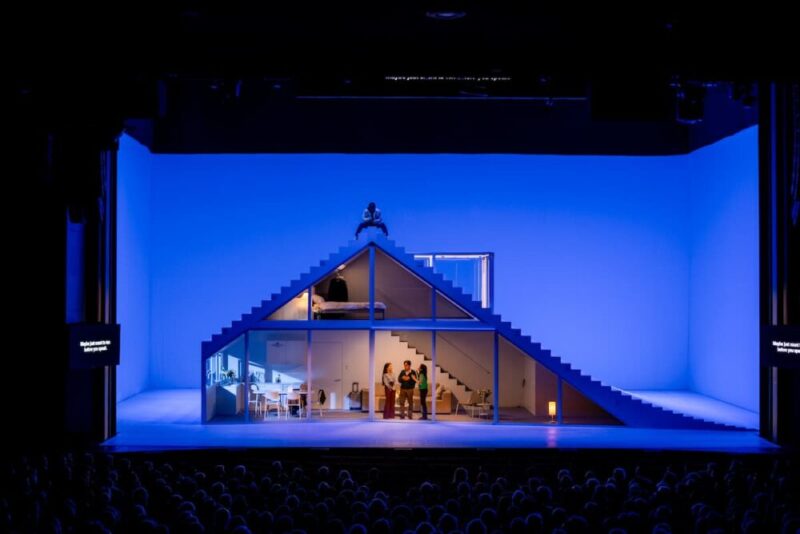
That’s a problem in the first act, when all ten cast members talk around and over each other constantly. The acting is universally excellent, with Byunghoon Yoo getting enough laughs as the buffoonish cousin to upstage several of his more famous co-stars. But the overlapping dialogue makes it impossible to follow the surtitles (the entire play is delivered in Korean) without missing some of the action, and I frequently found myself scrambling to figure out who delivered which line.
Fortunately, things slow down from the second act onwards as the characters begin to introduce some of Chekhov’s big ideas and a celebratory mood gives way to grim acceptance of the family’s downfall.
Both comedy and tragedy are close to the surface throughout, as the onstage rhythm canters at breakneck speed between impassioned arguments, whimsical monologues and more reflective moments.
And any doubt about the contemporary relevance of the material vanishes during a blistering screed by the family’s former tutor concerning the death of morality as evidenced by the venal and self-enriching leaders we see today. But while this visually impressive production includes some clever touches, it ultimately never quite transcends its source material.


THREE AND A HALF STARS (OUT OF FIVE)
The reviewer attended the performance on 1 st March.
Images by Jack Fenby.
