

There are films about chosen family – and then there are films that gently ask whether your biological family might be something you can choose, too.
In Jimpa, acclaimed director Sophie Hyde (Good Luck to You, Leo Grande) returns with a tender, funny and quietly radical portrait of three generations negotiating love, identity and the stories we tell about ourselves. Set between Adelaide and Amsterdam, the film follows Hannah (Olivia Colman) as she travels with her non-binary teen Frances (Aud Mason-Hyde) to reconnect with her fiercely independent, politically engaged father – affectionately known as Jimpa (John Lithgow). When Frances announces their desire to stay in Amsterdam for a year, what feels like an act of queer possibility soon collides with the realities of ageing, memory and family responsibility.
Warm without ever tipping into sentimentality, Jimpa explores the mythology of place, the generational shifts within queer identity, and the radical act of simply listening to one another. It’s a film about parents learning to be uncertain, about children who know exactly who they are, and about the fragile space between freedom and belonging.
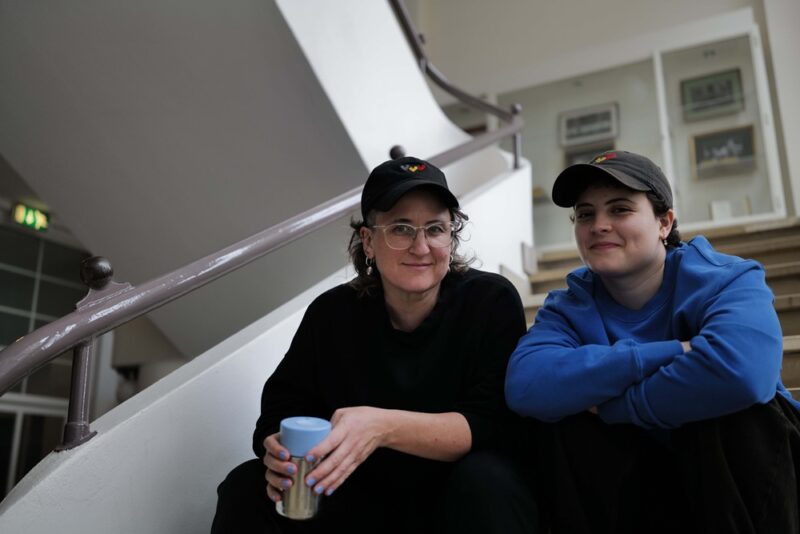
Our Peter Gray spoke with Hyde about fictionalising the personal, collaborating with her own child, working with Olivia Colman, and why – in a cultural moment increasingly defined by noise – listening might be the most powerful thing a family can do.
You’ve said that Hannah might be the character least taken directly from life, even though she’s the one closest to you. Was that a protective instinct? Or did fictionalising yourself actually allow you to be more honest?
It’s funny – I think everyone who’s even slightly represented in the film would say, “That’s the least real character.” My sister would be like, “As if that’s me!” And she’d be right. We’re only ever using one tiny fragment of a person or a story. When you fictionalise something, you’re taking this cut-out version of yourself – and in this case, quite explicitly, the identities of you and the people around you – and then you’re taking feelings that are very real and transforming them into fiction. You try to keep them true emotionally, but they also have to work for a narrative.
Matt Cormack, my co-writer, is largely in Hannah as well. She’s a mix. And then you cast someone, and they change it again. So yes, there’s protection in that. There’s fiction. And I think all of us would want to say, “That’s not exactly me.”
Frances’ desire to stay with Jimpa doesn’t feel like rebellion. It feels more like an attraction to freedom. Did you see that as a generational shift in queer identity, or something more timeless?
We explore the mythology of a place and the mythology of a person. Hannah has created a narrative around her family that builds that mythology, which is helpful for a character like Frances. Amsterdam represents possibility. Jim represents possibility.
When I was growing up, it felt like queer people had to leave places like Adelaide. Not everyone, of course, but there was this pull to bigger cities where you could be more open, more yourself. Those places are still like that, even if the people who live there will downplay it. Communities form differently there.
That idea of leaving to find yourself – I think that will always exist. One of the questions in the film is whether you have to leave your biological family to find your chosen family. So many queer stories are built around that separation because there’s so much heartache. I didn’t have answers, but I had questions. Could you choose your biological family too?
I was very lucky – when I came out, it was easy. My mum just wanted me to be happy. So I loved that question in the film. It also made me think about the doubling of Adelaide and Amsterdam. You shot in Adelaide before going to Amsterdam. Did that mirror the film’s themes of memory and mythologising places?
I wanted to be playful with that idea, with people and places. We often want to see the myth of them as much as the reality. The flashbacks aren’t about truth exactly, they’re about memory and imagination. They’re what lives in your mind about someone or somewhere, not the whole thing.
Practically, it was a challenge. Our production designer built the Amsterdam bathroom before we’d even shot there. We had to recreate a café in Adelaide, which meant sourcing a lot of bikes! But most of what we shot in Australia was Australia. After Amsterdam, we came back and shot the flashbacks with the younger characters, so by then we knew what emotional texture we wanted.
You’ve collaborated with Aud their whole life, but stepping onto set together – did that shift your relationship at all?
We’ve always been collaborators. Since they were little, they’d say, “Our movie is doing this.” We’ve always been in conversation about turning lived experience into art. What changed was my responsibility as a director. The way I create a safe space for actors – Aud and I already had deep intimacy. I worried they might carry responsibility for how I felt instead of being free just to act. At the same time, when you’re drawing on lived experience, you do carry responsibility.
And of course, we’re exploring in the film that separation between parent and child who are very close. That’s ongoing in real life too – wanting to be together, but also needing to let them live fully in the world. The film became a mirror for that.
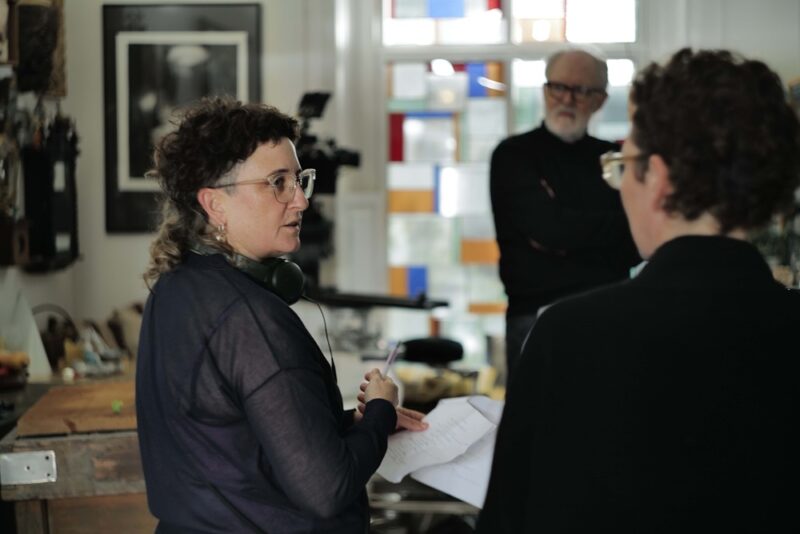
There were reports the film struggled to find distribution amid the current political climate. Did that shift how you viewed its urgency?
When we were making it, we felt like we were in a space where intra-community conversation was possible. By the time we premiered at Sundance, it was inauguration day. Studios were dropping DEI initiatives. Queer stories were being re-marginalised. Suddenly things felt politicised in a sharper way. And when trans people are used as cultural footballs, that’s painful. It made things harder for distributors too.
But we also met audiences who were craving this story – a family trying really hard to love each other, without cynicism. We’ve partnered with people who deeply care about the material, and we’ve had incredible experiences at LGBTQ+ festivals. Sharing the film and hearing people share their own stories back – that’s been extraordinary.
Reuniting with the distributor of 52 Tuesdays – does that feel full circle?
It does. It’s a different team now, but walking into their New York office felt surreal. They have strong feelings about the material they release, and they’ve been wonderful partners.
Olivia Colman brings such warmth and defensiveness in a single glance. What was the key conversation you had with her about Hannah?
She related deeply to being both a parent and still someone’s child. We talked a lot about restraint. Hannah is trying to do the right thing by everyone. There’s emotion there, but she’s often holding it back. Olivia is incredibly emotional – she’s ready to go. So sometimes it was about saying, “She wouldn’t cry here.” What’s happening that makes Hannah stay composed? Olivia listens beautifully to the script. She understands the nuance and then lets herself enter it. You just support her.
There’s something radical about letting the parent be the least certain person in the room. It’s the kind of film I would’ve loved growing up – something that says, “You’re not alone.”
That’s so beautiful to hear. One of the amazing things about having a child like Aud – who is trans, non-binary, and so unapologetically themselves – is that they show you who they are. And the easiest thing in the world is to say, “I love you,” and to listen. I’m not sure why that’s so hard culturally right now. Olivia said something similar – that Hannah’s job was simply to listen to the other characters.
Maybe that’s something we could all do a little more of.
Jimpa is screening in Australian theatres from February 19th, 2026.
