

Few novels have been simultaneously romanticised and misunderstood as thoroughly as “Wuthering Heights“. Emily Brontë’s 1847 fever dream of obsession, cruelty, class resentment and emotional sadism has, over time, been softened into windswept yearning and tragic soulmates. Emerald Fennell’s “Wuthering Heights” arrives not to preserve that illusion, but to tear it open. This is not a reverent literary adaptation; it is a reclamation – bold, sensual and unapologetically excessive. Judged by the standards of fidelity, it falters. Judged as reinvention, it burns with provocative force.
From its opening moments, Fennell signals that this is a version in quotation marks – her own term for the impossibility of truly “adapting” a novel so psychologically dense and structurally complex. The familiar frame narrative is stripped away. The second generation is largely excised. Characters are compressed, motivations sharpened, and sexuality – merely implied in Brontë’s prose – is brought vividly to the surface. Fennell’s camera lingers on flesh, on hunger, on bodies in collision with one another and with the moors themselves. This is a horny and indulgent film, uninterested in restraint. Yet beneath the red-saturated corridors and operatic glances lies a sharp reading of the novel’s heart: love not as transcendence, but as addiction.
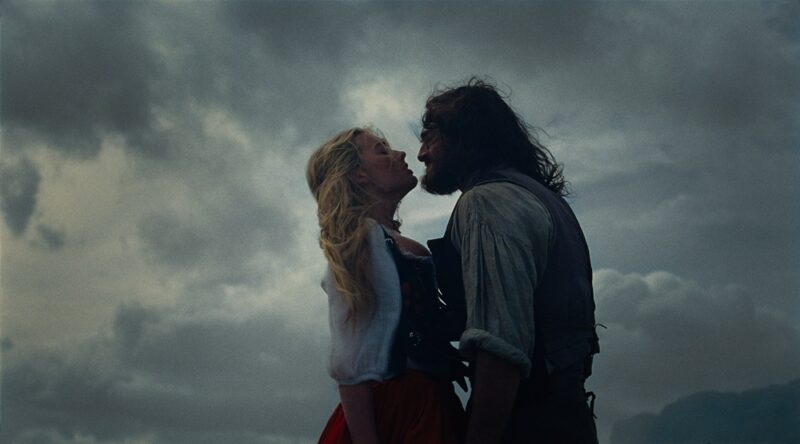
Visually, the film is intoxicating. Shot on celluloid by Linus Sandgren (La La Land, No Time To Die, Dune: Part Three), the Yorkshire landscapes feel tactile and untamed, grounding the heightened aesthetic in something elemental. Anthony Willis’ score swells with gothic urgency, punctured by contemporary sonic flourishes that feel defiantly anachronistic. Fennell’s stylisation sometimes tips toward theatrical excess – Heathcliff riding against an almost surreal orange blaze, crimson light spilling across interiors as if passion required underlining – but the visual language is purposeful. Colour functions as emotional temperature: red as humiliation, desire, vengeance. It’s lush to the point of decadence, occasionally bordering on kitsch, but never inert.
Margot Robbie takes a significant risk in refusing to soften Catherine Earnshaw. Her Cathy is calculating, vain, restless – acutely aware of class boundaries and unwilling to sacrifice status for love. Robbie leans into that haughtiness, sometimes at the expense of vulnerability, but her star presence is undeniable. Jacob Elordi, meanwhile, finds surprising texture in Heathcliff. Yes, the camera acknowledges his physical magnetism, but Elordi layers that surface allure with something wounded and volatile. His Heathcliff’s resentment feels earned, born of humiliation and exclusion. When he mishears Cathy’s infamous declaration – “It would degrade me to marry Heathcliff” – and flees before her confession of devotion, the moment lands with operatic inevitability rather than simple misunderstanding.
The film’s explicitness will divide audiences. Scenes of raw sexual expression and bodily intensity replace Victorian repression with contemporary candour. It is unsubtle. It is melodramatic. It occasionally overstates its themes with the confidence of a director who knows subtlety has never been her brand. But Fennell understands something essential: Brontë’s work was never a polite romance. It was scandalous in its own time because it exposed love as violent, selfish, and corrosive. This version doesn’t romanticise toxicity; it presents it as a narcotic force that consumes everything in its path.
For purists, this will feel like heresy. For others, it will feel invigorating. Fennell doesn’t attempt to create a definitive “Wuthering Heights” – she creates a heightened, contemporary fever-dream interpretation. It is messy, excessive and occasionally self-indulgent, but it is never timid. In restoring the story’s feral energy and erotic charge, Fennell reminds us that classics endure not because they remain frozen, but because they can withstand being reimagined. This isn’t Brontë preserved in amber. It’s Brontë set alight.


THREE AND A HALF STARS (OUT OF FIVE)
“Wuthering Heights” is now screening in Australian theatres, before opening in the United States on February 13th, 2026.
