

Sexual assault is one of cinema’s most fraught subjects. Not because it can’t be depicted, but because it so often can be mishandled. Films either flinch away from its reality, overtly depict the act with an almost exploitative lens, aestheticise it into something palatable, or frame it through adult comprehension that dulls its true terror. Josephine does none of those things. Instead, within its opening minutes, it presents a staggering, deeply unsettling depiction of violence that feels brutally real precisely because it is experienced through the eyes of a child who has no framework to process what she has seen. It is shocking, triggering, and impossible to shake – and it sets the tone for a film that never offers the audience relief, only truth.
What follows is not a procedural or a tidy trauma narrative, but a sustained immersion into the aftershock of that moment. Beth de Araújo’s debut feature is fearless in its refusal to soften or explain away fear. Once childhood innocence fractures here, it does not slowly mend; it corrodes. Across its relentless 120 minute running time, the film charts how violence lodges itself into a young mind, warping behaviour, trust, and perception in ways that feel both alien and painfully recognisable.
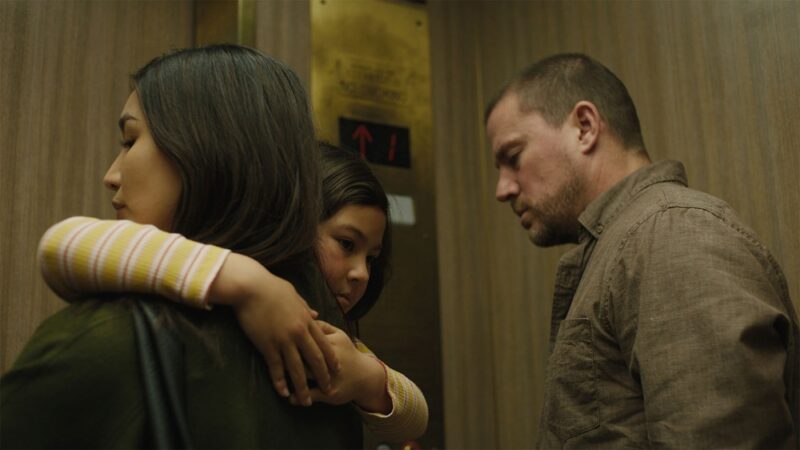
After an unsettling incident in San Francisco’s Golden Gate Park, eight-year-old Josephine’s (Newcomer Mason Reeves) sense of safety is irrevocably altered. In the days that follow, she begins to act out at home and at school, her behaviour growing increasingly erratic as she struggles to process an experience she cannot fully understand or articulate. Her parents respond with fierce love and concern, but quickly realise there are no clear answers or solutions. As Josephine pushes against rules and authority in an effort to regain control, the film traces the quiet unraveling of a family grappling with emotional fallout that resists comfort or resolution.
Reeves delivers one of the most extraordinary child performances in recent memory. Her Josephine is delicate and inquisitive, observant in ways that are unsettling rather than darling. She is dangerous not because she seeks harm, but because she now understands something she never should have had to. Reeves plays her not as a victim but as a child clawing for control – pushing boundaries, lashing out, testing the limits of safety because the concept itself has been violently dismantled. Even when Josephine’s actions disturb or frustrate, Araújo’s script and Reeves’ performance ensure we always understand why. Agreement is never required; empathy is unavoidable.
The film’s power lies in its commitment to Josephine’s perspective. Greta Zozula’s cinematography frequently drops us to her eye level, compressing the world into something looming and hostile. Adult bodies crowd the frame, spaces feel cavernous and unsafe, and moments of supposed calm thrum with menace. The visual language becomes an extension of Josephine’s internal state – fear doesn’t recede just because nothing “bad” is happening.
Miles Ross’s score leans into this unease with an almost horror-like temperament. Low, pulsating, and disquieting, it refuses to function as emotional reassurance. Instead, it stalks the film, amplifying the sense that the danger Josephine encountered never truly left, it simply changed form.
Channing Tatum delivers what may be a career-highlight performance as Josephine’s father, Damien. Stripped of bravado or sentimentality, Tatum plays a man desperate to protect his child while realising, minute by minute, that he is profoundly unequipped to do so. His love is ferocious, but his helplessness is devastating. Gemma Chan is equally superb as Claire, a mother whose quiet attentiveness masks a growing terror that no amount of care or patience can undo what has been broken. Their performances are achingly human – portraits of parents doing everything right and still failing, because trauma does not operate by rules.
Elsewhere, Philip Ettinger’s supporting turn as the man responsible for the act itself is quietly unforgettable, threading throughout the film as a figure both haunting and guiding Josephine’s forever shattered frame of mind. Like the rest of the film, his performance resists comfort.
Araújo’s direction is precise, compassionate, and unyielding. She never exploits Josephine’s trauma, but she also never allows the audience to look away. This is a film about fear – not as a momentary response, but as a shaping force. It is about how violence teaches lessons long before language arrives, and how those lessons embed themselves into the body.
By the time Josephine reaches its final moments, the film hasn’t offered catharsis or closure – and that feels entirely intentional. Instead, it leaves you sitting with the discomfort it has so carefully cultivated, aware that the damage inflicted in those opening minutes cannot be neatly resolved. It’s a film that announces the arrival of a filmmaker with astonishing empathy and control, and introduces a young talent of rare depth.
Josephine is not an easy watch, but it is a necessary one; A shattering, compassionate, and profoundly unsettling exploration of how violence reverberates long after the act itself is over.


FIVE STARS (OUT OF FIVE)
Josephine is screening as part of this year’s Sundance Film Festival, running between January 22nd and February 1st, 2026. For more information on tickets and session times, head to the official site here.
