
Returning to a world that once redefined cinematic terror, 28 Years Later: The Bone Temple doesn’t simply extend the legacy of Danny Boyle and Alex Garland’s vision – it interrogates it. Under Nia DaCosta’s direction, the film pivots away from the familiar terror of the infected and toward something colder and more unsettling: the ways humanity curdles under prolonged survival. With Dr. Kelson (Ralph Fiennes) entangled in a relationship that could alter the balance of this ravaged world, and Spike’s (Alfie Williams) fateful encounter with the unnerving Jimmy Crystal (Jack O’Connell) spiralling into inescapable trauma, The Bone Temple feels both expansive and deeply personal.
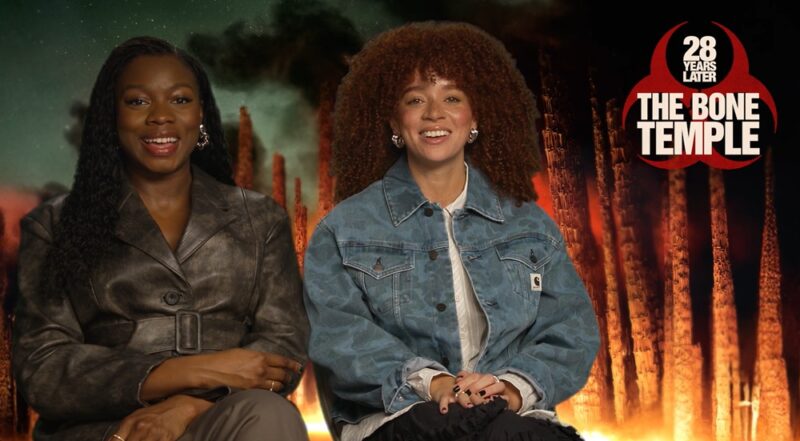
Our Peter Gray spoke with DaCosta and Erin Kellyman – whose performance channels defiance, grief, and rebellion in equal measure – about reshaping a beloved apocalypse through a distinctly authorial lens, finding resistance within broken systems, and the pieces of art they’d each cling to when the world ends.
I wanted to ask you, Nia, about The Bone Temple as a metaphor. This monument is both a literal and spiritual structure, it’s as if it’s death giving shape to life. Did you think of the film as a reflection of your own act of directing? Taking something that already existed and then building a new kind of living organism from it?
Nia DaCosta: I did not think of it in that way (laughs), but I think that’s really beautiful. I think that is absolutely what the film is about, and why I connected to it so much. In 28 Years (Later), the first one, it says “Memento mori, Memento amere”, “Remember you must die, remember you must love.” I think The Bone Temple encapsulates that, of death giving shape to life. I think it’s incredibly important and it’s why I connected to (the film). I’m glad that you had that as well.
And Erin, your character starts to question (your leader’s) faith and then her own complicity. Did you approach that awakening as an act of rebellion, or more like grief for a version of herself that no longer existed?
Erin Kellyman: Oh, I think both, less so the rebellion. To me, it felt like there was one moment, one very specific moment towards the end of the film, where it felt like more of a rebellion and more of a “Fuck you.” But throughout, I think she is just so sad and so tired and so traumatized, and yeah, grieving her past. I think we said that she joined pretty early, really young. Really, really young. So I just think she’s seen so much and is so broken. I think she was just tired of doing it.
Nia, your world building has this kind of painterly restraint, and then Erin, your character is navigating the ruins of male power, literal and cultish. How do you see the feminine perspective reshaping what we expect from apocalyptic horror?
Nia DaCosta: Once again, I didn’t think about that, ever (laughs). But I am obsessed with that reading. I think, for me, I can just speak to how I approached it, and maybe that’s a feminine thing, but it was so important to have two distinct worlds, like the separate piece that (Ralph Fiennes’ character) has, and also the frenetic, violent, cruel energy of (Jack O’Connell’s character). And then seeing them clash. I think if you stylistically separate them and then bring them together, that’s really satisfying for an audience. But also, as a director, I don’t want to get in the way of the performances. I don’t want to get in the way of the script. I really want to push and emphasize and stylize where I think it’s appropriate. But the actor, for me, is what we’re there to watch. We’re here to watch these people experience whatever the script says they experience, and so I put a lot of trust into them to communicate the emotional parts, because the violence and the cruelty will be communicated.

And before I wrap up, I wanted to ask, because we see how much Duran Duran and music means to Kelson. If there was one album, one song, one piece of art that both of you would want to hold onto in an apocalyptic state, what do you think it would be?
Nia DaCosta: Oh, my God. Okay, this is the first thing that came to my head. Jurassic Park is a movie I can watch over and over and over again. It has everything I love about a movie. It makes you think. It’s entertaining. It’s about real wonder. That’s a movie I would take with me to the desert island of the apocalypse.
Erin Kellyman: Again, this is the first thing that came to mind. Beyonce’s Renaissance album. Vibes up. Everybody is in a catastrophe, but I’ve got my headphones on, locking it out.
Ain’t nothing wrong with that. Thank you so much for taking the time out and making this oddly beautiful film. I’m really excited for everybody to see it.
28 Years Later: The Bone Temple is screening in Australian theatres from January 15th, 2026.
