

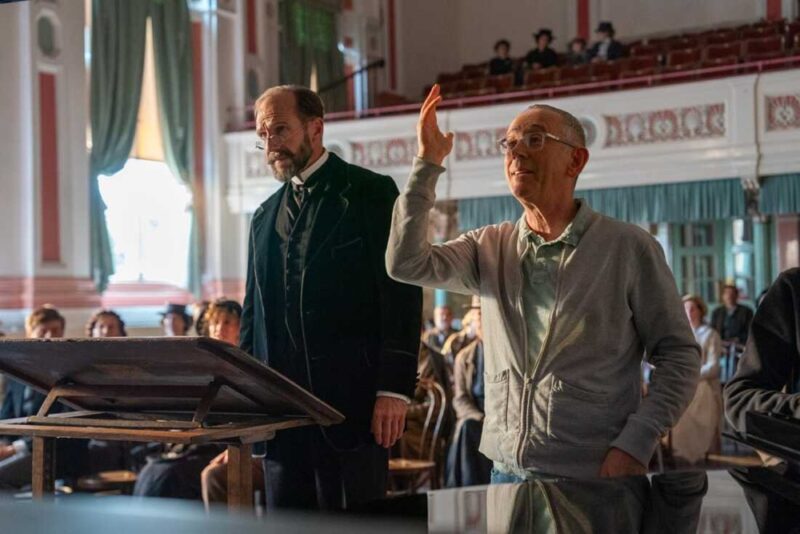
Against the thunder of the Western Front, The Choral listens instead for something quieter – the fragile, defiant sound of people choosing to sing. Set in Ramsden, Yorkshire in 1916, the film unfolds as a community hollowed out by war attempts to hold itself together through music, recruiting boys to replace the men who have gone and placing their faith in a new chorus master, Dr Henry Guthrie (Ralph Fiennes): brilliant, abrasive, and carrying secrets of his own.
In conversation with our Peter Gray, Nicholas Hytner spoke with characteristic clarity about the alchemy between his directing instincts and Alan Bennett’s writing, whether this return to filmmaking has sharpened or softened his relationship with directing itself, and why – in a time of conscription, suspicion and quiet heroism – the music at the heart of The Choral becomes not an ornament, but a lifeline.
Before getting to The Choral, I know many moons ago you directed The Object of My Affection, and it was one of those films I was struck quite deeply by how it understood intimacy without needing to label or justify. As a gay man that felt quite radical. Do you see a throughline from that film to The Choral in the way that you depict human connection, and then the longing for closeness in times of uncertainty?
I’ve had some close relationships with writers, and very often I respond to what they bring me. I’m sure there is a throughline. The Object of My Affection came out of a close relationship I had with the American playwright Wendy Wasserstein, whose sense of humour and sensibility and insight into human connection very much resonated with me. Alan Bennett is somebody else with whom I have had a very close working relationship, and who is also a friend, and I think they do share, what should we say? A similar yearning for connection. Maybe an underlying melancholy, an underlying realism about how difficult connection is. And, at the same time, what, in the case of The Choral, do these young people yearn for? It’s all too imaginable with the certainty of death coming, but what they need first is human connection. That’s what these young men and young women need most urgently. They know their time is limited in The Choral, and there’s one other thing they need, which is art, which is music. Those are the two things that are most important in my life. Human connection and art. So when Alan Bennett first showed me a sketch of the idea, it resonated very, very strongly with me.
On the mention of Alan Bennett, his writing has always found meaning in the ordinary. Your directing elevates the ordinary into the profound. What’s the alchemy between your two sensibilities? And how has that evolved since your first film, The Madness of King George, to now?
We come from, more or less, the same part of the world, from the north of England. If you’re from the north, you have to make a very clear distinction between Yorkshire, where he’s from, and Lancashire, where I’m from. But there’s a realism, a sense of humour, a similar sense of irony. But also, I suppose, both of us growing up gay at a time when it was hard to be gay. The lack of sentimentality in the way he explores both established relationships, marriages, and unrequited relationships, or relationships that are hard to requite. I resonate strongly with that. So in The Choral, apart from that kind of really vigorous need that the young people have to connect to each other, there’s also a sense amongst the older people that pursuing closeness or intimacy always involves a sense that it’s time limited. That achieving and preserving intimacy is something that’s not easy. It’s not always wine and roses. There’s a kind of underlying melancholy in The Choral, as well as a tremendous, inspiring sense that community can come together through music and find real satisfaction.
I know that you’ve said this story is about how people make sense of their lives through performance. Did directing this story about the healing power of art change or clarify your own relationship to why you direct specifically?
It reminded me of what it was like when I used to sing in choirs, which I haven’t done since I was a teenager. As a student I used to sing in choirs a lot, and I think that the first audience for this film is going to be people who know about that community. It clarified to me why, and it made me feel incredibly privileged that I’ve been able to make a life and career out of this. But what this film celebrates above all is people who, outside of their everyday lives, turn to music. It clarified, to me, the importance of that. To watch these actors, some of whom sang in choirs when they were young, come together to sing this music, which is quite challenging, was inspiring and moving.
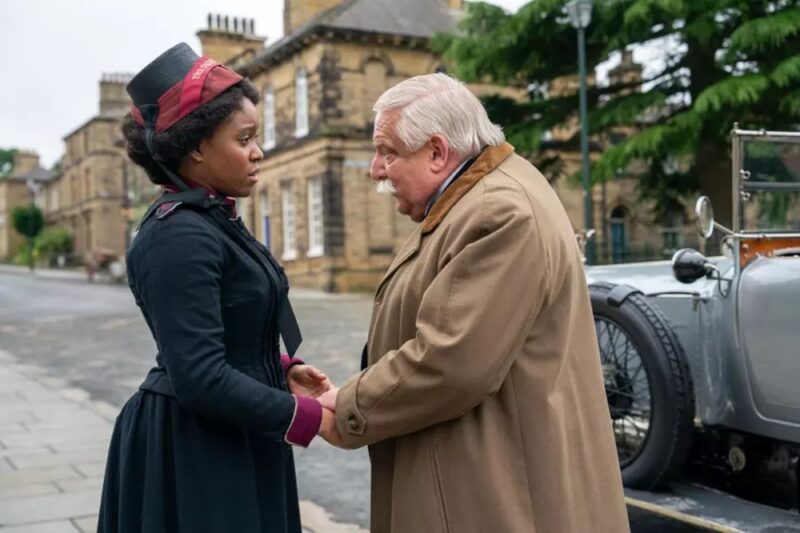
Does the piece of Edward Elgar’s music mean something to you personally? How did you want the audience to feel its presence beyond simply just hearing it?
It’s such an interesting piece of music. In reality, it’s 90 minutes long. It has quite a lot of challenging stuff in it, which the movie hones in on. It’s beautiful and inspiring, but its text is well past its sell-by date. It’s such an interesting thing about music, that it can transcend and mean something different to the text that inspires it. This is a super devout, late 19th century poem by Cardinal Newman, a prominent English Roman Catholic Cardinal, and it’s about the soul of an old man going into the after life and being sent to purgatory.
Even the Vatican has disowned purgatory. Purgatory is not on anybody’s menu anymore, and the words have a kind of high-Victorian religiosity, which doesn’t really connect with us now. But the music goes so way beyond that, and they find in that music, in the film, something that responds to the grief they’re going through. These young men are being picked up and thrown into the front line in northern France and slaughtered. They find some sense of consolation. Something that explains their grief to them, something that explains the horror that’s being visited on them that they have nothing to do with.
It really is a beautiful film. It was the first thing I saw at the Toronto International Film Festival this year, and movies and music have such meaning to everyone, and I’m sure this will mean something different to whoever watches it. We need a film like this right now, to remind us how wonderful life can be when we all come together.
Thank you so much. This is the first conversation I’ve had today. I’ve really enjoyed it. It was a lovely surprise to start off with The Object of My Affection, and to remember that was a lovely surprise. And Jennifer Aniston and Paul Rudd, they were both so wonderful in that movie. So, thank you.
The Choral is screening in Australian theatres from New Year’s Day, January 1st, 2026.
