

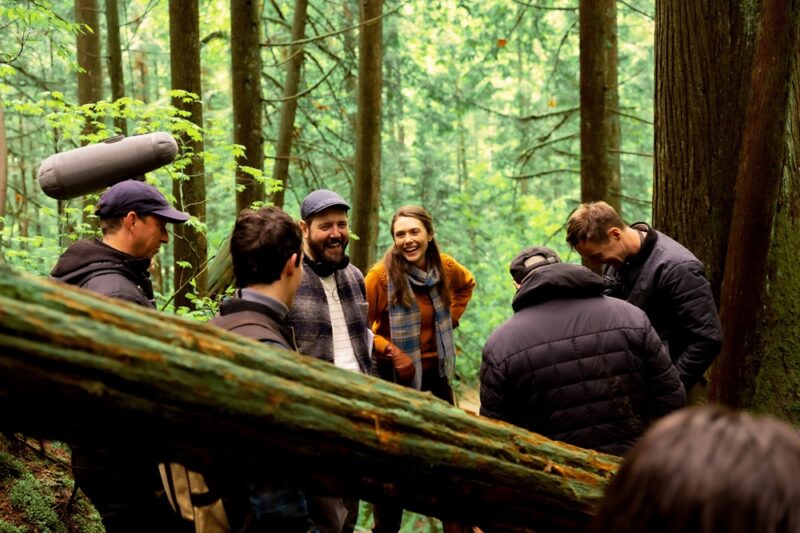
Eternity is an imaginative and bittersweet romantic comedy about the afterlife, where souls have one week to decide where to spend eternity. For Joan (Elizabeth Olsen) it’s a facing of an impossible choice between the man she spent her life with (Miles Teller) and her first love (Callum Turner), who died young and has waited decades for her to arrive.
As the romantic comedy arrives in Australian theatres, Peter Gray spoke with Eternity director David Freyne about the first spark of inspiration behind the film, knowing that his cast were up to par in exploring the genre, and which classic films served as visual inspiration.
I know that you’ve said that the idea for the film came to you crystal clear. Do you remember the exact image or feeling that unlocked the film for you?
Of course. I co-wrote it with Pat Cunnane, who’s amazing, and he started the script. I came on early in the draft, and I immediately had an image for what I wanted this junction to look like. This idea of this almost-chaotic trade floor, where you’re hawking the different ideas of currently in this brutalist building. As I read that very first early draft from him, I loved the potential, and I think what I wanted to do with all my ideas just formed very naturally. I studied production design in college, and I did my thesis on Wizard of Oz and A Matter Of Life and Death, and it was always my dream to make a film set in two worlds. So getting to create my own afterlife was heaven to me. It was extraordinary. I think it just came fully formed to me.
What I wanted to say with the film about love and the different forms of love and celebrating that kind of love was very crystal clear. For me and Pat, it was really an extraordinary collaboration. And it was a very easy writing process. The version I wrote over Christmas, when I first got to thinking, ended up being very different to that original version, so I assume I’d be fired. But, thankfully, they really responded to my draft. It was surprisingly easy. This was really one of those (stories) that just felt like it was always there, and I just had to birth it.
Well on the mention of the afterlife, I love that there’s this delightful irony in that the afterlife looks like a tourism expo or a hotel convention. Was that a way to explore how even death isn’t safe from capitalism? Or was it more about finding comedy in how humans organize chaos?
Exactly. It was really important to me that this junction, this kind of limbo, feel very real and very human and very bureaucratic. That it had layers and boredom and tedium, and it has its own mechanics and works in a certain way. It didn’t need to feel celestial or other worldly. It just felt very human, and we built it that way. We always made sure it felt tangible and practical. That the sets felt real. That the boredom of the people who work there and their rivalries all felt really petty and real as well. And that there was a real chaos in that place where you have to choose where you’re going to go forever. That just felt like a great pressure cooker in which Joan gets to make this decision. It felt like there’s a great kind of dramatic situation for her, but it was really important that it felt gritty. One of the big references was The Graduate. Those 60s films that have a real grit and texture to them.
Speaking of Joan, obviously Elizabeth Olsen and Miles Teller are two actors more known for their intensity, so what surprised you the most about their comedic instincts? I’m going to say, watching Elizabeth Olsen in this was reminding me of Michelle Pfeiffer in Married To The Mob. We’re used to seeing them as a dramatic actress, and then you see how hilarious and natural they are.
They were always really the first on my mind. It is that thing where they are so known for their dramatic work, but you could just tell that they were really funny, they were sharp, whether it be from interviews. It’s always really exciting as a director to have actors do something that you don’t expect and how a different side to themselves. I was just so honoured and grateful that they responded to the script and wanted to do it. They were really excited to go full hog on the comedy. They were really excited to show that side of themselves. Lizzie really wanted to. They both had no ego in how they approached the roles. They really wanted to embody these 90-year-olds in these 30-something bodies. I think, for Miles, he went that neurotic Albert Brooks route, which was amazing. He’s born for that.
And I always say that Lizzie feels like the love child of Jack Lemmon. She’s just so witty and comedic, and there’s so much depth there as well. They never lost sight of the stakes in their comedy, which is incredible. Lizzie speaks about this all the time, (but) she loved being a 90-year-old woman. She loved the physicality, the posture, the voice…I think she could live in that role forever. It’s just so exciting to see them do something that the world is going to be really surprised by. They are the most delightful people to work with. They’re so joyous every day.
And then you have Callum Turner. I feel like his character, Luke, could have so easily been this fantasy figure, but you gave him so much vulnerability and insecurity. How did you and Callum ensure that he wasn’t just the idealized first love?
Yeah, that’s absolutely right. I think in the wrong hands, he would just be a kind of a matinee idol. He would just be that hot guy. We worked really hard to give that role layers and depth in the script. I had a coffee with Callum in Soho in London, and it was just before Masters of the Air came out. It was actually before Boys in the Boat came out. I’d seen Green Room, and things like that, but I was just so immediately charmed by him. He’s so smart and lovely, and he was instantly pinpointing the insecurities of Luke and that idea of Luke being in this stasis, and how he’s trying to hold this facade that’s invariably going to crumble. He had just an instinctive understanding of the role that it was immediately clear to me before I finished my flat white that he was Luke. That he should be the only person for the role. In some ways, I think he has the most difficult role, because he is really just the hot guy, but you whittle away the layers and you find this deeply insecure man beneath it all who doesn’t really know what he’s doing. He’s extraordinary. He’s such a sophisticated actor in how he approaches things. And, again, he’s really funny and doesn’t seem to have an ego in how he approaches the roles. It’s so clear he’s going to be a mega-star. You can feel it happening for him. He’s punishingly attractive though, I don’t like standing beside him (laughs).
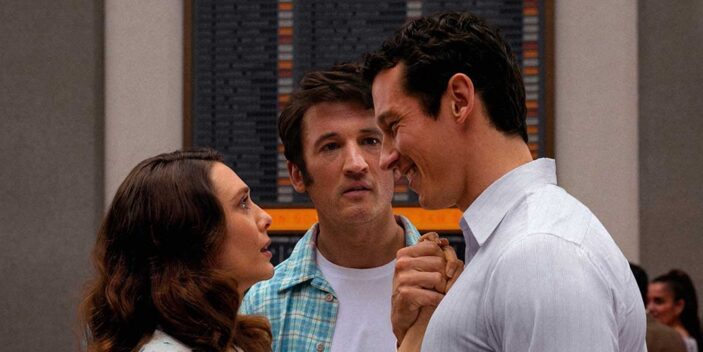
You mentioned The Graduate before. I loved the look of the afterlife in this. It feels like a dream, almost Singin’ in the Rain, but more metaphysical. Were musicals part of your tonal compass when looking at the visual and rhythm of the film at all?
Absolutely. Singin’ in the Rain was a huge reference. I did a really big look book when we were writing the script. In fact, I showed the actors (the book) at points, and Singin’ in the Rain was there. I think the bigger references for me were the Powell & Pressburger films in the 40s, where they had such big painting backdrops, particularly A Matter of Life and Death. I think we always wanted the idea that this junction felt like you’re almost on the backlot of the film set where you had those scenic looks and artificial skies. Those really beautiful, old Hollywood films were a huge reference in how the backdrops change, and it’s staggering and beautiful, but then you realise it’s all artificial, and you’re stuck in this kind of fake world.
Another big reference was Agnès Varda documentaries. She had one (called) Du côté de la côte, which is just a half-hour of gorgeous shots of beaches. Our entire beach wold was frame-by-frame just from that (film). We had very specific references across different kinds of films where they all came from the 60s. That kind of technicolour and high contrast, which we really tried to emulate in how we shot (Eternity). We then shot in anamorphic, which was referencing the shots of Billy Wilder, We wanted the afterlife world to have that real cinematic scope.
It really is such a beautiful looking film. And that just adds to the classicality of it all. It feels like the kind of movie we’ve been watching for years.
I think the romantic comedy really is my favourite genre. Obviously you look at Nora Ephron, but going back to Billy Wilder and Preston Sturges, they (made) such extraordinary films and weren’t afraid to be deeply funny and deeply moving. They dealt with serious things with such a lightness of touch that I think sometimes we’re missing in cinema now. I always inspired to make something in the vein of those filmmakers, and that was always a big touchstone for myself and my cast in making this. I just hope to do justice to the history of rom coms. They deserve the big screen. These epic love stories deserve big, lovely cinemas to be shown in. They used to be the big films that would win Oscars, and they’ve been relegated to something else. I want them to get their prominence.
Eternity is screening in Australian theatres from December 4th, 2025.
